Search
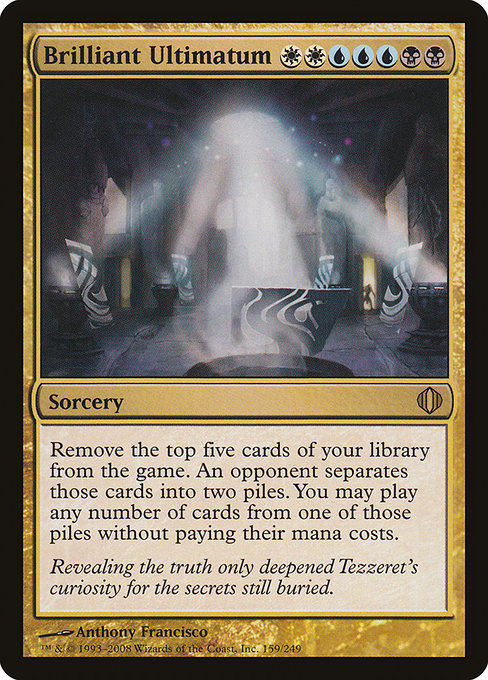
Brilliant Ultimatum
Sorcery
rare
Exile the top five cards of your library. An opponent separates those cards into two piles. You may play lands and cast spells from one of those piles. If you cast a spell this way, you cast it without paying its mana cost.
 Card Kingdom
 Cardmarket
Semantic Tags
A keyword ability that lets you tap creatures rather than pay mana to cast a spell. See rule 702.51, “Convoke.”
Exile-based card advantage — exile cards from the top of your library and cast them temporarily. Red's primary draw mechanic.
Exile-based card advantage — exile cards from the top of your library and cast them temporarily. Red's primary draw mechanic.
A keyword ability that lets a player cast a card they discard. See rule 702.35, “Madness.”
Tax or prevent spellcasting — Rule of Law, Thalia, Sphere of Resistance.
A keyword ability that provides an alternative way to play a card. See rule 702.62, “Suspend.” A card is “suspended” if it’s in the exile zone, has suspend, and has a time counter on it.
Makes all players discard their hand and draw a new one. Named after Wheel of Fortune.
Format Legality
Price history
Loading price history…
Printings (1)
| Set | Rarity | TCGplayer | Card Kingdom | Cardmarket |
|---|---|---|---|---|
| Shards of Alara#159 | rare | · | · | · |
Related Rules
If a cost associated with a special action, such as a suspend cost or a morph cost, has an {X} or an X in it, the value of X is chosen by the player taking the special action immediately before they pay that cost.
A player who has a card with suspend in their hand may exile that card. This is a special action. A player can take this action any time they have priority, but only if they could begin to cast that card by putting it onto the stack. See rule 702.62, “Suspend.”
After resolving a madness triggered ability (see rule 702.35), if the exiled card wasn’t cast and was moved to a public zone, effects referencing the discarded card can find that object.
Suspend
To time travel means to choose any number of permanents you control with one or more time counters on them and/or suspended cards you own in exile with one or more time counters on them and, for each of those objects, put a time counter on it or remove a time counter from it. See rule 702.62, “Suspend.”
Madness
Madness is a keyword that represents two abilities. The first is a static ability that functions while the card with madness is in a player’s hand. The second is a triggered ability that functions when the first ability is applied. “Madness [cost]” means “If a player would discard this card, that player discards it, but exiles it instead of putting it into their graveyard” and “When this card is exiled this way, its owner may cast it by paying [cost] rather than paying its mana cost. If that player doesn’t, they put this card into their graveyard.”
Casting a spell using its madness ability follows the rules for paying alternative costs in rules 601.2b and 601.2f–h.
Rulings
The cards are exiled face up.
The cards in the pile that wasn’t chosen remain exiled. Likewise, any cards in the chosen pile that you can’t play or you choose not to play remain exiled.
If you cast a card “without paying its mana cost,” you can’t pay any alternative costs. You can pay additional costs, such as conspire costs and kicker costs.
You can play a land card from the chosen pile only if it’s your turn (which it probably is, since Brilliant Ultimatum is a sorcery) and you haven’t yet played a land this turn. That means that if there are two lands in the chosen pile, you’ll be able to play a maximum of one of them.
You play cards from the chosen pile as part of the resolution of Brilliant Ultimatum. You may play them in any order. Timing restrictions based on the card’s type (such as creature or sorcery) are ignored. Other play restrictions are not (such as “Cast [this card] only during combat”). You play all of the cards you like, putting land onto the battlefield and spells on the stack, then Brilliant Ultimatum finishes resolving and is put into your graveyard. The spells you cast this way will then resolve as normal, one at a time, in the opposite order that they were put on the stack.
One of the piles may have zero cards in it if the opponent wishes.