Search
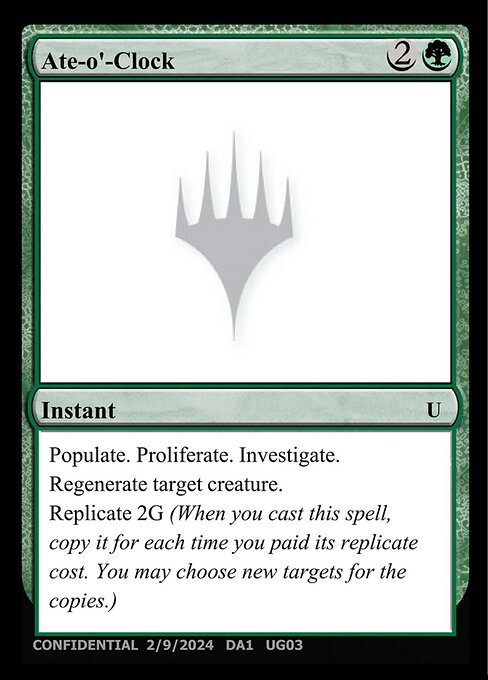
Ate-o'-Clock
Instant
uncommon
Populate. Proliferate. Investigate. Regenerate target creature. Replicate (When you cast this spell, copy it for each time you paid its replicate cost. You may choose new targets for the copy.)
Semantic Tags
Clue token and investigate synergies — card draw and artifact interactions.
Cares about +1/+1 counters — places, moves, doubles, or benefits from counters on creatures.
Creates copies of tokens — populate keyword and similar effects.
Creates copies of tokens — populate keyword and similar effects.
Proliferate-focused strategy — adds counters of all types.
Proliferate-focused strategy — adds counters of all types.
Creates creature tokens, Treasure tokens, Food tokens, Clue tokens, or other token types.
Format Legality
Price history
Loading price history…
Printings (1)
| Set | Rarity | TCGplayer | Card Kingdom | Cardmarket |
|---|---|---|---|---|
| Unknown Event#UG03a | uncommon | · | · | · |
Related Concepts
A keyword action that creates a Clue artifact token. See rule 701.16, “Investigate.”
To give an additional counter to any number of players and/or permanents of each kind they already have. See rule 701.34, “Proliferate.”
To replace a permanent’s destruction with an alternate sequence of events. See rule 701.19, “Regenerate.”
Related Rules
Damage marked on a creature remains until the cleanup step, even if that permanent stops being a creature. If the total damage marked on a creature is greater than or equal to its toughness, that creature has been dealt lethal damage and is destroyed as a state-based action (see rule 704). All damage marked on a permanent is removed when it regenerates (see rule 701.19, “Regenerate”) and during the cleanup step (see rule 514.2).
If an ability of an object refers to that object by name, and an object with a different name gains that ability, each instance of the first name in the gained ability that refers to the first object by name should be treated as the second name.
Damage dealt to a creature by a source with neither wither nor infect is marked on that creature (see rule 120.3). If the total damage marked on that creature is greater than or equal to its toughness, that creature has been dealt lethal damage and is destroyed as a state-based action (see rule 704). All damage marked on a creature is removed when it regenerates (see rule 701.19, “Regenerate”) and during the cleanup step (see rule 514.2).
Replacement effects must exist before the appropriate event occurs—they can’t “go back in time” and change something that’s already happened. Spells or abilities that generate these effects are often cast or activated in response to whatever would produce the event and thus resolve before that event would occur.
Regeneration is a destruction-replacement effect. The word “instead” doesn’t appear on the card but is implicit in the definition of regeneration. “Regenerate [permanent]” means “The next time [permanent] would be destroyed this turn, instead remove all damage marked on it and its controller taps it. If it’s an attacking or blocking creature, remove it from combat.” Abilities that trigger from damage being dealt still trigger even if the permanent regenerates. See rule 701.19.
Investigate
“Investigate” means “Create a Clue token.” See rule 111.10f.
Regenerate