Search
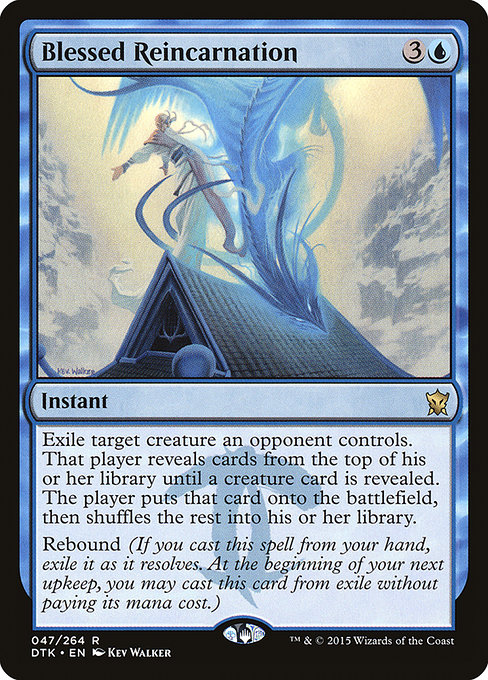
Blessed Reincarnation
Instant
rare
Exile target creature an opponent controls. That player reveals cards from the top of their library until a creature card is revealed. The player puts that card onto the battlefield, then shuffles the rest into their library. Rebound (If you cast this spell from your hand, exile it as it resolves. At the beginning of your next upkeep, you may cast this card from exile without paying its mana cost.)
 Card Kingdom
 Cardmarket
Semantic Tags
A keyword ability that lets you tap creatures rather than pay mana to cast a spell. See rule 702.51, “Convoke.”
Specifically removes creatures — destroy, exile, damage, or -X/-X.
Specifically removes creatures — destroy, exile, damage, or -X/-X.
A keyword ability that lets a card be discarded and replaced with a new card. See rule 702.29, “Cycling.”
A keyword ability that lets you exile cards from your graveyard rather than pay generic mana to cast a spell. See rule 702.66, “Delve.”
A keyword ability that allows a player to cast a double-faced card transformed from the graveyard. See rule 702.146, “Disturb.”
A keyword ability that lets a player return a card from their graveyard to their hand. See rule 702.52, “Dredge.”
Removes threats by exiling rather than destroying — bypasses indestructible and death triggers.
Removes threats by exiling rather than destroying — bypasses indestructible and death triggers.
A keyword ability that lets a player exile cards from their hand and cast them for an alternative cost on future turns. See rule 702.143, “Foretell.”
Exile-based card advantage — exile cards from the top of your library and cast them temporarily. Red's primary draw mechanic.
A keyword ability that lets a player cast a card they discard. See rule 702.35, “Madness.”
Answers an opponent's threat by destroying, exiling, bouncing, or otherwise removing a permanent or spell.
Answers an opponent's threat by destroying, exiling, bouncing, or otherwise removing a permanent or spell.
Cares about or manipulates the top card(s) of your library. Includes scry, surveil, and top-deck payoffs.
Format Legality
Price history
Loading price history…
Printings (2)
| Set | Rarity | TCGplayer | Card Kingdom | Cardmarket |
|---|---|---|---|---|
| Dragons of Tarkir#47 | rare | · | · | · |
| Dragons of Tarkir Promos#47s | rare | · | · | · |
Related Concepts
Related Rules
A player who has a card with foretell in their hand may pay {2} and exile that card face down. This is a special action. A player may take this action any time they have priority during their turn. See rule 702.143, “Foretell.”
After resolving a madness triggered ability (see rule 702.35), if the exiled card wasn’t cast and was moved to a public zone, effects referencing the discarded card can find that object.
Exiling a card using its foretell ability is a special action, which doesn’t use the stack. See rule 116, “Special Actions.”
Madness
Cycling
Cycling is an activated ability that functions only while the card with cycling is in a player’s hand. “Cycling [cost]” means “[Cost], Discard this card: Draw a card.”
Although the cycling ability can be activated only if the card is in a player’s hand, it continues to exist while the object is on the battlefield and in all other zones. Therefore objects with cycling will be affected by effects that depend on objects having one or more activated abilities.
Some cards with cycling have abilities that trigger when they’re cycled. “When you cycle this card” means “When you discard this card to pay an activation cost of a cycling ability.” These abilities trigger from whatever zone the card winds up in after it’s cycled.
Rulings
If there are no creature cards in the library, it will be revealed and shuffled. The target creature will remain exiled.
Casting the card again due to the delayed triggered ability is optional. If you choose not to cast the card, or if you can’t (perhaps because there are no legal targets available), the card will stay exiled. You won’t get another chance to cast it on a future turn.
If you cast a spell with rebound from any zone other than your hand (including your opponent’s hand), rebound will have no effect.
Rebound will have no effect on copies of spells because you don’t cast them from your hand.
If you cast a card from exile this way, it will go to its owner’s graveyard when it resolves, fails to resolve, or is countered. It won’t go back to exile.
At the beginning of your upkeep, all delayed triggered abilities created by rebound effects trigger. You may handle them in any order. If you want to cast a card this way, you do so as part of the resolution of its delayed triggered ability. Timing restrictions based on the card’s type (if it’s a sorcery) are ignored. Other restrictions, such as “Cast [this spell] only during combat,” must be followed.
If a spell with rebound that you cast from your hand doesn’t resolve for any reason (either because another spell or ability counters it or because all its targets are illegal as it tries to resolve), none of its effects will happen, including rebound. The spell will be put into its owner’s graveyard and you won’t get to cast it again on your next turn.
If a replacement effect (such as the one created by Rest in Peace) would cause a spell with rebound that you cast from your hand to be put somewhere other than into your graveyard as it resolves, you can choose whether to apply the rebound effect or the other effect as the spell resolves.
As long as you cast a spell with rebound from your hand, rebound will work regardless of whether you paid its mana cost or an alternative cost you were permitted to pay.