Search
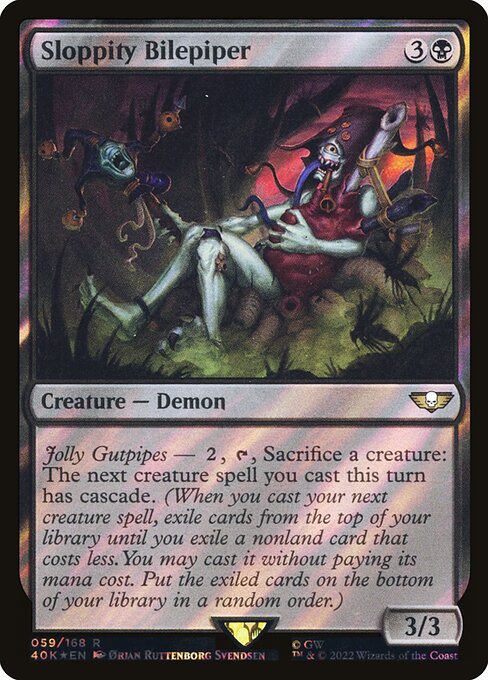
Sloppity Bilepiper
Creature — Demon
rare
Jolly Gutpipes — , , Sacrifice a creature: The next creature spell you cast this turn has cascade. (When you next cast a creature spell, exile cards from the top of your library until you exile a nonland card that costs less. You may cast it without paying its mana cost. Put the exiled cards on the bottom in a random order.)
3/3
Semantic Tags
Exile-based card advantage — exile cards from the top of your library and cast them temporarily. Red's primary draw mechanic.
A permanent with a repeatable activated ability that converts excess mana into value.
A card or token on the battlefield. See rule 110, “Permanents.”
Broadly benefits from sacrificing permanents — overlaps aristocrats but includes non-creature sacrifice.
Lets you sacrifice your own creatures or permanents for value. Key enabler for aristocrats strategies.
Cares about or manipulates the top card(s) of your library. Includes scry, surveil, and top-deck payoffs.
Cares about or manipulates the top of library — Sensei's Top, miracles, Future Sight.
Format Legality
Price history
Loading price history…
Printings (2)
| Set | Rarity | TCGplayer | Card Kingdom | Cardmarket |
|---|---|---|---|---|
| Warhammer 40,000 Commander#59★ | rare | · | · | · |
| Warhammer 40,000 Commander#59 | rare | · | · | · |
Related Rules
If an ability would produce one or more mana of an undefined type, it produces no mana instead.
Some abilities produce mana based on the type of mana another permanent or permanents “could produce.” The type of mana a permanent could produce at any time includes any type of mana that an ability of that permanent would produce if the ability were to resolve at that time, taking into account any applicable replacement effects in any possible order. Ignore whether any costs of the ability could or could not be paid. If that permanent wouldn’t produce any mana under these conditions, or no type of mana can be defined this way, there’s no type of mana it could produce.
To “tap [a permanent] for mana” is to activate a mana ability of that permanent that includes the {T} symbol in its activation cost. See rule 605, “Mana Abilities.”
An ability that triggers whenever a permanent “is tapped for mana” or is tapped for mana of a specified type triggers whenever such a mana ability resolves and produces mana or the specified type of mana.
A replacement effect that applies if a permanent “is tapped for mana” or tapped for mana of a specific type and/or amount modifies the mana production event while such an ability is resolving and producing mana or the specified type and/or amount of mana.
If an object’s enters-the-battlefield triggered ability or replacement effect refers to X, and the spell that became that object as it resolved had a value of X chosen for any of its costs, the value of X for that ability is the same as the value of X for that spell, although the value of X for that permanent is 0. This is an exception to rule 107.3i.
The tap symbol is {T}. The tap symbol in an activation cost means “Tap this permanent.” A permanent that’s already tapped can’t be tapped again to pay the cost. A creature’s activated ability with the tap symbol in its activation cost can’t be activated unless the creature has been under its controller’s control continuously since their most recent turn began. See rule 302.6.
The untap symbol is {Q}. The untap symbol in an activation cost means “Untap this permanent.” A permanent that’s already untapped can’t be untapped again to pay the cost. A creature’s activated ability with the untap symbol in its activation cost can’t be activated unless the creature has been under its controller’s control continuously since their most recent turn began. See rule 302.6.
Rulings
Cascade triggers when you cast the spell, meaning that it resolves before that spell. If you end up casting the exiled card, it will go on the stack above the spell with cascade.
If the card has {X} in its mana cost, you must choose 0 as the value of X when casting it without paying its mana cost.
A spell's mana value is determined only by its mana cost. Ignore any alternative costs, additional costs, cost increases, or cost reductions.
If you activate the ability of more than one Sloppity Bilepiper (or the same one more than once) in the same turn, the next creature spell you cast will have that many instances of cascade, each of which will trigger separately.
Two new cards in this set give the next spell you cast cascade. This means that the next spell you cast gains cascade as you begin to cast it by putting it on the stack, and the cascade ability will trigger when you finish casting that spell.
If you cast a card "without paying its mana cost," you can't choose to cast it for any alternative costs. You can, however, pay additional costs. If the card has any mandatory additional costs, you must pay those to cast the card.
You exile the cards face up. All players will be able to see them.
As Sloppity Bilepiper's activated ability resolves, it creates a continuous effect that won't begin to apply until you start casting a creature spell this turn. It applies to that spell and the timestamp of that effect is the time that the object was put on the stack.
See also "Returning Keyword Ability: Cascade" in general notes.
Due to a 2021 rules change to cascade, not only do you stop exiling cards if you exile a nonland card with lesser mana value than the spell with cascade, but the resulting spell you cast must also have lesser mana value. Previously, in cases where a card's mana value differed from the resulting spell, such as with some modal double-faced cards or cards with an Adventure, you could cast a spell with a higher mana value than the exiled card.
If a spell with cascade is countered, the cascade ability will still resolve normally.
When the cascade ability resolves, you must exile cards. The only optional part of the ability is whether or not you cast the last card exiled.