Search
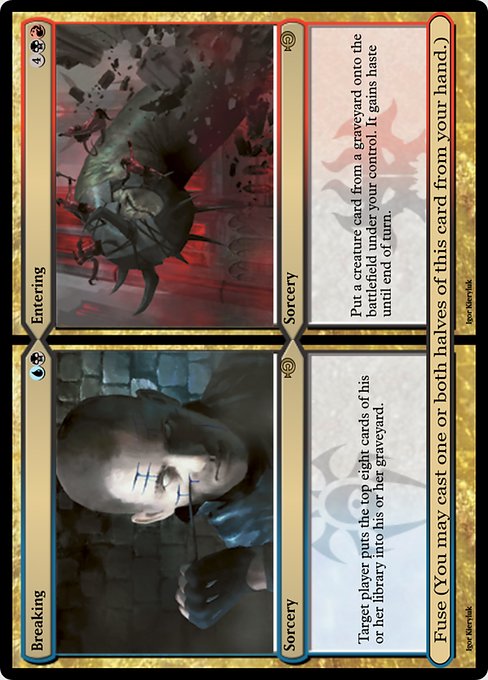
Breaking // Entering
Sorcery // Sorcery
rare
Breaking
Sorcery
Target player mills eight cards. Fuse (You may cast one or both halves of this card from your hand.)
Entering
Sorcery
Put a creature card from a graveyard onto the battlefield under your control. It gains haste until end of turn. Fuse (You may cast one or both halves of this card from your hand.)
Semantic Tags
To mill a number of cards, a player puts that many cards from the top of their library into their graveyard. See rule 701.17.
Format Legality
Price history
Loading price history…
Printings (3)
| Set | Rarity | TCGplayer | Card Kingdom | Cardmarket |
|---|---|---|---|---|
| Magic Online Promos#48586 | rare | · | · | · |
| Dragon's Maze#124 | rare | · | · | · |
| Dragon's Maze Promos#124★ | rare | · | · | · |
Related Concepts
Related Rules
While applying a replacement effect that modifies how a permanent enters the battlefield, another replacement effect may cause a player to mill cards or exile cards from the top of a library. In that case, any card that is entering the battlefield from that library won’t be included in that effect, even though those cards are in the library as the effect is applied.
Mill
For a player to mill a number of cards, that player puts that many cards from the top of their library into their graveyard.
A player can’t mill a number of cards greater than the number of cards in their library. If given the choice to do so, they can’t choose to take that action. If instructed to do so, they mill as many as possible. Similarly, the player can’t pay a cost that includes milling a number of cards greater than the number of cards in their library.
Fuse
Dredge is a static ability that functions only while the card with dredge is in a player’s graveyard. “Dredge N” means “As long as you have at least N cards in your library, if you would draw a card, you may instead mill N cards and return this card from your graveyard to your hand.”
A player with fewer cards in their library than the number required by a dredge ability can’t mill any of them this way.
Fuse is a static ability found on some split cards (see rule 709, “Split Cards”) that applies while the card with fuse is in a player’s hand. If a player casts a split card with fuse from their hand, the player may choose to cast both halves of that split card rather than choose one half. This choice is made before putting the split card with fuse onto the stack. The resulting spell is a fused split spell.
Rulings
If you cast a split card with fuse from your hand without paying its mana cost, you can choose to use its fuse ability and cast both halves without paying their mana costs.
On the stack, a split spell that hasn’t been fused has only that half’s characteristics and mana value. The other half is treated as though it didn’t exist.
To cast a fused split spell, pay both of its mana costs. While the spell is on the stack, its mana value is the total amount of mana in both costs.
You can choose the same object as the target of each half of a fused split spell, if appropriate.
When resolving a fused split spell with multiple targets, treat it as you would any spell with multiple targets. If all targets are illegal when the spell tries to resolve, the spell doesn’t resolve and none of its effects happen. If at least one target is still legal at that time, the spell resolves, but an illegal target can’t perform any actions or have any actions performed on it.
Some split cards with fuse have two monocolor halves of different colors. If such a card is cast as a fused split spell, the resulting spell is multicolored. If only one half is cast, the spell is the color of that half. While not on the stack, such a card is multicolored.
If you’re casting a split card with fuse from any zone other than your hand, you can’t cast both halves. You’ll only be able to cast one half or the other.
When a fused split spell resolves, follow the instructions of the left half first, then the instructions on the right half.
If a player names a card, the player may name either half of a split card, but not both. A split card has the chosen name if one of its two names matches the chosen name.
Some split cards with fuse have two halves that are both multicolored. That card is multicolored no matter which half is cast, or if both halves are cast. It’s also multicolored while not on the stack.
Entering doesn’t target any creature card. You choose which card you’re putting onto the battlefield as Entering resolves. You can choose any creature card in a graveyard at time, including one put into a graveyard because of Breaking if you cast Breaking // Entering as a fused split spell.