Search
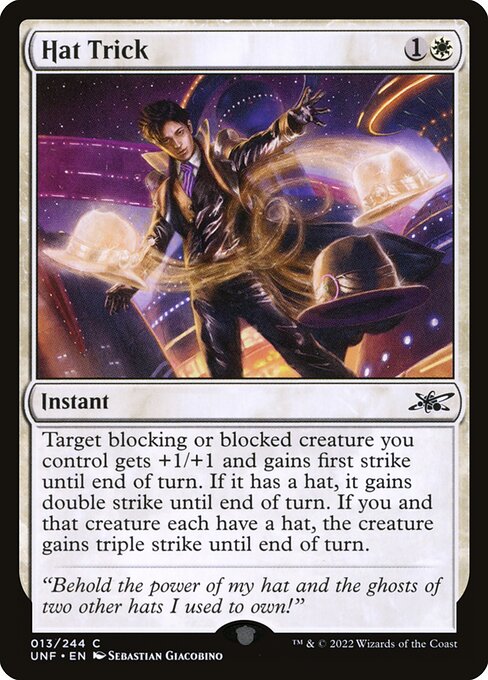
Hat Trick
Instant
common
Target blocking or blocked creature you control gets +1/+1 and gains first strike until end of turn. If it has a hat, it gains double strike until end of turn. If you and that creature each have a hat, the creature gains triple strike until end of turn.
 Card Kingdom
 Cardmarket
Semantic Tags
Attacks quickly and deals damage efficiently. Includes haste, double strike, first strike, prowess, and cards that grant these.
A keyword ability that lets a creature deal its combat damage twice. See rule 702.4, “Double Strike.”
A keyword ability that lets a creature deal its combat damage before other creatures. See rule 702.7, “First Strike.”
Has first strike or double strike — trades favorably in combat.
A spell or ability that gives a temporary power/toughness boost.
Slows opponents down by taxing actions or restricting what they can do.
Cares about creature types — lords, type-matters effects, and changeling.
Format Legality
Price history
Loading price history…
Printings (2)
| Set | Rarity | TCGplayer | Card Kingdom | Cardmarket |
|---|---|---|---|---|
| Unfinity#13 | common | · | · | · |
| Unfinity#299 | common | · | · | · |
Related Rules
A keyword counter on a permanent or on a card in a zone other than the battlefield causes that object to gain that keyword. The keywords that a keyword counter can be are flying, first strike, double strike, deathtouch, decayed, exalted, haste, hexproof, indestructible, lifelink, menace, reach, shadow, trample, and vigilance, as well as any variants of those keywords. See rule 613.1f.
The combat phase has five steps, which proceed in order: beginning of combat, declare attackers, declare blockers, combat damage, and end of combat. The declare blockers and combat damage steps are skipped if no creatures are declared as attackers or put onto the battlefield attacking (see rule 508.8). There are two combat damage steps if any attacking or blocking creature has first strike (see rule 702.7) or double strike (see rule 702.4).
If at least one attacking or blocking creature has first strike (see rule 702.7) or double strike (see rule 702.4) as the combat damage step begins, the only creatures that assign combat damage in that step are those with first strike or double strike. After that step, instead of proceeding to the end of combat step, the phase gets a second combat damage step. The only creatures that assign combat damage in that step are the remaining attackers and blockers that had neither first strike nor double strike as the first combat damage step began, as well as the remaining attackers and blockers that currently have double strike. After that step, the phase proceeds to the end of combat step.
An effect may state that “the same is true for” a list of keyword abilities or similar. If one of those keyword abilities has variants or variables and the effect grants that keyword or counters of that keyword to one or more objects and/or players, it grants each appropriate variant and variable of that keyword.
Double Strike
Double strike is a static ability that modifies the rules for the combat damage step. (See rule 510, “Combat Damage Step.”)
If at least one attacking or blocking creature has first strike (see rule 702.7) or double strike as the combat damage step begins, the only creatures that assign combat damage in that step are those with first strike or double strike. After that step, instead of proceeding to the end of combat step, the phase gets a second combat damage step. The only creatures that assign combat damage in that step are the remaining attackers and blockers that had neither first strike nor double strike as the first combat damage step began, as well as the remaining attackers and blockers that currently have double strike. After that step, the phase proceeds to the end of combat step.
Removing double strike from a creature during the first combat damage step will stop it from assigning combat damage in the second combat damage step.
Rulings
Additional hats won't give the creature more "strikes," but we like your spirit.
You "have a hat" if you have a hat with you, not if you own one somewhere. You don't have to be wearing the hat. But if you have a hat with you, why wouldn't you be wearing it? Does it not fit? Is it for a sports team that's bad? Did you just get your hair done? We're just curious. You don't have to explain.
Wigs and headbands count as hats. There are wig and headband stickers.
A creature with triple strike deals combat damage up to three times per combat: once along with other creatures with first strike (or double strike or triple strike), again with creatures without those abilities, and again along with creatures with last strike (an Un- game exclusive). The creature must survive each combat damage step in order to deal combat damage in the next one.
A hat is a garment worn on the head that's not part of another garment. Hoodies, for example, are not hats. Items that cover only the face and not the top of the head, such as a face mask, are also not hats. Hats are purposely decorative. Simply balancing a thing on your head doesn't make that thing a hat.
No player can remove another player's hat. That's unsporting conduct.
The above information pertaining to hats for creatures also pertains to actual hats for players.
A creature "has a hat" if the creature depicted in the art is in possession of a hat. That creature doesn't need to be wearing the hat. A background character such as a scale bird having a hat won't count.
You're "wearing a hat" if you're wearing a hat.
Key in this set—space helmets are not hats, although some creatures with space helmets also are wearing hats underneath those helmets.