Search
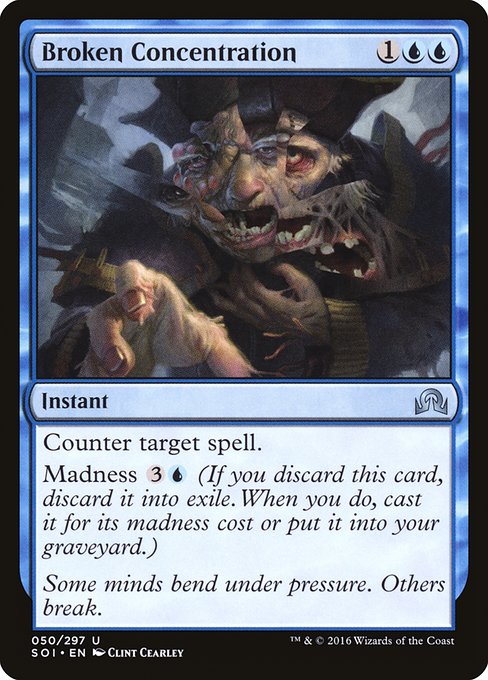
Broken Concentration
Instant
uncommon
Counter target spell. Madness (If you discard this card, discard it into exile. When you do, cast it for its madness cost or put it into your graveyard.)
 Card Kingdom
 Cardmarket
Semantic Tags
Prevents a spell or ability from resolving.
Benefits from discarding cards — madness, Waste Not effects, Oskar strategies.
Cares about cards in the graveyard, puts cards into the graveyard, or benefits from things dying.
A keyword ability that lets a player cast a card they discard. See rule 702.35, “Madness.”
A keyword ability that lets a player cast a card they discard. See rule 702.35, “Madness.”
Answers an opponent's threat by destroying, exiling, bouncing, or otherwise removing a permanent or spell.
A triggered ability that can counter spells or abilities that target the permanent with ward. See rule 702.21, “Ward.”
Format Legality
Price history
Loading price history…
Printings (1)
| Set | Rarity | TCGplayer | Card Kingdom | Cardmarket |
|---|---|---|---|---|
| Shadows over Innistrad#50 | uncommon | · | · | · |
Related Concepts
Related Rules
A Royal Role token is a colorless Aura Role enchantment token named Royal with enchant creature and “Enchanted creature gets +1/+1 and has ward {1}.”
One card (Golgothian Sylex) refers to permanents with a name originally printed in the Antiquities™ expansion. Those names are Amulet of Kroog, Argivian Archaeologist, Argivian Blacksmith, Argothian Pixies, Argothian Treefolk, Armageddon Clock, Artifact Blast, Artifact Possession, Artifact Ward, Ashnod’s Altar, Ashnod’s Battle Gear, Ashnod’s Transmogrant, Atog, Battering Ram, Bronze Tablet, Candelabra of Tawnos, Circle of Protection: Artifacts, Citanul Druid, Clay Statue, Clockwork Avian, Colossus of Sardia, Coral Helm, Crumble, Cursed Rack, Damping Field, Detonate, Drafna’s Restoration, Dragon Engine, Dwarven Weaponsmith, Energy Flux, Feldon’s Cane, Gaea’s Avenger, Gate to Phyrexia, Goblin Artisans, Golgothian Sylex, Grapeshot Catapult, Haunting Wind, Hurkyl’s Recall, Ivory Tower, Jalum Tome, Martyrs of Korlis, Mightstone, Millstone, Mishra’s Factory, Mishra’s War Machine, Mishra’s Workshop, Obelisk of Undoing, Onulet, Orcish Mechanics, Ornithopter, Phyrexian Gremlins, Power Artifact, Powerleech, Priest of Yawgmoth, Primal Clay, The Rack, Rakalite, Reconstruction, Reverse Polarity, Rocket Launcher, Sage of Lat-Nam, Shapeshifter, Shatterstorm, Staff of Zegon, Strip Mine, Su-Chi, Tablet of Epityr, Tawnos’s Coffin, Tawnos’s Wand, Tawnos’s Weaponry, Tetravus, Titania’s Song, Transmute Artifact, Triskelion, Urza’s Avenger, Urza’s Chalice, Urza’s Mine, Urza’s Miter, Urza’s Power Plant, Urza’s Tower, Wall of Spears, Weakstone, Xenic Poltergeist, Yawgmoth Demon, and Yotian Soldier.
After resolving a madness triggered ability (see rule 702.35), if the exiled card wasn’t cast and was moved to a public zone, effects referencing the discarded card can find that object.
To cloak a card, turn it face down. It becomes a 2/2 face-down creature card with ward {2}, no name, no subtypes, and no mana cost. Put that card onto the battlefield face down. That permanent is a cloaked permanent for as long as it remains face down. The effect defining its characteristics works while the card is face down and ends when it’s turned face up.
Ward
Ward is a triggered ability. Ward [cost] means “Whenever this permanent becomes the target of a spell or ability an opponent controls, counter that spell or ability unless that player pays [cost].”
Some ward abilities include an X in their cost and state what X is equal to. This value is determined at the time the ability resolves, not locked in as the ability triggers.
Madness
Rulings
If you discard a card with madness while a spell or ability is resolving, it moves immediately to exile. Continue resolving that spell or ability, noting that the card you discarded is not in your graveyard at this time. Its madness triggered ability will be placed onto the stack once that spell or ability has completely resolved.
Madness works independently of why you're discarding the card. You could discard it to pay a cost, because a spell or ability tells you to, or because you have too many cards in your hand during your cleanup step. You can't discard a card with madness just because you want to, though.
To determine the total cost of a spell, start with the mana cost or alternative cost (such as a madness cost) you're paying, add any cost increases, then apply any cost reductions. The mana value of the spell is determined by only its mana cost, no matter what the total cost to cast that spell was.
Cards are discarded in a Magic game only from a player's hand. Effects that put cards into a player's graveyard from anywhere else do not cause those cards to be discarded.
If you discard a card with madness to pay the cost of a spell or activated ability, that card's madness triggered ability (and the spell that card becomes, if you choose to cast it) will resolve before the spell or ability the discard paid for.
A spell cast for its madness cost is put onto the stack like any other spell. It can be countered, copied, and so on. As it resolves, it's put onto the battlefield if it's a permanent card or into its owner's graveyard if it's an instant or sorcery card.
If you choose not to cast a card with madness when the madness triggered ability resolves, it's put into your graveyard. Madness doesn't give you another chance to cast it later.
Casting a spell with madness ignores the timing rules based on the card's card type. For example, you can cast a sorcery with madness if you discard it during an opponent's turn.
A card with madness that's discarded counts as having been discarded even though it's put into exile rather than a graveyard. If it was discarded to pay a cost, that cost is still paid. Abilities that trigger when a card is discarded will still trigger.