Search
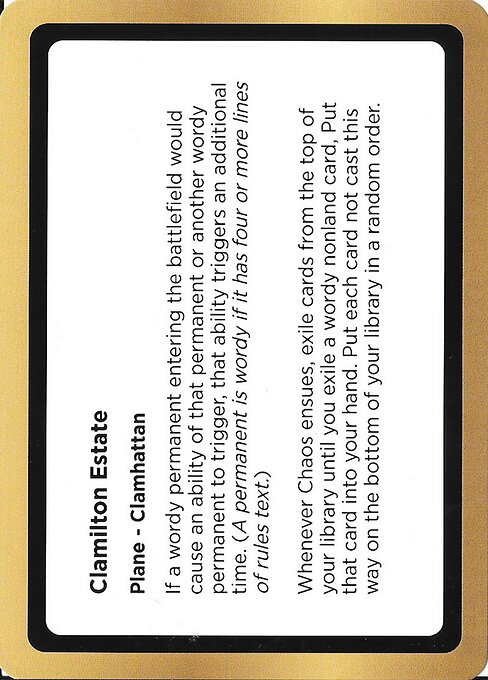
Clamilton Estate
Plane — Clamhattan
common
If a wordy permanent entering the battlefield would cause an ability of that permanent or another wordy permanent to trigger, that ability triggers an additional time. (A permanent is wordy if it has four or more lines of rules text.) Whenever Chaos ensues, exile cards from the top of your library until you exile a wordy nonland card, Put that card into your hand. Put each card not cast this way on the bottom of your library in a random order.
Semantic Tags
Puts additional cards into your hand. Includes direct draw, 'look/reveal and put into hand' effects, and conditional draw triggers.
Random, chaotic, or coin-flip effects that create unpredictable game states.
Exile-based card advantage — exile cards from the top of your library and cast them temporarily. Red's primary draw mechanic.
A keyword ability that allows a spell to affect either a single target or many objects. See rule 702.96, “Overload.”
Cares about or manipulates the top card(s) of your library. Includes scry, surveil, and top-deck payoffs.
Cares about or manipulates the top of library — Sensei's Top, miracles, Future Sight.
Format Legality
Price history
Loading price history…
Printings (1)
| Set | Rarity | TCGplayer | Card Kingdom | Cardmarket |
|---|---|---|---|---|
| Black Lotus Unknown Planechase#PLA012 | common | · | · | · |
Related Rules
Overload
Overload is a keyword that represents two static abilities that function while the spell with overload is on the stack. Overload [cost] means “You may choose to pay [cost] rather than pay this spell’s mana cost” and “If you chose to pay this spell’s overload cost, change its text by replacing all instances of the word ‘target’ with the word ‘each.’” Casting a spell using its overload ability follows the rules for paying alternative costs in rules 601.2b and 601.2f–h.
If a player chooses to pay the overload cost of a spell, that spell won’t require any targets. It may affect objects that couldn’t be chosen as legal targets if the spell were cast without its overload cost being paid.
Overload’s second ability creates a text-changing effect. See rule 612, “Text-Changing Effects.”