Search
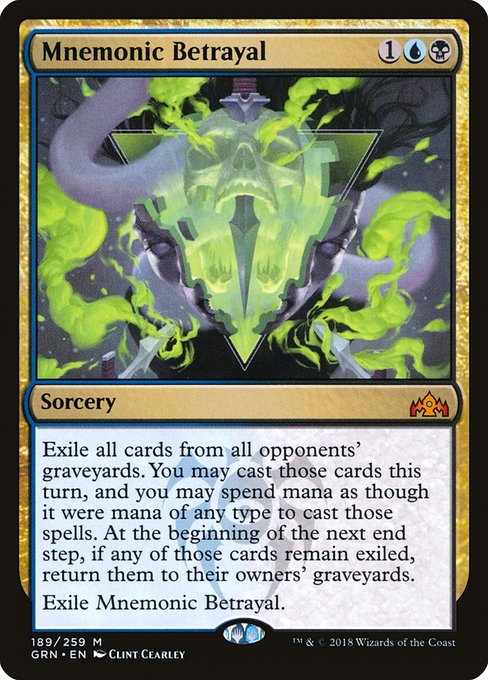
Mnemonic Betrayal
Sorcery
mythic
Exile all opponents' graveyards. You may cast spells from among those cards this turn, and mana of any type can be spent to cast them. At the beginning of the next end step, if any of those cards remain exiled, return them to their owners' graveyards. Exile Mnemonic Betrayal.
 Card Kingdom
 Cardmarket
Semantic Tags
A keyword ability that lets you exile cards from your graveyard rather than pay generic mana to cast a spell. See rule 702.66, “Delve.”
A keyword ability that allows a player to cast a double-faced card transformed from the graveyard. See rule 702.146, “Disturb.”
A keyword ability that lets a player cast a card from their graveyard. See rule 702.34, “Flashback.”
Exiles cards from graveyards or prevents graveyard interaction. Shuts down recursion, flashback, and graveyard-matters strategies.
Exiles cards from graveyards or prevents graveyard interaction. Shuts down recursion, flashback, and graveyard-matters strategies.
Cares about cards in the graveyard, puts cards into the graveyard, or benefits from things dying.
Returns cards from the graveyard to your hand, the battlefield, or the top of your library.
A keyword ability that lets a player cast a card they discard. See rule 702.35, “Madness.”
Helps produce colors you need. Includes multicolor lands, color filtering, and 'any color' mana sources.
A keyword ability that provides an alternative way to play a card. See rule 702.62, “Suspend.” A card is “suspended” if it’s in the exile zone, has suspend, and has a time counter on it.
Format Legality
Price history
Loading price history…
Printings (1)
| Set | Rarity | TCGplayer | Card Kingdom | Cardmarket |
|---|---|---|---|---|
| Guilds of Ravnica#189 | mythic | · | · | · |
Related Rules
If a cost associated with a special action, such as a suspend cost or a morph cost, has an {X} or an X in it, the value of X is chosen by the player taking the special action immediately before they pay that cost.
A player who has a card with suspend in their hand may exile that card. This is a special action. A player can take this action any time they have priority, but only if they could begin to cast that card by putting it onto the stack. See rule 702.62, “Suspend.”
After resolving a madness triggered ability (see rule 702.35), if the exiled card wasn’t cast and was moved to a public zone, effects referencing the discarded card can find that object.
If the spell is modal, the player announces the mode choice (see rule 700.2). If the player wishes to splice any cards onto the spell (see rule 702.47), they reveal those cards in their hand. If the spell has alternative or additional costs that will be paid as it’s being cast such as buyback or kicker costs (see rules 118.8 and 118.9), the player announces their intentions to pay any or all of those costs (see rule 601.2f). A player can’t apply two alternative methods of casting or two alternative costs to a single spell. If the spell has a variable cost that will be paid as it’s being cast (such as an {X} in its mana cost; see rule 107.3), the player announces the value of that variable. If the value of that variable is defined in the text of the spell by a choice that player would make later in the announcement or resolution of the spell, that player makes that choice at this time instead of that later time. If a cost that will be paid as the spell is being cast includes hybrid mana symbols, the player announces the nonhybrid equivalent cost they intend to pay. If a cost that will be paid as the spell is being cast includes Phyrexian mana symbols, the player announces whether they intend to pay 2 life or a corresponding colored mana cost for each of those symbols. Previously made choices (such as choosing to cast a spell with flashback from a graveyard or choosing to cast a creature with morph face down) may restrict the player’s options when making these choices.
If two effects state that a player may (or a creature can) do the same thing “as though” different conditions were true, both conditions could apply. If one “as though” effect satisfies the requirements for another “as though” effect, then both effects will apply.
Suspend
If an effect would cause a player to shuffle one or more specific objects into a library, that library is shuffled even if none of those objects are in the zone they’re expected to be in or an effect causes all of those objects to be moved to another zone or remain in their current zone.
To time travel means to choose any number of permanents you control with one or more time counters on them and/or suspended cards you own in exile with one or more time counters on them and, for each of those objects, put a time counter on it or remove a time counter from it. See rule 702.62, “Suspend.”
Rulings
Mnemonic Betrayal doesn’t change when you can cast the exiled cards. For example, if you exile a sorcery card, you can cast it only during your main phase when the stack is empty.
You can’t play land cards exiled this way.
Only the cards that remain in exile are returned to their owners’ graveyards. For example, a permanent spell cast this way will remain on the battlefield.
In a multiplayer game, if a player leaves the game, all cards that player owns leave as well. If you leave the game, any spells or permanents you control from Mnemonic Betrayal’s effect are exiled. If you leave the game before Mnemonic Betrayal’s delayed triggered ability resolves, the cards remain exiled.
If you cast a spell this way and that card is exiled, it’s considered a new object. Mnemonic Betrayal no longer allows you to cast it. It remains in exile when Mnemonic Betrayal’s delayed triggered ability resolves.