Search
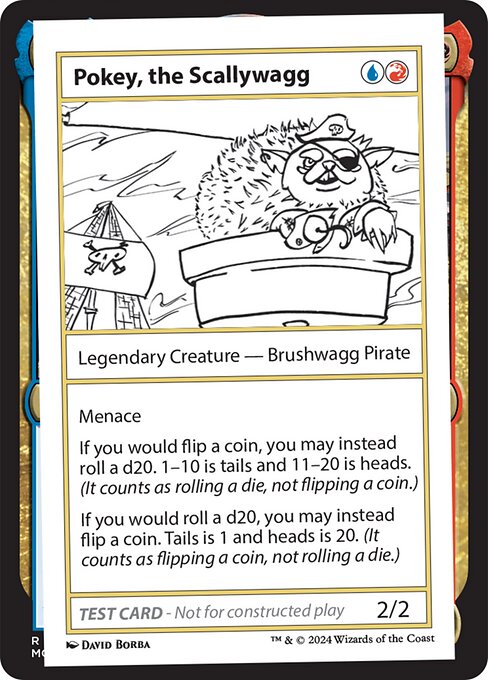
Pokey, the Scallywagg
Legendary Creature — Brushwagg Pirate
rare
Menace If you would flip a coin, you may instead roll a d20. 1−10 is tails and 11−20 is heads. (It counts as rolling a die, not flipping a coin.) If you would roll a d20, you may instead flip a coin. Tails is 1 and heads is 20. (It counts as flipping a coin, not rolling a die.)
2/2
 Card Kingdom
 Cardmarket
Semantic Tags
Random, chaotic, or coin-flip effects that create unpredictable game states.
Difficult to block or grants evasion. Includes flying, menace, fear, intimidate, shadow, skulk, horsemanship, unblockable effects, and cards that grant these abilities.
An evasion ability that makes creatures unblockable by a single creature. See rule 702.111, “Menace.”
A card or token on the battlefield. See rule 110, “Permanents.”
Format Legality
Price history
Loading price history…
Printings (1)
| Set | Rarity | TCGplayer | Card Kingdom | Cardmarket |
|---|---|---|---|---|
| Mystery Booster 2#600 | rare | · | · | · |
Related Concepts
Related Rules
If an ability would produce one or more mana of an undefined type, it produces no mana instead.
Some abilities produce mana based on the type of mana another permanent or permanents “could produce.” The type of mana a permanent could produce at any time includes any type of mana that an ability of that permanent would produce if the ability were to resolve at that time, taking into account any applicable replacement effects in any possible order. Ignore whether any costs of the ability could or could not be paid. If that permanent wouldn’t produce any mana under these conditions, or no type of mana can be defined this way, there’s no type of mana it could produce.
To “tap [a permanent] for mana” is to activate a mana ability of that permanent that includes the {T} symbol in its activation cost. See rule 605, “Mana Abilities.”
An ability that triggers whenever a permanent “is tapped for mana” or is tapped for mana of a specified type triggers whenever such a mana ability resolves and produces mana or the specified type of mana.
A replacement effect that applies if a permanent “is tapped for mana” or tapped for mana of a specific type and/or amount modifies the mana production event while such an ability is resolving and producing mana or the specified type and/or amount of mana.
If an object’s enters-the-battlefield triggered ability or replacement effect refers to X, and the spell that became that object as it resolved had a value of X chosen for any of its costs, the value of X for that ability is the same as the value of X for that spell, although the value of X for that permanent is 0. This is an exception to rule 107.3i.
The tap symbol is {T}. The tap symbol in an activation cost means “Tap this permanent.” A permanent that’s already tapped can’t be tapped again to pay the cost. A creature’s activated ability with the tap symbol in its activation cost can’t be activated unless the creature has been under its controller’s control continuously since their most recent turn began. See rule 302.6.
The untap symbol is {Q}. The untap symbol in an activation cost means “Untap this permanent.” A permanent that’s already untapped can’t be untapped again to pay the cost. A creature’s activated ability with the untap symbol in its activation cost can’t be activated unless the creature has been under its controller’s control continuously since their most recent turn began. See rule 302.6.
Rulings
Playtest cards use a modified version of game symbols, such as {T} and {W}. These modified symbols should be treated as the standard symbols during play.
Each time a spell or ability instructs you to roll a d20, you may apply Pokey’s third ability as a replacement effect to flip a coin instead. If the coin comes up heads, the original spell or ability sees the result of the roll as 20. If the coin comes up tails, the original spell or ability sees the result of the roll as 1. If the coin somehow doesn’t come up heads or tails . . . good luck!
Playtest cards aren’t legal for play in any tournament format other than Mystery Booster Limited formats. On the other hand, we expect they will spice up a wide variety of non-tournament games (as long as everyone’s on the same page about using them!).
If you apply Pokey’s third ability as a replacement effect to rolling a d20, other than the original effect that called for the d20 roll, all other game effects, including replacement effects and triggered abilities, recognize that you flipped a coin rather than rolled a d20. For example, you can then apply the replacement effect of Krark’s Thumb but not the replacement effect of Pixie Guide. And after the roll, the ability of Tavern Scoundrel would trigger, while the first ability of Brazen Dwarf would not trigger.
Each time a spell or ability instructs you to flip a coin, you may apply Pokey’s second ability as a replacement effect to roll a d20 instead. If the result of that roll is 1-10, the original spell or ability sees the result of the flip as tails. If the result of the roll is 11-20, the original spell or ability sees the result of the flip as heads. If the result of the roll is somehow less than 1 or greater than 20, the original spell or ability doesn’t see heads nor tails (you’ll have to read the effect carefully then to determine what happens).
If you apply Pokey’s second ability as a replacement effect to flipping a coin, other than the original effect that called for the coin flip, all other game effects, including replacement effects and triggered abilities, recognize that you rolled a d20 rather than flipped a coin. For example, you can then apply the replacement effect of Pixie Guide but not the replacement effect of Krark’s Thumb. And after the roll, the ability of Brazen Dwarf would trigger, while the first ability of Tavern Scoundrel would not trigger.
If you really want to, you can apply the effects of both Pokey’s second and third abilities to a coin flip or a d20 roll. For example, if you would flip a coin, you can choose to replace that flip with a d20 roll, and you can choose to replace that d20 roll with a coin flip. (Since you can only apply a replacement effect to a single event once, the nonsense stops there.) In that case, you’d flip a coin. If it’s heads, that would count as 20 for the replaced d20 roll, which would count as heads for the originally replaced coin flip. Great job.
For many playtest cards, you’ll need to make a generous assumption that basic game rules would be updated to allow them to work. The Mystery Booster 2 Playtest Card Notes section (reproduced here in individual Gatherer rulings) provides guidance for fitting these cards into the existing rules structure.