Search
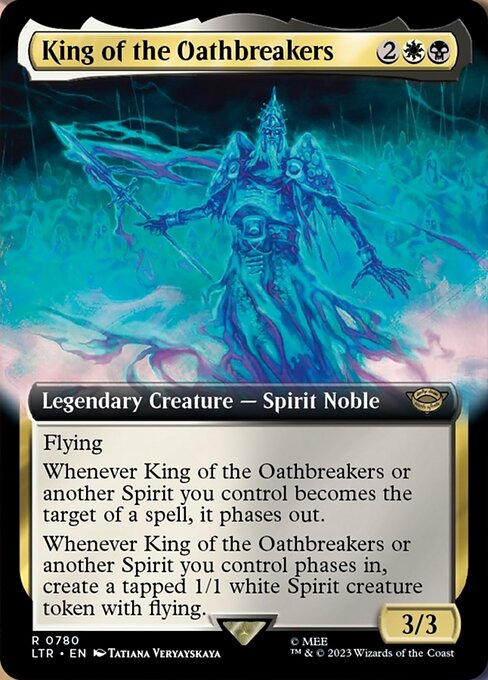
King of the Oathbreakers
Legendary Creature — Spirit Noble
rare
Flying Whenever King of the Oathbreakers or another Spirit you control becomes the target of a spell, it phases out. (Treat it and anything attached to it as though they don't exist until your next turn.) Whenever King of the Oathbreakers or another Spirit you control phases in, create a tapped 1/1 white Spirit creature token with flying.
3/3
 Card Kingdom
 Cardmarket
Semantic Tags
Difficult to block or grants evasion. Includes flying, menace, fear, intimidate, shadow, skulk, horsemanship, unblockable effects, and cards that grant these abilities.
A keyword ability that restricts how a creature may be blocked. See rule 702.9, “Flying.”
A card or token on the battlefield. See rule 110, “Permanents.”
Creates creature tokens, Treasure tokens, Food tokens, Clue tokens, or other token types.
Format Legality
Price history
Loading price history…
Printings (5)
| Set | Rarity | TCGplayer | Card Kingdom | Cardmarket |
|---|---|---|---|---|
| The Lord of the Rings: Tales of Middle-earth#780 | rare | · | · | · |
| The Lord of the Rings: Tales of Middle-earth#662 | rare | · | · | · |
| The Lord of the Rings: Tales of Middle-earth#369 | rare | · | · | · |
| The Lord of the Rings: Tales of Middle-earth#211 | rare | · | · | · |
| Tales of Middle-earth Promos#211s | rare | · | · | · |
Related Concepts
Related Rules
If an ability would produce one or more mana of an undefined type, it produces no mana instead.
Some abilities produce mana based on the type of mana another permanent or permanents “could produce.” The type of mana a permanent could produce at any time includes any type of mana that an ability of that permanent would produce if the ability were to resolve at that time, taking into account any applicable replacement effects in any possible order. Ignore whether any costs of the ability could or could not be paid. If that permanent wouldn’t produce any mana under these conditions, or no type of mana can be defined this way, there’s no type of mana it could produce.
To “tap [a permanent] for mana” is to activate a mana ability of that permanent that includes the {T} symbol in its activation cost. See rule 605, “Mana Abilities.”
An ability that triggers whenever a permanent “is tapped for mana” or is tapped for mana of a specified type triggers whenever such a mana ability resolves and produces mana or the specified type of mana.
A replacement effect that applies if a permanent “is tapped for mana” or tapped for mana of a specific type and/or amount modifies the mana production event while such an ability is resolving and producing mana or the specified type and/or amount of mana.
If an object’s enters-the-battlefield triggered ability or replacement effect refers to X, and the spell that became that object as it resolved had a value of X chosen for any of its costs, the value of X for that ability is the same as the value of X for that spell, although the value of X for that permanent is 0. This is an exception to rule 107.3i.
The tap symbol is {T}. The tap symbol in an activation cost means “Tap this permanent.” A permanent that’s already tapped can’t be tapped again to pay the cost. A creature’s activated ability with the tap symbol in its activation cost can’t be activated unless the creature has been under its controller’s control continuously since their most recent turn began. See rule 302.6.
The untap symbol is {Q}. The untap symbol in an activation cost means “Untap this permanent.” A permanent that’s already untapped can’t be untapped again to pay the cost. A creature’s activated ability with the untap symbol in its activation cost can’t be activated unless the creature has been under its controller’s control continuously since their most recent turn began. See rule 302.6.
Rulings
Permanents phase back in during their controller's untap step, immediately before that player untaps their permanents. Creatures that phase in this way are able to attack and pay a cost of {T} during that turn. If a permanent had counters on it when it phased out, it will have those counters when it phases back in.
A phased-out token will phase in at the beginning of its controller's untap step just like a nontoken permanent would.
If a spell an opponent controls targets multiple Spirits you control, King of the Oathbreakers's triggered ability will trigger once for each of those Spirits.
If King of the Oathbreakers phases in at the same time as one or more other Spirits you control, King of the Oathbreakers's last ability will trigger for each of them.
Any continuous effects with a "for as long as" duration, such as that of Rangers of Ithilien, ignore phased-out objects. If ignoring those objects causes the effect's conditions to no longer be met, the duration will expire.
An attacking or blocking creature that phases out is removed from combat.
Phasing out doesn't cause any "leaves the battlefield" abilities to trigger. Similarly, phasing in won't cause any "enters the battlefield" abilities to trigger.
As a creature is phased out, Auras and Equipment attached to it also phase out at the same time. Those Auras and Equipment will phase in at the same time that creature does, and they'll phase in still attached to that creature.
Choices made for permanents as they entered the battlefield are remembered even after they phase in.
Phased-out permanents are treated as though they don't exist. They can't be the target of spells or abilities, their static abilities have no effect on the game, their triggered abilities can't trigger, they can't attack or block, and so on.