Search
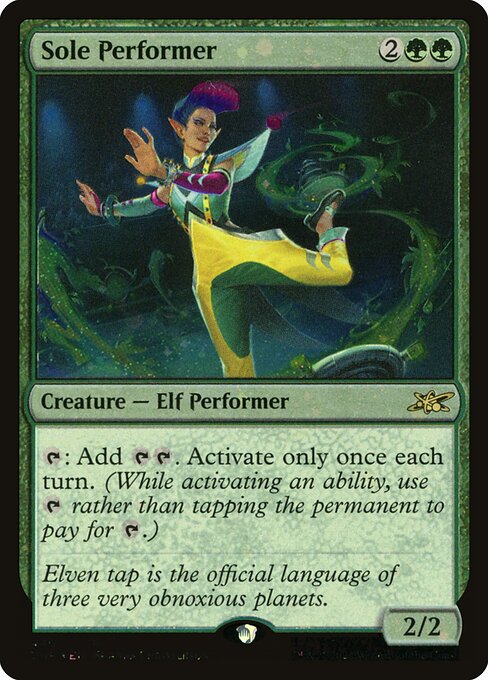
Sole Performer
Creature — Elf Performer
rare
: Add . Activate only once each turn. (While activating an ability, use rather than tapping the permanent to pay for .)
2/2
 Card Kingdom
 Cardmarket
Semantic Tags
Creatures that tap to produce mana. Llanowar Elves, Birds of Paradise, Elvish Mystic.
Creatures that tap to produce mana. Llanowar Elves, Birds of Paradise, Elvish Mystic.
A permanent with a repeatable activated ability that converts excess mana into value.
A card or token on the battlefield. See rule 110, “Permanents.”
Accelerates mana production beyond the one-land-per-turn baseline. Umbrella tag — see ramp subtypes for land ramp, mana dorks, mana rocks, and rituals.
Format Legality
Price history
Loading price history…
Printings (2)
| Set | Rarity | TCGplayer | Card Kingdom | Cardmarket |
|---|---|---|---|---|
| Unfinity#440 | rare | · | · | · |
| Unfinity#154 | rare | · | · | · |
Related Rules
If an ability would produce one or more mana of an undefined type, it produces no mana instead.
Some abilities produce mana based on the type of mana another permanent or permanents “could produce.” The type of mana a permanent could produce at any time includes any type of mana that an ability of that permanent would produce if the ability were to resolve at that time, taking into account any applicable replacement effects in any possible order. Ignore whether any costs of the ability could or could not be paid. If that permanent wouldn’t produce any mana under these conditions, or no type of mana can be defined this way, there’s no type of mana it could produce.
To “tap [a permanent] for mana” is to activate a mana ability of that permanent that includes the {T} symbol in its activation cost. See rule 605, “Mana Abilities.”
An ability that triggers whenever a permanent “is tapped for mana” or is tapped for mana of a specified type triggers whenever such a mana ability resolves and produces mana or the specified type of mana.
A replacement effect that applies if a permanent “is tapped for mana” or tapped for mana of a specific type and/or amount modifies the mana production event while such an ability is resolving and producing mana or the specified type and/or amount of mana.
If an object’s enters-the-battlefield triggered ability or replacement effect refers to X, and the spell that became that object as it resolved had a value of X chosen for any of its costs, the value of X for that ability is the same as the value of X for that spell, although the value of X for that permanent is 0. This is an exception to rule 107.3i.
The tap symbol is {T}. The tap symbol in an activation cost means “Tap this permanent.” A permanent that’s already tapped can’t be tapped again to pay the cost. A creature’s activated ability with the tap symbol in its activation cost can’t be activated unless the creature has been under its controller’s control continuously since their most recent turn began. See rule 302.6.
The untap symbol is {Q}. The untap symbol in an activation cost means “Untap this permanent.” A permanent that’s already untapped can’t be untapped again to pay the cost. A creature’s activated ability with the untap symbol in its activation cost can’t be activated unless the creature has been under its controller’s control continuously since their most recent turn began. See rule 302.6.
Rulings
Spending {T} allows you to activate the tap ability of a creature that's already tapped. Normally, you couldn't pay the cost of tapping the creature because it's already tapped. With Sole Performer, you don't have to worry about that. You have {T}!
You can't spend {T} to have a creature attack without tapping. You also can't use it to pay the cost of an ability that taps a creature without using the {T} symbol. For example, you can't activate an ability that says "Tap an untapped creature you control: [Do something]" with {T}.
For example, say you control Prize Wall, which has "{U}, {T}: You get {TK}." You activate Sole Performer to get {T}{T}. You then activate Prize Wall, spending {U} and one of the {T}s you got from Sole Performer. You could then activate Prize Wall again, spending another {U} and the other {T}. Prize Wall itself is still untapped at this point. You can then activate Prize Wall a third time, spending a third {U} and finally actually tapping Prize Wall.
Spending {T} rather than tapping the permanent doesn't let you activate abilities of creatures that have "summoning sickness." That is, if a creature's ability has {T} in the cost, and it hasn't been under your control since the beginning of your most recent turn, you can't activate the ability (unless the creature has haste), even if you intend to spend {T} rather than tap the creature.
Although {T} acts in many ways like mana, it is not mana. An ability that triggers from a creature tapping to add mana wouldn't trigger when you activate Sole Performer's ability, for example.
Sole Performer turns {T} into a resource you can add, much like mana. You spend {T} to pay for that symbol appearing in the costs of activated abilities. If you spend a {T} you have, you don't have to tap the permanent that has the ability.
You lose unused {T} as steps and phases end, at the same time you lose unspent mana.