Search
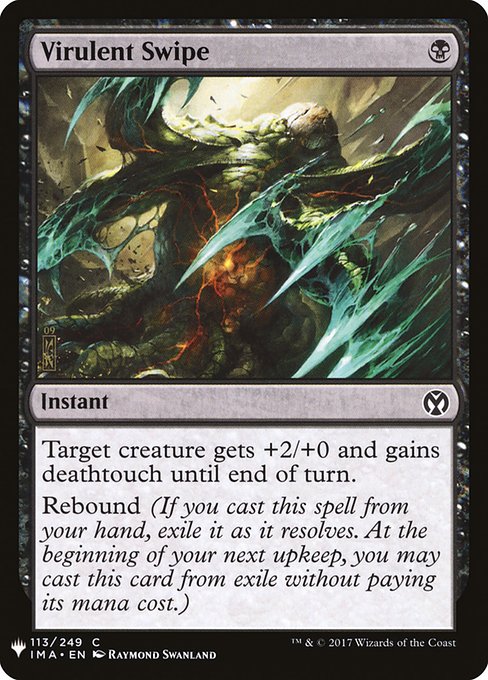
Virulent Swipe
Instant
common
Target creature gets +2/+0 and gains deathtouch until end of turn. Rebound (If you cast this spell from your hand, exile it as it resolves. At the beginning of your next upkeep, you may cast this card from exile without paying its mana cost.)
 Card Kingdom
 Cardmarket
Semantic Tags
An instant-speed spell that modifies combat — pump, protection, or removal during combat.
An instant-speed spell that modifies combat — pump, protection, or removal during combat.
A keyword ability that causes damage dealt by an object to be especially effective. See rule 702.2, “Deathtouch.”
Has or grants deathtouch — kills anything it damages, effective deterrent and combat removal.
A spell or ability that gives a temporary power/toughness boost.
Format Legality
Price history
Loading price history…
Printings (3)
| Set | Rarity | TCGplayer | Card Kingdom | Cardmarket |
|---|---|---|---|---|
| The List#IMA-113 | common | · | · | · |
| Iconic Masters#113 | common | · | · | · |
| Rise of the Eldrazi#131 | uncommon | · | · | · |
Related Concepts
Related Rules
First, if an effect that’s causing damage to be dealt states that excess damage that would be dealt to a permanent is dealt to another permanent or player instead, the damage event is modified accordingly. If the first permanent is a creature, the excess damage is the amount of damage in excess of what would be lethal damage, taking into account damage already marked on the creature and damage from other sources that would be dealt at the same time. (See rule 120.6.) Any amount of damage greater than 1 is excess damage if the source dealing that damage to a creature has deathtouch. (See rule 702.2.) If the first permanent is a planeswalker, the excess damage is the amount of damage in excess of that planeswalker’s loyalty, taking into account damage from other sources that would be dealt at the same time. If the first permanent is a battle, the excess damage is the amount of damage in excess of that battle’s defense, taking into account damage from other sources that would be dealt at the same time. If the first permanent has multiple card types from among the list of creature, planeswalker, and battle, the excess damage is the greatest of the calculated amounts for each of the card types it has.
A keyword counter on a permanent or on a card in a zone other than the battlefield causes that object to gain that keyword. The keywords that a keyword counter can be are flying, first strike, double strike, deathtouch, decayed, exalted, haste, hexproof, indestructible, lifelink, menace, reach, shadow, trample, and vigilance, as well as any variants of those keywords. See rule 613.1f.
The only ways a permanent can be destroyed are as a result of an effect that uses the word “destroy” or as a result of the state-based actions that check for lethal damage (see rule 704.5g) or damage from a source with deathtouch (see rule 704.5h). If a permanent is put into its owner’s graveyard for any other reason, it hasn’t been “destroyed.”
Deathtouch
Deathtouch is a static ability.
Any nonzero amount of combat damage assigned to a creature by a source with deathtouch is considered to be lethal damage for the purposes of determining if excess damage is being dealt.
The deathtouch rules function no matter what zone an object with deathtouch deals damage from.
If an object changes zones before an effect causes it to deal damage, its last known information is used to determine whether it had deathtouch.
Rulings
If you cast a card from exile this way, it will go to your graveyard when it resolves, fails to resolve, or is countered. It won’t go back to exile.
If a replacement effect would cause a spell with rebound that you cast from your hand to be put somewhere else instead of your graveyard (such as Leyline of the Void might), you choose whether to apply the rebound effect or the other effect as the spell resolves.
Rebound will have no effect on copies of spells because you don’t cast them from your hand.
At the beginning of your upkeep, all delayed triggered abilities created by rebound effects trigger. You may handle them in any order. If you want to cast a card this way, you do so as part of the resolution of its delayed triggered ability. Timing restrictions based on the card’s type (if it’s a sorcery) are ignored. Other restrictions are not (such as the one from Rule of Law).
If you are unable to cast a card from exile this way, or you choose not to, nothing happens when the delayed triggered ability resolves. The card remains exiled for the rest of the game, and you won’t get another chance to cast the card. The same is true if the ability is countered (due to Stifle, perhaps).
If you cast a spell with rebound from anywhere other than your hand (such as from your graveyard due to Sins of the Past, from your library due to cascade, or from your opponent’s hand due to Sen Triplets), rebound won’t have any effect. If you do cast it from your hand, rebound will work regardless of whether you paid its mana cost (for example, if you cast it from your hand due to Maelstrom Archangel).
If a spell with rebound that you cast from your hand doesn’t resolve for any reason (due being countered by a spell like Cancel, or because all of its targets are illegal), rebound has no effect. The spell is simply put into your graveyard. You won’t get to cast it again next turn.
If you cast a spell with rebound from your hand and it resolves, it isn’t put into your graveyard. Rather, it’s exiled directly from the stack. Effects that care about cards being put into your graveyard won’t do anything.