Search
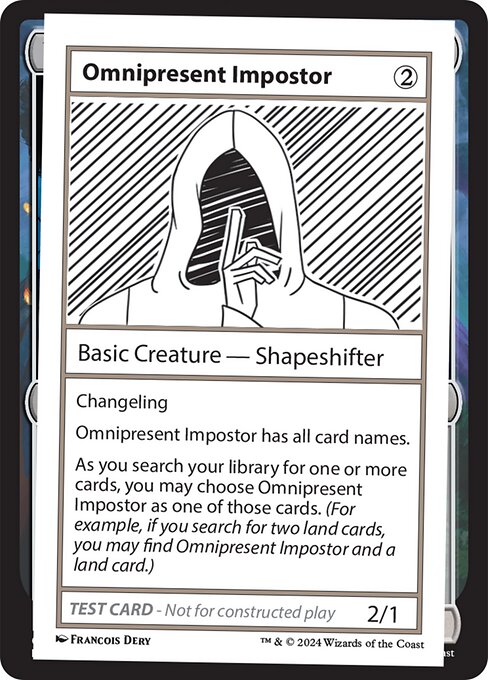
Omnipresent Impostor
Basic Creature — Shapeshifter
rare
Changeling Omnipresent Impostor has all card names. As you search your library for one or more cards, you may choose Omnipresent Impostor as one of those cards. (For example, if you search for two land cards, you may find Omnipresent Impostor and a land card.)
2/1
 Card Kingdom
 Cardmarket
Semantic Tags
A card or token on the battlefield. See rule 110, “Permanents.”
Accelerates mana production beyond the one-land-per-turn baseline. Umbrella tag — see ramp subtypes for land ramp, mana dorks, mana rocks, and rituals.
Cares about creature types — lords, type-matters effects, and changeling.
Format Legality
Price history
Loading price history…
Printings (1)
| Set | Rarity | TCGplayer | Card Kingdom | Cardmarket |
|---|---|---|---|---|
| Mystery Booster 2#504 | rare | · | · | · |
Related Concepts
A characteristic-defining ability that grants the object it’s on every creature type. See rule 702.73, “Changeling.”
Related Rules
If an ability would produce one or more mana of an undefined type, it produces no mana instead.
Some abilities produce mana based on the type of mana another permanent or permanents “could produce.” The type of mana a permanent could produce at any time includes any type of mana that an ability of that permanent would produce if the ability were to resolve at that time, taking into account any applicable replacement effects in any possible order. Ignore whether any costs of the ability could or could not be paid. If that permanent wouldn’t produce any mana under these conditions, or no type of mana can be defined this way, there’s no type of mana it could produce.
To “tap [a permanent] for mana” is to activate a mana ability of that permanent that includes the {T} symbol in its activation cost. See rule 605, “Mana Abilities.”
An ability that triggers whenever a permanent “is tapped for mana” or is tapped for mana of a specified type triggers whenever such a mana ability resolves and produces mana or the specified type of mana.
A replacement effect that applies if a permanent “is tapped for mana” or tapped for mana of a specific type and/or amount modifies the mana production event while such an ability is resolving and producing mana or the specified type and/or amount of mana.
If an object’s enters-the-battlefield triggered ability or replacement effect refers to X, and the spell that became that object as it resolved had a value of X chosen for any of its costs, the value of X for that ability is the same as the value of X for that spell, although the value of X for that permanent is 0. This is an exception to rule 107.3i.
The tap symbol is {T}. The tap symbol in an activation cost means “Tap this permanent.” A permanent that’s already tapped can’t be tapped again to pay the cost. A creature’s activated ability with the tap symbol in its activation cost can’t be activated unless the creature has been under its controller’s control continuously since their most recent turn began. See rule 302.6.
The untap symbol is {Q}. The untap symbol in an activation cost means “Untap this permanent.” A permanent that’s already untapped can’t be untapped again to pay the cost. A creature’s activated ability with the untap symbol in its activation cost can’t be activated unless the creature has been under its controller’s control continuously since their most recent turn began. See rule 302.6.
Rulings
Playtest cards use a modified version of game symbols, such as {T} and {W}. These modified symbols should be treated as the standard symbols during play.
Playtest cards aren’t legal for play in any tournament format other than Mystery Booster Limited formats. On the other hand, we expect they will spice up a wide variety of non-tournament games (as long as everyone’s on the same page about using them!).
For many playtest cards, you’ll need to make a generous assumption that basic game rules would be updated to allow them to work. The Mystery Booster 2 Playtest Card Notes section (reproduced here in individual Gatherer rulings) provides guidance for fitting these cards into the existing rules structure.
Omnipresent Impostor’s second ability is a characteristic-defining ability that functions in all zones as well as outside the game.
Omnipresent Impostor has the basic supertype, and you can play as many of them as you want in your Constructed decks. These two statements may or may not be related.
Omnipresent Impostor has the names of all cards, including the back faces of double-faced cards. Notably, it doesn’t have the names of tokens, such as Zombie Token, Blood Token, and similar.
Each time you search your deck for one or more cards, you can find Omnipresent Impostor in place of one of those cards. If you search your deck for more than one card, you can replace each of those cards with an Omnipresent Impostor as long as there are enough Omnipresent Impostors in your deck. Continue resolving the search effect with Omnipresent Impostor in place of whatever card it replaced. For example, Sakura-Tribe Elder’s activated ability lets you put an Omnipresent Impostor onto the battlefield tapped, while Goblin Engineer’s enters ability lets you put an Omnipresent Impostor into your graveyard.