Search
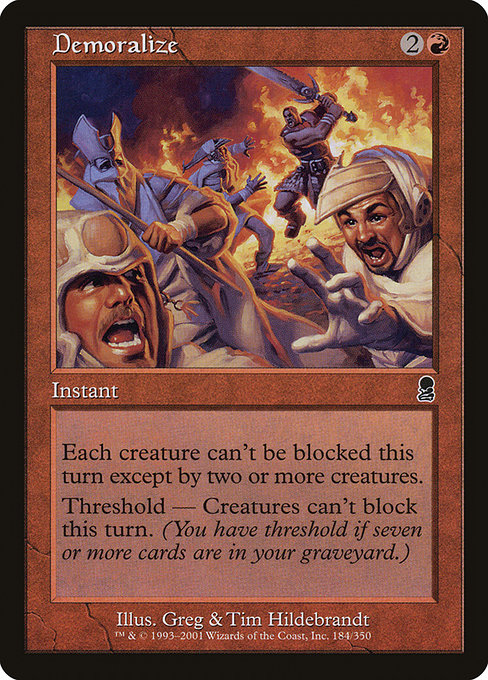
Demoralize
Instant
common
All creatures gain menace until end of turn. (They can't be blocked except by two or more creatures.) Threshold — If there are seven or more cards in your graveyard, creatures can't block this turn.
 Card Kingdom
 Cardmarket
Semantic Tags
A keyword ability that lets a player cast a spell for less by sacrificing a creature. See rule 702.119, “Emerge.”
Difficult to block or grants evasion. Includes flying, menace, fear, intimidate, shadow, skulk, horsemanship, unblockable effects, and cards that grant these abilities.
Difficult to block or grants evasion. Includes flying, menace, fear, intimidate, shadow, skulk, horsemanship, unblockable effects, and cards that grant these abilities.
Cares about cards in the graveyard, puts cards into the graveyard, or benefits from things dying.
An evasion ability that makes creatures unblockable by a single creature. See rule 702.111, “Menace.”
Cannot be blocked or has an ability that makes it very hard to block.
Format Legality
Price history
Loading price history…
Printings (1)
| Set | Rarity | TCGplayer | Card Kingdom | Cardmarket |
|---|---|---|---|---|
| Odyssey#184 | common | · | · | · |
Related Concepts
“Threshold” used to be a keyword ability. It is now an ability word and has no rules meaning. All cards printed with the threshold keyword have received errata in the Oracle card reference.
Related Rules
A keyword counter on a permanent or on a card in a zone other than the battlefield causes that object to gain that keyword. The keywords that a keyword counter can be are flying, first strike, double strike, deathtouch, decayed, exalted, haste, hexproof, indestructible, lifelink, menace, reach, shadow, trample, and vigilance, as well as any variants of those keywords. See rule 613.1f.
An ability word appears in italics at the beginning of some abilities. Ability words are similar to keywords in that they tie together cards that have similar functionality, but they have no special rules meaning and no individual entries in the Comprehensive Rules. The ability words are adamant, addendum, alliance, battalion, bloodrush, celebration, channel, chroma, cohort, constellation, converge, council’s dilemma, coven, delirium, descend 4, descend 8, disappear, domain, eerie, eminence, enrage, fateful hour, fathomless descent, ferocious, flurry, formidable, grandeur, hellbent, heroic, imprint, inspired, join forces, kinship, landfall, lieutenant, magecraft, metalcraft, morbid, pack tactics, paradox, parley, radiance, raid, rally, renew, revolt, secret council, spell mastery, strive, survival, sweep, tempting offer, threshold, undergrowth, valiant, vivid, void, and will of the council.
The defending player checks each creature they control to see whether it’s affected by any requirements (effects that say a creature must block, or that it must block if some condition is met). If the number of requirements that are being obeyed is fewer than the maximum possible number of requirements that could be obeyed without disobeying any restrictions, the declaration of blockers is illegal. If a creature can’t block unless a player pays a cost, that player is not required to pay that cost, even if blocking with that creature would increase the number of requirements being obeyed. If a requirement that says a creature blocks if able during a certain turn refers to a turn with multiple combat phases, the creature blocks if able during each declare blockers step in that turn.
A suspected permanent has menace and “This creature can’t block” for as long as it’s suspected.
Menace
Menace is an evasion ability.
A creature with menace can’t be blocked except by two or more creatures. (See rule 509, “Declare Blockers Step.”)
Multiple instances of menace on the same creature are redundant.