Search
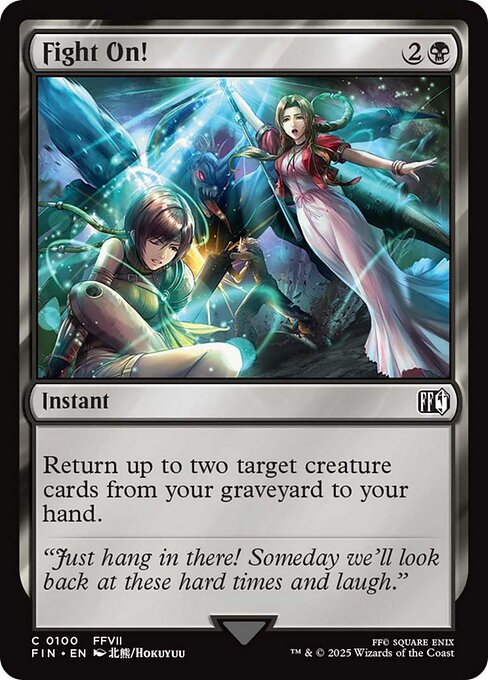
Fight On!
Instant
common
Return up to two target creature cards from your graveyard to your hand.
 Card Kingdom
 Cardmarket
Semantic Tags
A keyword ability that lets a player return a card from their graveyard to their hand. See rule 702.52, “Dredge.”
Cares about cards in the graveyard, puts cards into the graveyard, or benefits from things dying.
Cares about cards in the graveyard, puts cards into the graveyard, or benefits from things dying.
Returns cards from the graveyard to your hand, the battlefield, or the top of your library.
Returns cards from graveyard to hand or library (not battlefield — that is reanimation).
A keyword ability that can return a creature from the graveyard to the battlefield. See rule 702.93, “Undying.”
Format Legality
Price history
Loading price history…
Printings (1)
| Set | Rarity | TCGplayer | Card Kingdom | Cardmarket |
|---|---|---|---|---|
| Final Fantasy#100 | common | · | · | · |
Related Rules
Dredge
Dredge is a static ability that functions only while the card with dredge is in a player’s graveyard. “Dredge N” means “As long as you have at least N cards in your library, if you would draw a card, you may instead mill N cards and return this card from your graveyard to your hand.”
A player with fewer cards in their library than the number required by a dredge ability can’t mill any of them this way.
Undying
Undying is a triggered ability. “Undying” means “When this permanent is put into a graveyard from the battlefield, if it had no +1/+1 counters on it, return it to the battlefield under its owner’s control with a +1/+1 counter on it.”
If a state-based action results in a permanent leaving the battlefield at the same time other state-based actions were performed, that permanent’s last known information is derived from the game state before any of those state-based actions were performed.