Search
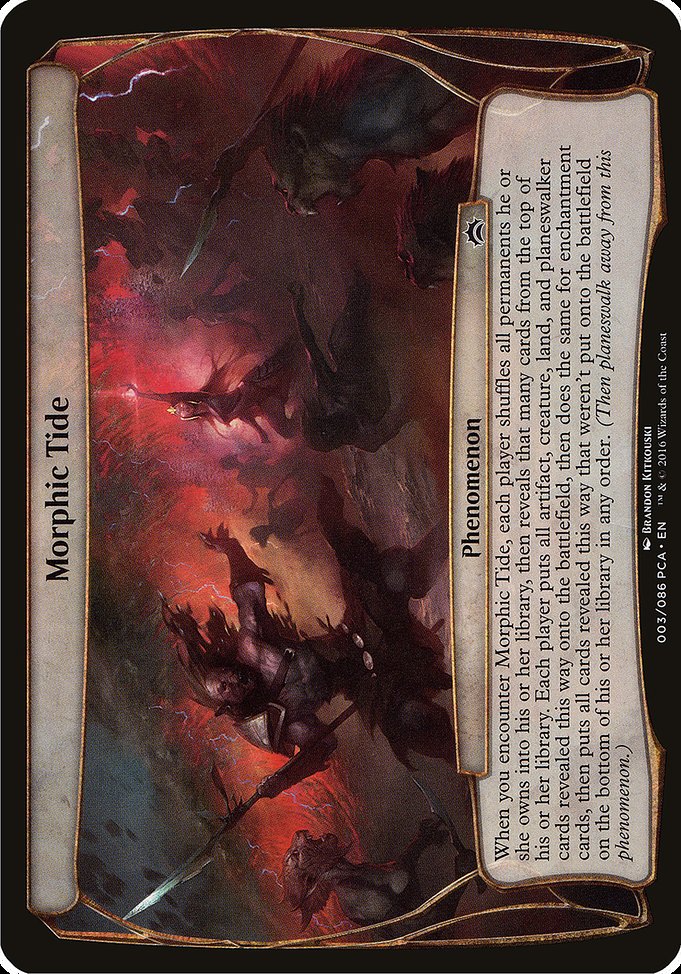
Morphic Tide
Phenomenon
common
When you encounter Morphic Tide, each player shuffles all permanents they own into their library, then reveals that many cards from the top of their library. Each player puts all artifact, creature, land, and planeswalker cards revealed this way onto the battlefield, then does the same for enchantment cards, then puts all cards revealed this way that weren't put onto the battlefield on the bottom of their library in any order. (Then planeswalk away from this phenomenon.)
 Card Kingdom
 Cardmarket
Semantic Tags
Benefits all players or gives opponents choices/resources. Political strategy.
A keyword ability that lets a card be cast face down as a 2/2 creature. See rule 702.37, “Morph,” and rule 708, “Face-Down Spells and Permanents.”
Cares about or manipulates the top card(s) of your library. Includes scry, surveil, and top-deck payoffs.
Format Legality
Price history
Loading price history…
Printings (2)
| Set | Rarity | TCGplayer | Card Kingdom | Cardmarket |
|---|---|---|---|---|
| Planechase Anthology Planes#3 | common | · | · | · |
| Planechase 2012 Planes#3 | common | · | · | · |
Related Rules
If a cost associated with a special action, such as a suspend cost or a morph cost, has an {X} or an X in it, the value of X is chosen by the player taking the special action immediately before they pay that cost.
Morph
Morph is a static ability that functions in any zone from which you could play the card it’s on, and the morph effect works any time the card is face down. “Morph [cost]” means “You may cast this card as a 2/2 face-down creature with no text, no name, no subtypes, and no mana cost by paying {3} rather than paying its mana cost.” (See rule 708, “Face-Down Spells and Permanents.”)
Some spells, activated abilities, and triggered abilities read, “[Do something]. If [a player] [does, doesn’t, or can’t], [effect].” Or “[A player] may [do something]. If [that player] [does, doesn’t, or can’t], [effect].” The action [do something] is a cost, paid when the spell or ability resolves. The “If [a player] [does, doesn’t, or can’t]” clause checks whether the player chose to pay an optional cost or started to pay a mandatory cost, regardless of what events actually occurred.
Megamorph is a variant of the morph ability. “Megamorph [cost]” means “You may cast this card as a 2/2 face-down creature with no text, no name, no subtypes, and no mana cost by paying {3} rather than paying its mana cost” and “As this permanent is turned face up, put a +1/+1 counter on it if its megamorph cost was paid to turn it face up.” A megamorph cost is a morph cost.
If the spell is modal, the player announces the mode choice (see rule 700.2). If the player wishes to splice any cards onto the spell (see rule 702.47), they reveal those cards in their hand. If the spell has alternative or additional costs that will be paid as it’s being cast such as buyback or kicker costs (see rules 118.8 and 118.9), the player announces their intentions to pay any or all of those costs (see rule 601.2f). A player can’t apply two alternative methods of casting or two alternative costs to a single spell. If the spell has a variable cost that will be paid as it’s being cast (such as an {X} in its mana cost; see rule 107.3), the player announces the value of that variable. If the value of that variable is defined in the text of the spell by a choice that player would make later in the announcement or resolution of the spell, that player makes that choice at this time instead of that later time. If a cost that will be paid as the spell is being cast includes hybrid mana symbols, the player announces the nonhybrid equivalent cost they intend to pay. If a cost that will be paid as the spell is being cast includes Phyrexian mana symbols, the player announces whether they intend to pay 2 life or a corresponding colored mana cost for each of those symbols. Previously made choices (such as choosing to cast a spell with flashback from a graveyard or choosing to cast a creature with morph face down) may restrict the player’s options when making these choices.
Some rules and effects state that an alternative set of characteristics or a subset of characteristics are considered to determine if a card or copy of a card is legal to cast. These alternative characteristics replace the object’s characteristics for this determination. Continuous effects that would apply to that object once it has those characteristics are also considered.
If a permanent’s morph cost includes X, other abilities of that permanent may also refer to X. The value of X in those abilities is equal to the value of X chosen as the morph special action was taken.
Rulings
This ability is very similar to that of Warp World, but note that planeswalkers are put onto the battlefield.
Cards such as Sakashima's Student that can enter as a copy of another permanent won't be able to enter as a copy of a permanent that's entering at the same time.
After all permanents are put onto the battlefield and you planeswalk away from Morphic Tide, any abilities that triggered from those permanents entering, from the previous generation of permanents leaving the battlefield, and from the new plane or phenomenon will be put onto the stack. You'll put all of your triggered abilities on the stack in any order, then each other player in turn order will do the same. (The last ability put on the stack will be the first one that resolves.)
The permanents will enter while Morphic Tide is face up. This means the game won't be on any plane when determining if any abilities trigger because those permanents entered, for example. However, you'll planeswalk away from Morphic Tide before any such abilities are put on the stack. After you turn the next card of the planar deck face up, any abilities that triggered during the resolution of Morphic Tide (including any abilities that triggered because you encountered another phenomenon or planeswalked to the next plane) will be put on the stack. The planar controller will put their abilities on the stack in any order, followed by each other player in turn order. The last ability put on the stack will be the first one to resolve.
Taking it slowly, here's what happens when Morphic Tide's ability resolves: 1) Each player counts the number of permanents they own. 2) Each player shuffles those permanents into their library. 3) Each player reveals cards from the top of their library equal to the number that player counted. 4) Each player puts all artifact, creature, land, and planeswalker cards revealed this way onto the battlefield. All of these cards enter at the same time. 5) Each player puts all enchantment cards revealed this way onto the battlefield. An Aura put onto the battlefield this way can enchant an artifact, creature, land, or planeswalker that was already put onto the battlefield, but can't enchant an enchantment that's being put onto the battlefield at the same time as it. If multiple players have Auras to put onto the battlefield, the player whose turn it is announces what their Auras will enchant, then each other player in turn order does the same, then all enchantments (both Auras and non-Auras) enter at the same time. 6) Each player puts all of their other revealed cards (instants, sorceries, and Auras that can't enchant anything) on the bottom of their library in any order.
Token permanents a player owns will count toward the number of cards that player reveals. They'll be shuffled into that player's library and subsequently cease to exist. A token's owner is the player who created it.