Search
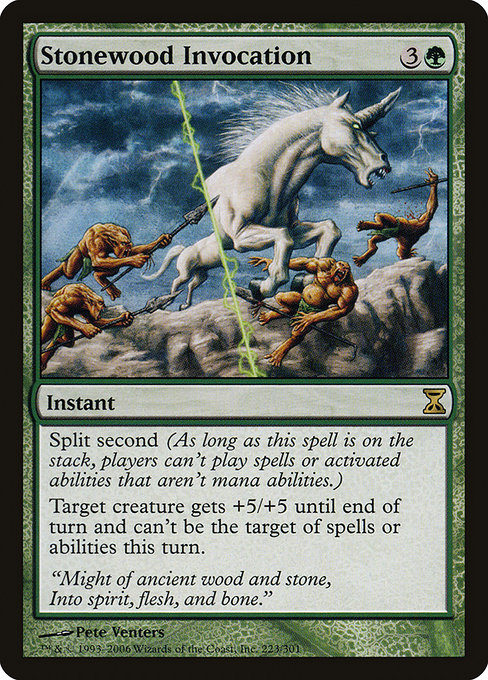
Stonewood Invocation
Instant
rare
Split second (As long as this spell is on the stack, players can't cast spells or activate abilities that aren't mana abilities.) Target creature gets +5/+5 and gains shroud until end of turn. (It can't be the target of spells or abilities.)
 Card Kingdom
 Cardmarket
Semantic Tags
An instant-speed spell that modifies combat — pump, protection, or removal during combat.
An instant-speed spell that modifies combat — pump, protection, or removal during combat.
A keyword ability that lets a creature deal its combat damage twice. See rule 702.4, “Double Strike.”
A keyword ability that lets a creature deal its combat damage before other creatures. See rule 702.7, “First Strike.”
Has first strike or double strike — trades favorably in combat.
Effects that double or multiply mana production.
A keyword ability that allows a spell to affect either a single target or many objects. See rule 702.96, “Overload.”
A keyword ability that provides a range of benefits against objects with a specific quality. See rule 702.16, “Protection.”
A spell or ability that gives a temporary power/toughness boost.
Slows opponents down by taxing actions or restricting what they can do.
A keyword ability that creates copies of a spell. See rule 702.40, “Storm.”
Format Legality
Price history
Loading price history…
Printings (1)
| Set | Rarity | TCGplayer | Card Kingdom | Cardmarket |
|---|---|---|---|---|
| Time Spiral#223 | rare | · | · | · |
Related Rules
A keyword counter on a permanent or on a card in a zone other than the battlefield causes that object to gain that keyword. The keywords that a keyword counter can be are flying, first strike, double strike, deathtouch, decayed, exalted, haste, hexproof, indestructible, lifelink, menace, reach, shadow, trample, and vigilance, as well as any variants of those keywords. See rule 613.1f.
The text that a name sticker is modifying may change due to other effects and/or a permanent’s face-down status (see rule 708, “Face-Down Spells and Permanents”). To determine the name of an object with one or more name stickers, start with the object’s copiable values, then apply each name sticker’s effect and each other text-changing effect in timestamp order. The position of each name sticker will continue to be after the number of words that were before it in the object’s name when it was placed. If there are fewer words in the object’s current name, the word on that sticker is added at the end of its name instead. The position and timestamp order of each name sticker on an object is remembered as the object that sticker is on moves from one public zone to another, and it continues to apply to the new object it becomes in that zone (see rule 123.5). This is an exception to rule 400.7.
One card (Golgothian Sylex) refers to permanents with a name originally printed in the Antiquities™ expansion. Those names are Amulet of Kroog, Argivian Archaeologist, Argivian Blacksmith, Argothian Pixies, Argothian Treefolk, Armageddon Clock, Artifact Blast, Artifact Possession, Artifact Ward, Ashnod’s Altar, Ashnod’s Battle Gear, Ashnod’s Transmogrant, Atog, Battering Ram, Bronze Tablet, Candelabra of Tawnos, Circle of Protection: Artifacts, Citanul Druid, Clay Statue, Clockwork Avian, Colossus of Sardia, Coral Helm, Crumble, Cursed Rack, Damping Field, Detonate, Drafna’s Restoration, Dragon Engine, Dwarven Weaponsmith, Energy Flux, Feldon’s Cane, Gaea’s Avenger, Gate to Phyrexia, Goblin Artisans, Golgothian Sylex, Grapeshot Catapult, Haunting Wind, Hurkyl’s Recall, Ivory Tower, Jalum Tome, Martyrs of Korlis, Mightstone, Millstone, Mishra’s Factory, Mishra’s War Machine, Mishra’s Workshop, Obelisk of Undoing, Onulet, Orcish Mechanics, Ornithopter, Phyrexian Gremlins, Power Artifact, Powerleech, Priest of Yawgmoth, Primal Clay, The Rack, Rakalite, Reconstruction, Reverse Polarity, Rocket Launcher, Sage of Lat-Nam, Shapeshifter, Shatterstorm, Staff of Zegon, Strip Mine, Su-Chi, Tablet of Epityr, Tawnos’s Coffin, Tawnos’s Wand, Tawnos’s Weaponry, Tetravus, Titania’s Song, Transmute Artifact, Triskelion, Urza’s Avenger, Urza’s Chalice, Urza’s Mine, Urza’s Miter, Urza’s Power Plant, Urza’s Tower, Wall of Spears, Weakstone, Xenic Poltergeist, Yawgmoth Demon, and Yotian Soldier.
One card (Apocalypse Chime) refers to permanents with a name originally printed in the Homelands™ expansion. Those names are Abbey Gargoyles; Abbey Matron; Aether Storm; Aliban’s Tower; Ambush; Ambush Party; Anaba Ancestor; Anaba Bodyguard; Anaba Shaman; Anaba Spirit Crafter; An-Havva Constable; An-Havva Inn; An-Havva Township; An-Zerrin Ruins; Apocalypse Chime; Autumn Willow; Aysen Abbey; Aysen Bureaucrats; Aysen Crusader; Aysen Highway; Baki’s Curse; Baron Sengir; Beast Walkers; Black Carriage; Broken Visage; Carapace; Castle Sengir; Cemetery Gate; Chain Stasis; Chandler; Clockwork Gnomes; Clockwork Steed; Clockwork Swarm; Coral Reef; Dark Maze; Daughter of Autumn; Death Speakers; Didgeridoo; Drudge Spell; Dry Spell; Dwarven Pony; Dwarven Sea Clan; Dwarven Trader; Ebony Rhino; Eron the Relentless; Evaporate; Faerie Noble; Feast of the Unicorn; Feroz’s Ban; Folk of An-Havva; Forget; Funeral March; Ghost Hounds; Giant Albatross; Giant Oyster; Grandmother Sengir; Greater Werewolf; Hazduhr the Abbot; Headstone; Heart Wolf; Hungry Mist; Ihsan’s Shade; Irini Sengir; Ironclaw Curse; Jinx; Joven; Joven’s Ferrets; Joven’s Tools; Koskun Falls; Koskun Keep; Labyrinth Minotaur; Leaping Lizard; Leeches; Mammoth Harness; Marjhan; Memory Lapse; Merchant Scroll; Mesa Falcon; Mystic Decree; Narwhal; Orcish Mine; Primal Order; Prophecy; Rashka the Slayer; Reef Pirates; Renewal; Retribution; Reveka, Wizard Savant; Root Spider; Roots; Roterothopter; Rysorian Badger; Samite Alchemist; Sea Sprite; Sea Troll; Sengir Autocrat; Sengir Bats; Serra Aviary; Serra Bestiary; Serra Inquisitors; Serra Paladin; Serrated Arrows; Shrink; Soraya the Falconer; Spectral Bears; Timmerian Fiends; Torture; Trade Caravan; Truce; Veldrane of Sengir; Wall of Kelp; Willow Faerie; Willow Priestess; Winter Sky; and Wizards’ School.
Storm is a triggered ability that functions on the stack. “Storm” means “When you cast this spell, copy it for each other spell that was cast before it this turn. If the spell has any targets, you may choose new targets for any of the copies.”
The combat phase has five steps, which proceed in order: beginning of combat, declare attackers, declare blockers, combat damage, and end of combat. The declare blockers and combat damage steps are skipped if no creatures are declared as attackers or put onto the battlefield attacking (see rule 508.8). There are two combat damage steps if any attacking or blocking creature has first strike (see rule 702.7) or double strike (see rule 702.4).
If at least one attacking or blocking creature has first strike (see rule 702.7) or double strike (see rule 702.4) as the combat damage step begins, the only creatures that assign combat damage in that step are those with first strike or double strike. After that step, instead of proceeding to the end of combat step, the phase gets a second combat damage step. The only creatures that assign combat damage in that step are the remaining attackers and blockers that had neither first strike nor double strike as the first combat damage step began, as well as the remaining attackers and blockers that currently have double strike. After that step, the phase proceeds to the end of combat step.
Storm
Rulings
Players still get priority while a card with split second is on the stack; their options are just limited to mana abilities and certain special actions.
Split second doesn’t stop triggered abilities from triggering, such as that of Chalice of the Void. If one does, its controller puts it on the stack and chooses targets for it, if any. Those abilities will resolve as normal.
Casting a spell with split second won’t affect spells and abilities that are already on the stack.
After a spell with split second resolves (or otherwise leaves the stack), players may again cast spells and activate abilities before the next object on the stack resolves.
If the resolution of a triggered ability involves casting a spell, that spell can’t be cast if a spell with split second is on the stack.
Players may turn face-down creatures face up while a spell with split second is on the stack.