Search
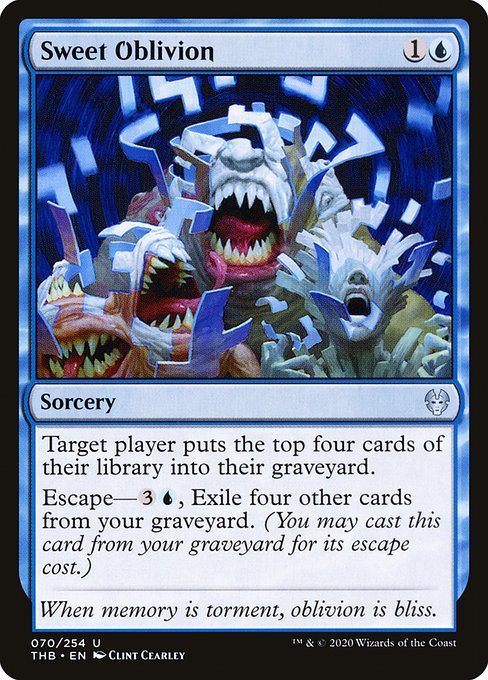
Sweet Oblivion
Sorcery
uncommon
Target player mills four cards. Escape—, Exile four other cards from your graveyard. (You may cast this card from your graveyard for its escape cost.)
 Card Kingdom
 Cardmarket
Semantic Tags
Exiles cards from graveyards or prevents graveyard interaction. Shuts down recursion, flashback, and graveyard-matters strategies.
Cares about cards in the graveyard, puts cards into the graveyard, or benefits from things dying.
Returns cards from the graveyard to your hand, the battlefield, or the top of your library.
To mill a number of cards, a player puts that many cards from the top of their library into their graveyard. See rule 701.17.
To mill a number of cards, a player puts that many cards from the top of their library into their graveyard. See rule 701.17.
An effect that puts cards from your own library into your graveyard for value.
An effect that puts cards from your own library into your graveyard for value.
Format Legality
Price history
Loading price history…
Printings (1)
| Set | Rarity | TCGplayer | Card Kingdom | Cardmarket |
|---|---|---|---|---|
| Theros Beyond Death#70 | uncommon | · | · | · |
Related Concepts
Related Rules
While applying a replacement effect that modifies how a permanent enters the battlefield, another replacement effect may cause a player to mill cards or exile cards from the top of a library. In that case, any card that is entering the battlefield from that library won’t be included in that effect, even though those cards are in the library as the effect is applied.
Mill
For a player to mill a number of cards, that player puts that many cards from the top of their library into their graveyard.
A player can’t mill a number of cards greater than the number of cards in their library. If given the choice to do so, they can’t choose to take that action. If instructed to do so, they mill as many as possible. Similarly, the player can’t pay a cost that includes milling a number of cards greater than the number of cards in their library.
Dredge is a static ability that functions only while the card with dredge is in a player’s graveyard. “Dredge N” means “As long as you have at least N cards in your library, if you would draw a card, you may instead mill N cards and return this card from your graveyard to your hand.”
A player with fewer cards in their library than the number required by a dredge ability can’t mill any of them this way.
Escape
Escape represents a static ability that functions while the card with escape is in a player’s graveyard. “Escape [cost]” means “You may cast this card from your graveyard by paying [cost] rather than paying its mana cost.” Casting a spell using its escape ability follows the rules for paying alternative costs in rules 601.2b and 601.2f–h.
Rulings
Once you begin casting a spell with escape, it immediately moves to the stack. Players can't take any other actions until you're done casting the spell.
To determine the total cost of a spell, start with the mana cost or alternative cost you're paying (such as an escape cost), add any cost increases, then apply any cost reductions. The mana value of the spell remains unchanged, no matter what the total cost to cast it was and no matter whether an alternative cost was paid.
If you cast a spell with its escape permission, you can't choose to apply any other alternative costs or to cast it without paying its mana cost. If it has any additional costs, you must pay those.
Escape's permission doesn't change when you may cast the spell from your graveyard.
If a card has multiple abilities giving you permission to cast it, such as two escape abilities or an escape ability and a flashback ability, you choose which one to apply. The others have no effect.
If a card with escape is put into your graveyard during your turn, you'll be able to cast it right away if it's legal to do so, before an opponent can take any actions.
After an escaped spell resolves, it returns to its owner's graveyard if it's not a permanent spell. If it is a permanent spell, it enters the battlefield and will return to its owner's graveyard if it dies later. Perhaps it will escape again—good underworld security is so hard to come by these days.