Search
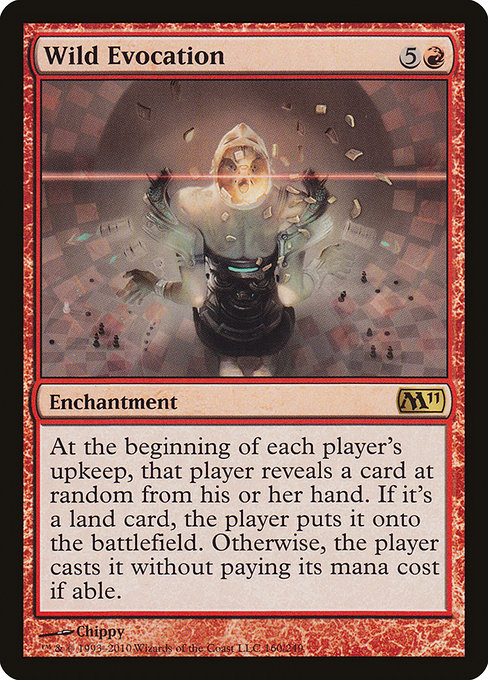
Wild Evocation
Enchantment
rare
At the beginning of each player's upkeep, that player reveals a card at random from their hand. If it's a land card, the player puts it onto the battlefield. Otherwise, the player casts it without paying its mana cost if able.
 Card Kingdom
 Cardmarket
Semantic Tags
Random, chaotic, or coin-flip effects that create unpredictable game states.
A card that makes a strategy possible or consistent without being the payoff itself.
Rewards controlling, casting, or interacting with enchantments.
Monarch mechanic — becoming and keeping the monarch for card advantage.
A card or token on the battlefield. See rule 110, “Permanents.”
A card or token on the battlefield. See rule 110, “Permanents.”
Rewards casting instants and sorceries. Includes magecraft, prowess triggers, and spell-count payoffs.
Makes all players discard their hand and draw a new one. Named after Wheel of Fortune.
Format Legality
Price history
Loading price history…
Printings (1)
| Set | Rarity | TCGplayer | Card Kingdom | Cardmarket |
|---|---|---|---|---|
| Magic 2011#160 | rare | · | · | · |
Related Rules
If an ability would produce one or more mana of an undefined type, it produces no mana instead.
Some abilities produce mana based on the type of mana another permanent or permanents “could produce.” The type of mana a permanent could produce at any time includes any type of mana that an ability of that permanent would produce if the ability were to resolve at that time, taking into account any applicable replacement effects in any possible order. Ignore whether any costs of the ability could or could not be paid. If that permanent wouldn’t produce any mana under these conditions, or no type of mana can be defined this way, there’s no type of mana it could produce.
To “tap [a permanent] for mana” is to activate a mana ability of that permanent that includes the {T} symbol in its activation cost. See rule 605, “Mana Abilities.”
An ability that triggers whenever a permanent “is tapped for mana” or is tapped for mana of a specified type triggers whenever such a mana ability resolves and produces mana or the specified type of mana.
A replacement effect that applies if a permanent “is tapped for mana” or tapped for mana of a specific type and/or amount modifies the mana production event while such an ability is resolving and producing mana or the specified type and/or amount of mana.
If an object’s enters-the-battlefield triggered ability or replacement effect refers to X, and the spell that became that object as it resolved had a value of X chosen for any of its costs, the value of X for that ability is the same as the value of X for that spell, although the value of X for that permanent is 0. This is an exception to rule 107.3i.
The tap symbol is {T}. The tap symbol in an activation cost means “Tap this permanent.” A permanent that’s already tapped can’t be tapped again to pay the cost. A creature’s activated ability with the tap symbol in its activation cost can’t be activated unless the creature has been under its controller’s control continuously since their most recent turn began. See rule 302.6.
The untap symbol is {Q}. The untap symbol in an activation cost means “Untap this permanent.” A permanent that’s already untapped can’t be untapped again to pay the cost. A creature’s activated ability with the untap symbol in its activation cost can’t be activated unless the creature has been under its controller’s control continuously since their most recent turn began. See rule 302.6.
Rulings
If casting the revealed card involves paying a mandatory additional cost (such as the one Fling has), the player casting that card must pay that cost if able. If they can't, the card remains uncast in their hand. If the mandatory additional cost includes a mana payment, the situation is more complex. If the player has enough unspent mana to pay the cost, that player must do so. If the player can't possibly pay the cost, the card remains uncast in their hand. However, if the player has the means to produce enough mana to pay the cost, then they have a choice: The player may cast the card, produce mana, and pay the cost. Or the player may choose to activate no mana abilities, thus making the card impossible to cast because the additional mana can't be paid.
If a player reveals a nonland card, but can't cast it due to a lack of legal targets or a play restriction, it simply remains in their hand.
If a player casts a nonland card revealed with Wild Evocation's ability, it's put on the stack as a spell, then Wild Evocation's ability finishes resolving. The spell will then resolve as normal, after players get a chance to cast spells and activate abilities.
If, as the result of Wild Evocation's ability, a player casts a card "without paying its mana cost," any X in the mana cost will be 0, and that player can't pay any alternative costs (such as Demon of Death's Gate's alternative cost). On the other hand, if the card has optional additional costs (such as kicker or multikicker), the player may pay those.
If a player reveals a nonland card, that player must cast that card if it's possible to do so, even if they don't want to. The player casts it as part of the resolution of Wild Evocation's ability. Timing restrictions based on the card's type (such as creature or sorcery) are ignored. Other play restrictions are not (such as "Cast [this card] only during combat").