Search
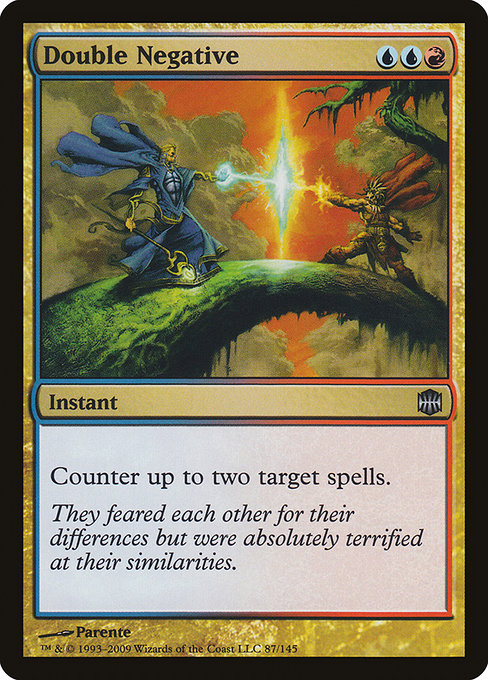
Double Negative
Instant
uncommon
Counter up to two target spells.
 Card Kingdom
 Cardmarket
Semantic Tags
Prevents a spell or ability from resolving.
A keyword ability that allows a spell to affect either a single target or many objects. See rule 702.96, “Overload.”
Tax or prevent spellcasting — Rule of Law, Thalia, Sphere of Resistance.
A triggered ability that can counter spells or abilities that target the permanent with ward. See rule 702.21, “Ward.”
Format Legality
Price history
Loading price history…
Printings (1)
| Set | Rarity | TCGplayer | Card Kingdom | Cardmarket |
|---|---|---|---|---|
| Alara Reborn#87 | uncommon | · | · | · |
Related Rules
A Royal Role token is a colorless Aura Role enchantment token named Royal with enchant creature and “Enchanted creature gets +1/+1 and has ward {1}.”
One card (Golgothian Sylex) refers to permanents with a name originally printed in the Antiquities™ expansion. Those names are Amulet of Kroog, Argivian Archaeologist, Argivian Blacksmith, Argothian Pixies, Argothian Treefolk, Armageddon Clock, Artifact Blast, Artifact Possession, Artifact Ward, Ashnod’s Altar, Ashnod’s Battle Gear, Ashnod’s Transmogrant, Atog, Battering Ram, Bronze Tablet, Candelabra of Tawnos, Circle of Protection: Artifacts, Citanul Druid, Clay Statue, Clockwork Avian, Colossus of Sardia, Coral Helm, Crumble, Cursed Rack, Damping Field, Detonate, Drafna’s Restoration, Dragon Engine, Dwarven Weaponsmith, Energy Flux, Feldon’s Cane, Gaea’s Avenger, Gate to Phyrexia, Goblin Artisans, Golgothian Sylex, Grapeshot Catapult, Haunting Wind, Hurkyl’s Recall, Ivory Tower, Jalum Tome, Martyrs of Korlis, Mightstone, Millstone, Mishra’s Factory, Mishra’s War Machine, Mishra’s Workshop, Obelisk of Undoing, Onulet, Orcish Mechanics, Ornithopter, Phyrexian Gremlins, Power Artifact, Powerleech, Priest of Yawgmoth, Primal Clay, The Rack, Rakalite, Reconstruction, Reverse Polarity, Rocket Launcher, Sage of Lat-Nam, Shapeshifter, Shatterstorm, Staff of Zegon, Strip Mine, Su-Chi, Tablet of Epityr, Tawnos’s Coffin, Tawnos’s Wand, Tawnos’s Weaponry, Tetravus, Titania’s Song, Transmute Artifact, Triskelion, Urza’s Avenger, Urza’s Chalice, Urza’s Mine, Urza’s Miter, Urza’s Power Plant, Urza’s Tower, Wall of Spears, Weakstone, Xenic Poltergeist, Yawgmoth Demon, and Yotian Soldier.
To cloak a card, turn it face down. It becomes a 2/2 face-down creature card with ward {2}, no name, no subtypes, and no mana cost. Put that card onto the battlefield face down. That permanent is a cloaked permanent for as long as it remains face down. The effect defining its characteristics works while the card is face down and ends when it’s turned face up.
Ward
Ward is a triggered ability. Ward [cost] means “Whenever this permanent becomes the target of a spell or ability an opponent controls, counter that spell or ability unless that player pays [cost].”
Some ward abilities include an X in their cost and state what X is equal to. This value is determined at the time the ability resolves, not locked in as the ability triggers.
Overload
Overload is a keyword that represents two static abilities that function while the spell with overload is on the stack. Overload [cost] means “You may choose to pay [cost] rather than pay this spell’s mana cost” and “If you chose to pay this spell’s overload cost, change its text by replacing all instances of the word ‘target’ with the word ‘each.’” Casting a spell using its overload ability follows the rules for paying alternative costs in rules 601.2b and 601.2f–h.
Rulings
You may cast Double Negative with no targets, one target, or two targets.
It’s unusual for a player to cast a spell in response to their own spell, and that will be specifically called out when it happens. Under normal circumstances, if a player casts a spell, it is assumed that the player passes priority afterward. If that player casts another spell, it is assumed that each other player has also passed priority, which caused the first spell to resolve and the first player to receive priority again. Unless the first player says otherwise, only one spell will be on the stack at a time in that scenario.
In order to counter two target spells, both of those spells must be on the stack at the time you cast Double Negative. Two spells can be on the stack at the same time as the result of an ability (such as cascade or replicate), as the result of a copy effect (such as the one from Cloven Casting or Twincast), or because a spell has been cast in response to another spell.