Search
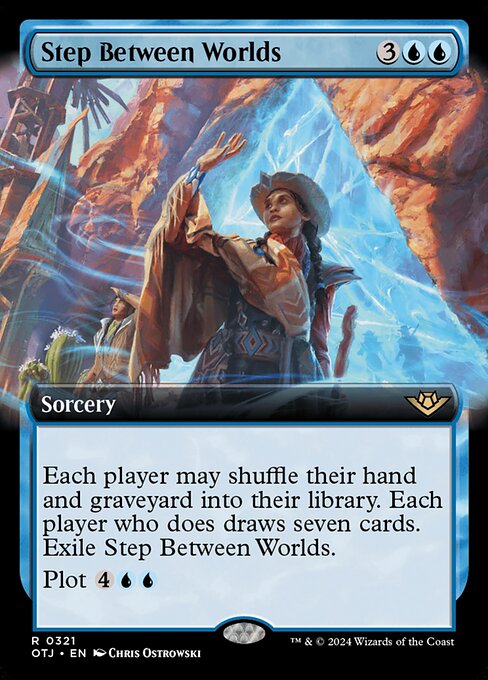
Step Between Worlds
Sorcery
rare
Each player may shuffle their hand and graveyard into their library. Each player who does draws seven cards. Exile Step Between Worlds. Plot (You may pay and exile this card from your hand. Cast it as a sorcery on a later turn without paying its mana cost. Plot only as a sorcery.)
 Card Kingdom
 Cardmarket
Semantic Tags
Puts additional cards into your hand. Includes direct draw, 'look/reveal and put into hand' effects, and conditional draw triggers.
Benefits all players or gives opponents choices/resources. Political strategy.
Makes all players discard their hand and draw a new one. Named after Wheel of Fortune.
Format Legality
Price history
Loading price history…
Printings (4)
| Set | Rarity | TCGplayer | Card Kingdom | Cardmarket |
|---|---|---|---|---|
| Outlaws of Thunder Junction#321 | rare | · | · | · |
| Outlaws of Thunder Junction Promos#70s | rare | · | · | · |
| Outlaws of Thunder Junction Promos#70p | rare | · | · | · |
| Outlaws of Thunder Junction#70 | rare | · | · | · |
Related Concepts
Related Rules
A player who has a card with plot in their hand may exile that card. This is a special action. A player can take this action any time they have priority during their own turn while the stack is empty. See rule 702.170, “Plot.”
Plot
Plot is a keyword ability that functions while the card with plot is in a player’s hand. “Plot [cost]” means “Any time you have priority during your main phase while the stack is empty, you may exile this card from your hand and pay [cost]. It becomes a plotted card.”
Exiling a card using its plot ability is a special action, which doesn’t use the stack. See rule 116, “Special Actions.”
In addition to the plot special action, some spells and abilities cause a card in exile to become plotted.
A plotted card’s owner may cast it from exile without paying its mana cost during their main phase while the stack is empty during any turn after the turn in which it became plotted. Casting a spell this way follows the rules for paying alternative costs in rules 601.2b and 601.2f–h. A plotted card may be cast this way even if it doesn’t have the plot ability while in exile.
If an effect refers to plotting a card, it means performing the special action associated with a plot ability.
An effect may allow the plot ability of a card to function in a zone other than a player’s hand. In that case, the card is exiled from the zone it is in as the action is taken rather than from its owner’s hand.
Rulings
If a plotted card has {X} in its mana cost, you must choose 0 as the value of X when casting it without paying its mana cost.
Plot abilities are written “Plot [cost],” which means “Any time you have priority during your main phase while the stack is empty, you may pay [cost] and exile this card from your hand. It becomes plotted.”
A player whose hand and/or graveyard contain no cards can still choose to shuffle their hand and graveyard into their library. If they do, they’ll still draw seven cards.
You can’t cast a plotted card on the same turn it became plotted. On any future turn, you may cast that card from exile without paying its mana cost during your main phase while the stack is empty.
If you’re casting a plotted card from exile without paying its mana cost, you can’t choose to cast it for any other alternative costs. You can, however, pay additional costs, such as kicker costs. If the plotted card has any mandatory additional costs, those must still be paid to cast the spell.
Players decide and announce in turn order, starting with the active player, whether they want to shuffle their hand and graveyard into their library. Then, all players who chose to do so shuffle their hands and graveyards into their libraries and draw seven cards. Players later in the turn order will know the choices made by players before them.
Exiling a card using its plot ability is a special action. Once you announce you’re taking that action, no other player can respond by trying to remove that card from your hand.