Search
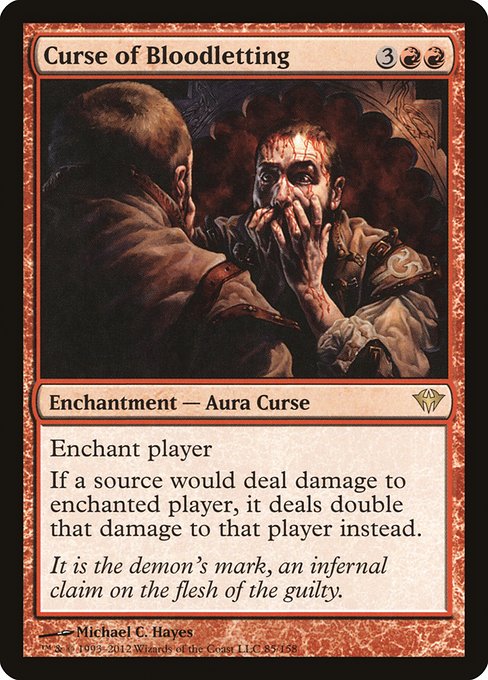
Curse of Bloodletting
Enchantment — Aura Curse
rare
Enchant player If a source would deal damage to enchanted player, it deals double that damage to that player instead.
 Card Kingdom
 Cardmarket
Semantic Tags
A card or token on the battlefield. See rule 110, “Permanents.”
Format Legality
Price history
Loading price history…
Printings (1)
| Set | Rarity | TCGplayer | Card Kingdom | Cardmarket |
|---|---|---|---|---|
| Dark Ascension#85 | rare | · | · | · |
Related Concepts
Related Rules
If an ability would produce one or more mana of an undefined type, it produces no mana instead.
Some spells or abilities that produce mana restrict how that mana can be spent, have an additional effect that affects the spell or ability that mana is spent on, or create a delayed triggered ability (see rule 603.7a) that triggers when that mana is spent. This doesn’t affect the mana’s type.
Some abilities produce mana based on the type of mana another permanent or permanents “could produce.” The type of mana a permanent could produce at any time includes any type of mana that an ability of that permanent would produce if the ability were to resolve at that time, taking into account any applicable replacement effects in any possible order. Ignore whether any costs of the ability could or could not be paid. If that permanent wouldn’t produce any mana under these conditions, or no type of mana can be defined this way, there’s no type of mana it could produce.
To “tap [a permanent] for mana” is to activate a mana ability of that permanent that includes the {T} symbol in its activation cost. See rule 605, “Mana Abilities.”
An ability that triggers whenever a permanent “is tapped for mana” or is tapped for mana of a specified type triggers whenever such a mana ability resolves and produces mana or the specified type of mana.
A replacement effect that applies if a permanent “is tapped for mana” or tapped for mana of a specific type and/or amount modifies the mana production event while such an ability is resolving and producing mana or the specified type and/or amount of mana.
If an object’s enters-the-battlefield triggered ability or replacement effect refers to X, and the spell that became that object as it resolved had a value of X chosen for any of its costs, the value of X for that ability is the same as the value of X for that spell, although the value of X for that permanent is 0. This is an exception to rule 107.3i.
The tap symbol is {T}. The tap symbol in an activation cost means “Tap this permanent.” A permanent that’s already tapped can’t be tapped again to pay the cost. A creature’s activated ability with the tap symbol in its activation cost can’t be activated unless the creature has been under its controller’s control continuously since their most recent turn began. See rule 302.6.
Rulings
If multiple effects modify how damage will be dealt to the enchanted player, that player chooses the order to apply the effects. For example, Mending Hands says, “Prevent the next 4 damage that would be dealt to any target this turn.” Suppose a spell would deal 5 damage to enchanted player and that player has cast Mending Hands targeting themselves. The enchanted player can either (a) prevent 4 damage first and then let Curse of Bloodletting’s effect double the remaining 1 damage, taking 2 damage, or (b) double the damage to 10 and then prevent 4 damage, taking 6 damage.
The source of the damage doesn’t change. A spell that deals damage will specify the source of the damage, often the spell itself. An ability that deals damage will also specify the source of the damage, although the ability itself will never be that source. Often the source of the ability is also the source of the damage.
Curse of Bloodletting works with any damage, not just combat damage. It also doesn’t matter who controls the source of the damage that’s being dealt.
If more than one Curse of Bloodletting enchants the same player, damage dealt to that player will double for each one (two of them will end up multiplying the damage by four, three of them by eight, and four of them by sixteen).