Search
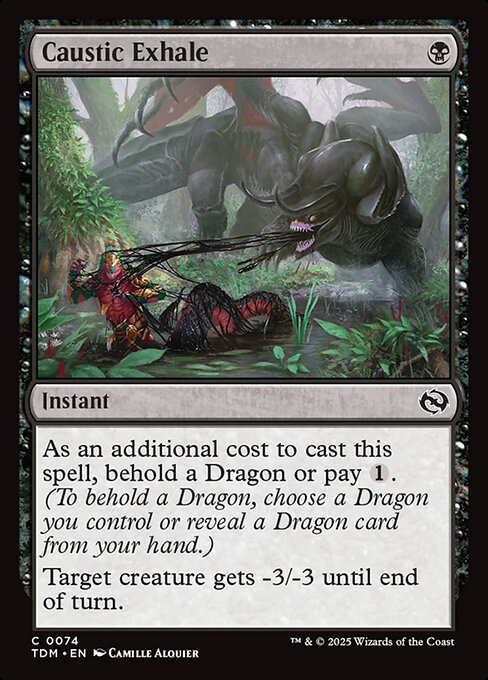
Caustic Exhale
Instant
common
As an additional cost to cast this spell, behold a Dragon or pay . (To behold a Dragon, choose a Dragon you control or reveal a Dragon card from your hand.) Target creature gets -3/-3 until end of turn.
 Card Kingdom
 Cardmarket
Semantic Tags
Specifically removes creatures — destroy, exile, damage, or -X/-X.
A keyword ability found on creature cards that allows them to be cast for an alternative cost. See rule 702.109, “Dash.”
Answers an opponent's threat by destroying, exiling, bouncing, or otherwise removing a permanent or spell.
Format Legality
Price history
Loading price history…
Printings (1)
| Set | Rarity | TCGplayer | Card Kingdom | Cardmarket |
|---|---|---|---|---|
| Tarkir: Dragonstorm#74 | common | · | · | · |
Related Concepts
Related Rules
Subtypes of each card type except creature and plane are always single words and are listed after a long dash. Each word after the dash is a separate subtype. Subtypes of creature cards are one or two words and are listed after a long dash. Each word or two-word phrase, as listed in rule 205.3m, is a separate subtype. Objects other than planes may have multiple subtypes. Subtypes of planes are also listed after a long dash, but may be multiple words; all words after the dash are, collectively, a single subtype.
Artifact subtypes are always a single word and are listed after a long dash: “Artifact — Equipment.” Artifact subtypes are also called artifact types. Artifacts may have multiple subtypes. See rule 205.3g for the complete list of artifact types.
Creature subtypes are usually a single word long and are listed after a long dash: “Creature — Human Soldier,” “Artifact Creature — Golem,” and so on. Creature subtypes are also called creature types. Creatures may have multiple subtypes. See rule 205.3m for the complete list of creature types.
Enchantment subtypes are always a single word and are listed after a long dash: “Enchantment — Shrine.” Each word after the dash is a separate subtype. Enchantment subtypes are also called enchantment types. Enchantments may have multiple subtypes. See rule 205.3h for the complete list of enchantment types.
Instant subtypes are always a single word and are listed after a long dash: “Instant — Arcane.” Each word after the dash is a separate subtype. The set of instant subtypes is the same as the set of sorcery subtypes; these subtypes are called spell types. Instants may have multiple subtypes. See rule 205.3k for the complete list of spell types.
Land subtypes are always a single word and are listed after a long dash. Land subtypes are also called land types. Lands may have multiple subtypes. See rule 205.3i for the complete list of land types.
Planeswalker subtypes are always a single word and are listed after a long dash: “Planeswalker — Jace.” Each word after the dash is a separate subtype. Planeswalker subtypes are also called planeswalker types. Planeswalkers may have multiple subtypes. See rule 205.3j for the complete list of planeswalker types.
Sorcery subtypes are always a single word and are listed after a long dash: “Sorcery — Arcane.” Each word after the dash is a separate subtype. The set of sorcery subtypes is the same as the set of instant subtypes; these subtypes are called spell types. Sorceries may have multiple subtypes. See rule 205.3k for the complete list of spell types.
Rulings
If a cost to cast a spell includes revealing a card, that card remains revealed from the time the spell is announced until the time it leaves the stack.
If an effect refers to a “[subtype] card,” it refers only to a card that has that subtype. For example, Teeming Dragonstorm is a card that cares about Dragons and features Dragons in its art, but it isn’t a Dragon card.
Effects that say “If a [quality] was beheld” only care if a card of that quality was revealed or a permanent you control of that quality was chosen. No matter what happens to that card or permanent after that, it was still beheld, and any additional effects that depend on that card or permanent being beheld will still happen.
If a card in your hand is already revealed (perhaps because it was revealed to pay a cost of a spell that’s still on the stack or due to the effect of a card like Telepathy), you may reveal it again to pay the cost of another spell or ability that requires you to reveal a card from your hand.