Search
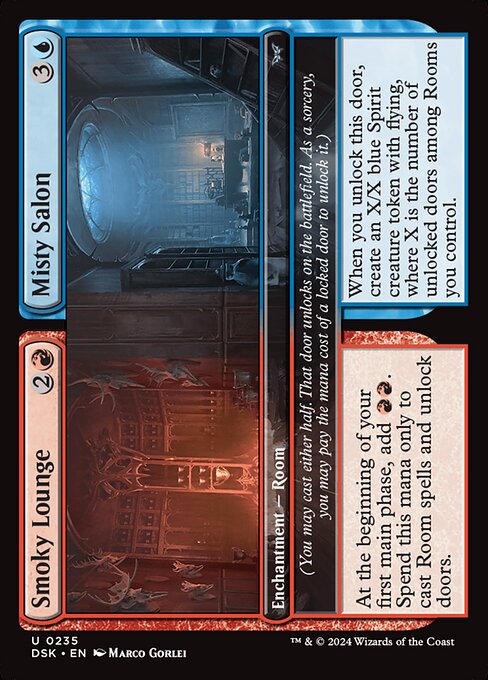
Smoky Lounge // Misty Salon
Enchantment — Room // Enchantment — Room
uncommon
Smoky Lounge
Enchantment — Room
At the beginning of your first main phase, add . Spend this mana only to cast Room spells and unlock doors. (You may cast either half. That door unlocks on the battlefield. As a sorcery, you may pay the mana cost of a locked door to unlock it.)
Misty Salon
Enchantment — Room
When you unlock this door, create an X/X blue Spirit creature token with flying, where X is the number of unlocked doors among Rooms you control. (You may cast either half. That door unlocks on the battlefield. As a sorcery, you may pay the mana cost of a locked door to unlock it.)
 Card Kingdom
 Cardmarket
Semantic Tags
Rewards controlling, casting, or interacting with enchantments.
A card or token on the battlefield. See rule 110, “Permanents.”
Format Legality
Price history
Loading price history…
Printings (1)
| Set | Rarity | TCGplayer | Card Kingdom | Cardmarket |
|---|---|---|---|---|
| Duskmourn: House of Horror#235 | uncommon | · | · | · |
Related Rules
If an ability would produce one or more mana of an undefined type, it produces no mana instead.
Some abilities produce mana based on the type of mana another permanent or permanents “could produce.” The type of mana a permanent could produce at any time includes any type of mana that an ability of that permanent would produce if the ability were to resolve at that time, taking into account any applicable replacement effects in any possible order. Ignore whether any costs of the ability could or could not be paid. If that permanent wouldn’t produce any mana under these conditions, or no type of mana can be defined this way, there’s no type of mana it could produce.
To “tap [a permanent] for mana” is to activate a mana ability of that permanent that includes the {T} symbol in its activation cost. See rule 605, “Mana Abilities.”
An ability that triggers whenever a permanent “is tapped for mana” or is tapped for mana of a specified type triggers whenever such a mana ability resolves and produces mana or the specified type of mana.
A replacement effect that applies if a permanent “is tapped for mana” or tapped for mana of a specific type and/or amount modifies the mana production event while such an ability is resolving and producing mana or the specified type and/or amount of mana.
If an object’s enters-the-battlefield triggered ability or replacement effect refers to X, and the spell that became that object as it resolved had a value of X chosen for any of its costs, the value of X for that ability is the same as the value of X for that spell, although the value of X for that permanent is 0. This is an exception to rule 107.3i.
The tap symbol is {T}. The tap symbol in an activation cost means “Tap this permanent.” A permanent that’s already tapped can’t be tapped again to pay the cost. A creature’s activated ability with the tap symbol in its activation cost can’t be activated unless the creature has been under its controller’s control continuously since their most recent turn began. See rule 302.6.
The untap symbol is {Q}. The untap symbol in an activation cost means “Untap this permanent.” A permanent that’s already untapped can’t be untapped again to pay the cost. A creature’s activated ability with the untap symbol in its activation cost can’t be activated unless the creature has been under its controller’s control continuously since their most recent turn began. See rule 302.6.
Rulings
Each Room card is a single card. For example, if you discard a Room card, you've discarded one card, not two. If an effect counts the number of enchantment cards in your graveyard, Bottomless Pool // Locker Room counts once, not twice.
Some abilities allow you to unlock a door of a Room you control. You can't choose to unlock a door that's already unlocked with such an ability. If such an ability requires a target, you can target a Room even if both of its doors are unlocked, but the ability won't do anything when it resolves.
An ability that triggers "when you unlock this door" triggers when that door becomes unlocked. This can happen one of two ways: (1) the door becomes unlocked on the battlefield or (2) the door becomes unlocked as the Room enters the battlefield because you cast the corresponding half. In the latter case, since the door becoming unlocked is what causes the ability to trigger, effects that cause abilities that trigger when a permanent enters to trigger an additional time (such as that of Panharmonicon) won't apply.
If an effect allows you to cast a spell with certain characteristics, consider only the characteristics of the door you're casting. For example, if an effect allows you to cast a permanent spell with mana value 3 or less from among cards in your graveyard, you could cast Bottomless Pool this way, but not Locker Room.
Each Room card has two names. If an effect instructs you to choose a card name, you may choose one of those names, but not both.
To cast a Room spell, choose a half (or "door") to cast. There's no way to cast both halves of a Room card. When the Room spell resolves, the corresponding door becomes unlocked as the Room enters.
An ability that triggers "whenever you fully unlock a Room" triggers when a door becomes unlocked and the other door of that Room is already unlocked, or when both doors of that Room become unlocked simultaneously.
While on the battlefield, a Room's characteristics are a combination of the characteristics of its unlocked doors. For example, if Bottomless Pool // Locker Room is on the battlefield with both doors unlocked, its names are Bottomless Pool and Locker Room, its mana value is 6, it's a Room Enchantment, and it has the abilities in each door's text box.
If a spell or ability would create a copy of a Room spell on the stack, the copy retains the choice of which door was cast but also retains the full characteristics of the spell. The characteristics of the door that wasn't cast are still ignored while the copy is on the stack, and when the copy resolves, the token it becomes will enter with the appropriate door unlocked.
Some abilities allow you to lock a door of a Room you control. You can't choose to lock a door that's already locked with such an ability. If such an ability requires a target, you can target a Room even if both of its doors are locked, but the ability won't do anything when it resolves.
While in any zone other than the stack or the battlefield, a Room card's characteristics are a combination of its two doors. For example, Bottomless Pool // Locker Room has a mana value of 6 while it's in your library. If an effect allows you to search your library for a card with mana value 4 or less, you can't find Bottomless Pool // Locker Room.
Any time you have priority during a main phase of your turn and the stack is empty, you may pay the mana cost of a locked door (also called its "unlock cost"). That door becomes unlocked. This is a special action. It doesn't use the stack and can't be responded to.
If neither door of a Room is unlocked, it's a Room enchantment with no name and no abilities.
The value of X is calculated only once, as Misty Salon's ability resolves. Changes in the number of unlocked doors among Rooms you control that occur after the ability resolves won't affect the power or toughness of the token.
If a Room enters from any zone other than the stack, it will enter with both halves locked.
Some doors have abilities that trigger whenever you unlock that door and require one or more targets. You can unlock that door even if there would be insufficient legal targets for that triggered ability. The triggered ability won't go on the stack.
Room cards have two card faces with a shared type line on a single card. The characteristics of the door you didn't cast are ignored while the spell is on the stack.