Search
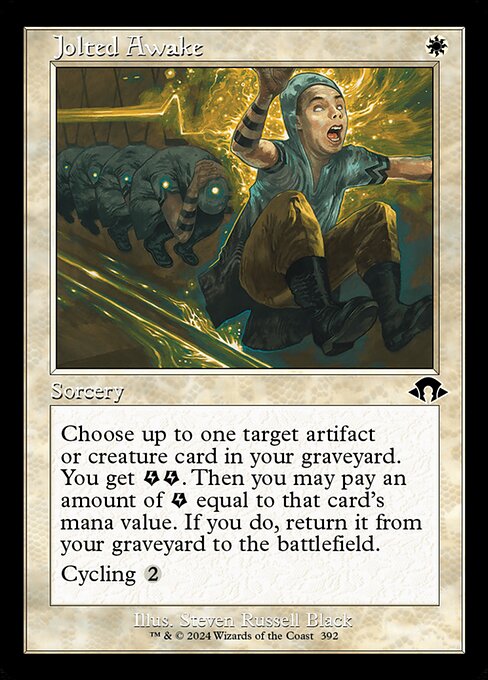
Jolted Awake
Sorcery
common
Choose up to one target artifact or creature card in your graveyard. You get (two energy counters). Then you may pay an amount of equal to that card's mana value. If you do, return it from your graveyard to the battlefield. Cycling (, Discard this card: Draw a card.)
 Card Kingdom
 Cardmarket
Semantic Tags
A spell that replaces itself by drawing a card as part of its resolution.
Puts additional cards into your hand. Includes direct draw, 'look/reveal and put into hand' effects, and conditional draw triggers.
A keyword ability that lets a card be discarded and replaced with a new card. See rule 702.29, “Cycling.”
A keyword ability that lets a card be discarded and replaced with a new card. See rule 702.29, “Cycling.”
Cycling-focused strategy — payoffs for cycling, cycling triggers, Astral Drift effects.
Uses the energy counter mechanic from Kaladesh and related sets.
Cares about cards in the graveyard, puts cards into the graveyard, or benefits from things dying.
Draw-then-discard or discard-then-draw effects that improve hand quality without net card advantage.
A permanent with a repeatable activated ability that converts excess mana into value.
Format Legality
Price history
Loading price history…
Printings (3)
| Set | Rarity | TCGplayer | Card Kingdom | Cardmarket |
|---|---|---|---|---|
| Modern Horizons 3#392 | common | · | · | · |
| Modern Horizons 3#509 | common | · | · | · |
| Modern Horizons 3#33 | common | · | · | · |
Related Concepts
Related Rules
Cycling
Cycling is an activated ability that functions only while the card with cycling is in a player’s hand. “Cycling [cost]” means “[Cost], Discard this card: Draw a card.”
Although the cycling ability can be activated only if the card is in a player’s hand, it continues to exist while the object is on the battlefield and in all other zones. Therefore objects with cycling will be affected by effects that depend on objects having one or more activated abilities.
Some cards with cycling have abilities that trigger when they’re cycled. “When you cycle this card” means “When you discard this card to pay an activation cost of a cycling ability.” These abilities trigger from whatever zone the card winds up in after it’s cycled.
Typecycling is a variant of the cycling ability. “[Type]cycling [cost]” means “[Cost], Discard this card: Search your library for a [type] card, reveal it, and put it into your hand. Then shuffle your library.” This type is usually a subtype (as in “mountaincycling”) but can be any card type, subtype, supertype, or combination thereof (as in “basic landcycling”).
Typecycling abilities are cycling abilities, and typecycling costs are cycling costs. Any cards that trigger when a player cycles a card will trigger when a card is discarded to pay an activation cost of a typecycling ability. Any effect that stops players from cycling cards will stop players from activating cards’ typecycling abilities. Any effect that increases or reduces a cycling cost will increase or reduce a typecycling cost. Any effect that looks for a card with cycling will find a card with typecycling.
Rulings
Energy counters aren't mana. They don't go away as steps, phases, and turns end, and effects that add mana "of any type" can't give you energy counters.
Energy counters are a kind of counter that a player may have. They're not associated with any specific permanents.
Some triggered abilities state that you "may pay" a certain amount of {E}. You can't pay that amount multiple times to multiply the effect. You simply choose whether or not to pay that amount of {E} as the ability resolves.
Keep track of how many energy counters each player has. Potential ways to track this include writing theme down on paper or using dice, but any method that is clear and mutually agreeable is fine. (At higher levels of tournament play, dice may not be allowed for tracking counters that players have.)
Some spells and abilities that give you {E} may require targets. If each target chosen is an illegal target as that spell or ability tries to resolve, it won't resolve. You won't get any {E}.
Some triggered abilities that state that you "may pay" a certain amount of {E} describe an effect that happens "If you do." In that case, no player may take actions to try to stop the ability's effect after you make your choice. If the payment is followed by the phrase "When you do," then you'll choose any targets for that reflexive triggered ability and put it on the stack before players can take actions.
If a spell or ability with one or more targets states that you "may pay" some amount of {E}, and each permanent that it targets has become an illegal target, the spell or ability won't resolve. You can't pay any {E} even if you want to.
If an effect says you get one or more {E}, you get that many energy counters. To pay one or more {E}, you lose that many energy counters. You can't pay more energy counters than you have. Any effects that interact with counters a player gets, has, or loses can interact with energy counters.
{E} is the energy symbol. It represents one energy counter.
If a card in your graveyard has {X} in its mana cost, X is 0 when determining its mana value.