Search
Displace
Instant
common
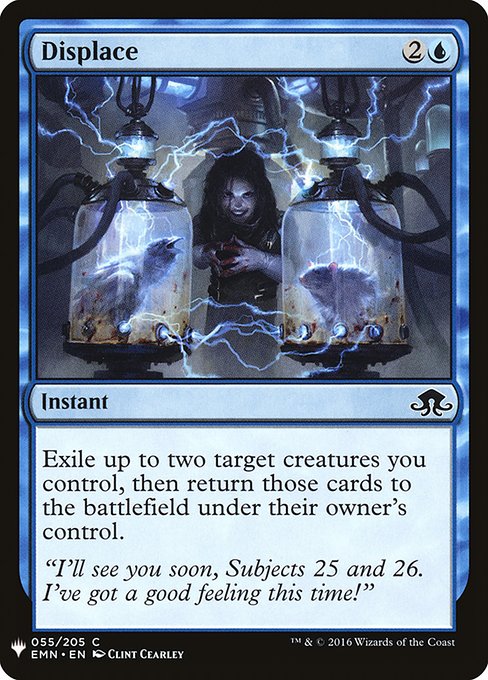
Exile up to two target creatures you control, then return those cards to the battlefield under their owner's control.
 Card Kingdom
 Cardmarket
Semantic Tags
Exiles a permanent and returns it to the battlefield — re-triggers ETB effects.
Exiles a permanent and returns it to the battlefield — re-triggers ETB effects.
A keyword ability that allows a player to cast a double-faced card transformed from the graveyard. See rule 702.146, “Disturb.”
A keyword ability that lets a creature deal its combat damage twice. See rule 702.4, “Double Strike.”
A keyword ability that lets a player cast a spell for less by sacrificing a creature. See rule 702.119, “Emerge.”
A keyword ability that lets a player play a card any time they could cast an instant. See rule 702.8, “Flash.”
Exiles and returns permanents for ETB reuse — distinct from blink by sometimes including end step return.
Exiles and returns permanents for ETB reuse — distinct from blink by sometimes including end step return.
Format Legality
Price history
Loading price history…
Printings (2)
| Set | Rarity | TCGplayer | Card Kingdom | Cardmarket |
|---|---|---|---|---|
| The List#EMN-55 | common | · | · | · |
| Eldritch Moon#55 | common | · | · | · |
Related Rules
A keyword counter on a permanent or on a card in a zone other than the battlefield causes that object to gain that keyword. The keywords that a keyword counter can be are flying, first strike, double strike, deathtouch, decayed, exalted, haste, hexproof, indestructible, lifelink, menace, reach, shadow, trample, and vigilance, as well as any variants of those keywords. See rule 613.1f.
The combat phase has five steps, which proceed in order: beginning of combat, declare attackers, declare blockers, combat damage, and end of combat. The declare blockers and combat damage steps are skipped if no creatures are declared as attackers or put onto the battlefield attacking (see rule 508.8). There are two combat damage steps if any attacking or blocking creature has first strike (see rule 702.7) or double strike (see rule 702.4).
If at least one attacking or blocking creature has first strike (see rule 702.7) or double strike (see rule 702.4) as the combat damage step begins, the only creatures that assign combat damage in that step are those with first strike or double strike. After that step, instead of proceeding to the end of combat step, the phase gets a second combat damage step. The only creatures that assign combat damage in that step are the remaining attackers and blockers that had neither first strike nor double strike as the first combat damage step began, as well as the remaining attackers and blockers that currently have double strike. After that step, the phase proceeds to the end of combat step.
If an effect allows a player to cast a spell with certain qualities as though it had flash, that player may consider any choices to be made during that spell’s proposal that may cause that spell’s qualities to change. If any such choices could cause that effect to apply, that player may begin to cast that spell as though it had flash.
If an effect allows a player to cast a spell as though it had flash only if an alternative or additional cost is paid, that player may begin to cast that spell as though it had flash.
If a spell would have flash only if certain conditions are met, its controller may begin to cast that spell as though it had flash if those conditions are met.
Once a player has begun casting a spell that had flash because certain conditions were met or that could be cast as though it had flash because certain conditions were met (see 601.3d), they may continue to cast that spell as though it had flash even if those conditions stop being met.
If two effects state that a player may (or a creature can) do the same thing “as though” different conditions were true, both conditions could apply. If one “as though” effect satisfies the requirements for another “as though” effect, then both effects will apply.
Rulings
After each creature returns to the battlefield, it will be a new object with no connection to the creature that was exiled. It won’t be in combat or have any additional abilities it may have had when it was exiled. Any counters on it cease to exist; Auras attached to it are put into their owner’s graveyards; and any Equipment will become unattached.
If a creature token is exiled this way, it will cease to exist and will not return to the battlefield.