Search
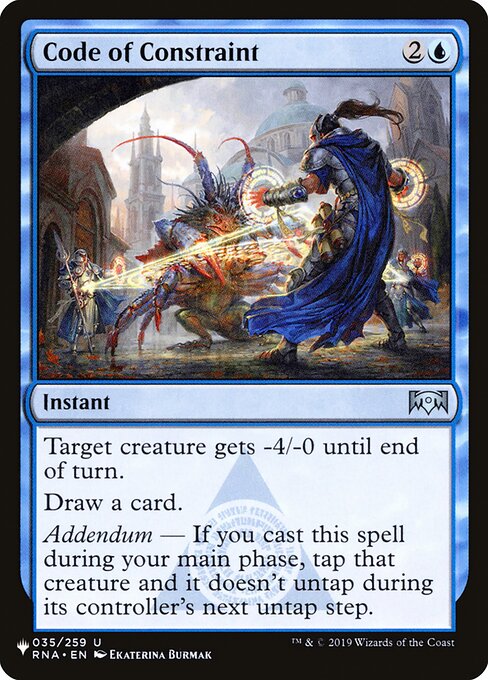
Code of Constraint
Instant
uncommon
Target creature gets -4/-0 until end of turn. Draw a card. Addendum — If you cast this spell during your main phase, tap that creature and it doesn't untap during its controller's next untap step.
 Card Kingdom
 Cardmarket
Semantic Tags
A spell that replaces itself by drawing a card as part of its resolution.
Puts additional cards into your hand. Includes direct draw, 'look/reveal and put into hand' effects, and conditional draw triggers.
Specifically removes creatures — destroy, exile, damage, or -X/-X.
Punishes or prevents opponents from drawing extra cards.
A keyword that lets a creature card be cast as a mutating creature spell. See rule 702.140, “Mutate.”
Answers an opponent's threat by destroying, exiling, bouncing, or otherwise removing a permanent or spell.
Format Legality
Price history
Loading price history…
Printings (3)
| Set | Rarity | TCGplayer | Card Kingdom | Cardmarket |
|---|---|---|---|---|
| The List#RNA-35 | uncommon | · | · | · |
| Ravnica: Clue Edition#83 | uncommon | · | · | · |
| Ravnica Allegiance#35 | uncommon | · | · | · |
Related Rules
Some keyword abilities, such as equip and modular, represent targeted activated or triggered abilities, and some keyword abilities, such as mutate, cause spells to have targets. In those cases, the phrase “target [something]” appears in the rule for that keyword ability rather than in the ability itself. (The keyword’s reminder text will often contain the word “target.”) See rule 702, “Keyword Abilities.”
Mutate
Mutate appears on some creature cards. It represents a static ability that functions while the spell with mutate is on the stack. “Mutate [cost]” means “You may pay [cost] rather than pay this spell’s mana cost. If you do, it becomes a mutating creature spell and targets a non-Human creature with the same owner as this spell.” Casting a spell using its mutate ability follows the rules for paying alternative costs (see 601.2b and 601.2f–h).
One keyword causes an object to merge with a permanent. See rule 702.140, “Mutate.”
Rulings
If the target creature is an illegal target by the time Code of Constraint tries to resolve, the spell doesn't resolve. You don't draw a card.
Code of Constraint can target a creature that's already tapped. If you cast it during your main phase, that creature won't untap during its controller's next untap step.
Addendum abilities of instant spells apply while the spell is resolving, not immediately after casting it. If the spell is countered, you don't get the addendum bonus.
If an effect copies a spell with an addendum ability while it's on the stack, the copy wasn't cast at all, so you won't get the addendum bonus.