Search
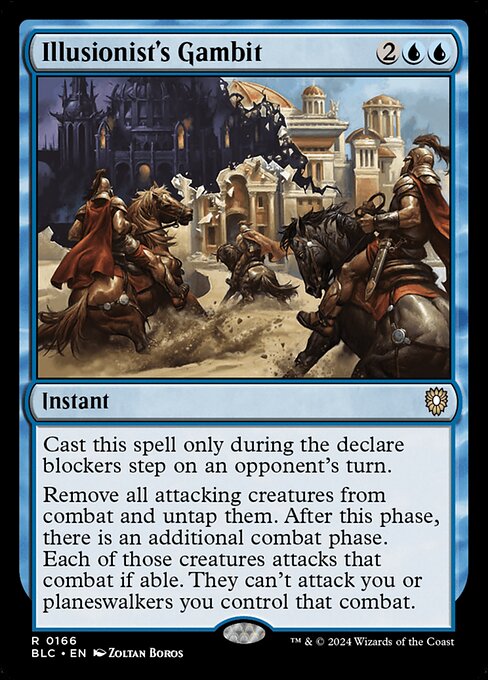
Illusionist's Gambit
Instant
rare
Cast this spell only during the declare blockers step on an opponent's turn. Remove all attacking creatures from combat and untap them. After this phase, there is an additional combat phase. Each of those creatures attacks that combat if able. They can't attack you or planeswalkers you control that combat.
 Card Kingdom
 Cardmarket
Semantic Tags
A keyword ability that can make a creature particularly brutal when it attacks. See rule 702.86, “Annihilator.”
Punishes or prevents creature-based strategies — makes creatures enter tapped, prevents attacking, taxes creatures.
A keyword ability found on creature cards that allows them to be cast for an alternative cost. See rule 702.109, “Dash.”
A keyword ability that prohibits a creature from attacking. See rule 702.3, “Defender.”
Suited for blocking and defense. Includes defender, reach, vigilance, and cards that incentivize blocking.
A keyword ability that can make a creature better in combat. See rule 702.83, “Exalted.”
Takes extra combat phases for additional attacks and triggers.
Takes extra combat phases for additional attacks and triggers.
A keyword ability that precludes a permanent or player from being targeted by an opponent. See rule 702.11, “Hexproof.”
An evasion ability that makes creatures unblockable by a single creature. See rule 702.111, “Menace.”
A keyword ability that lets a creature suddenly enter combat. See rule 702.49, “Ninjutsu.”
Discourages opponents from attacking you with taxes, penalties, and deterrents.
Slows opponents down by taxing actions or restricting what they can do.
Slows opponents down by taxing actions or restricting what they can do.
Format Legality
Price history
Loading price history…
Printings (3)
| Set | Rarity | TCGplayer | Card Kingdom | Cardmarket |
|---|---|---|---|---|
| Bloomburrow Commander#166 | rare | · | · | · |
| Wilds of Eldraine Commander#97 | rare | · | · | · |
| Commander 2013#47 | rare | · | · | · |
Related Rules
A keyword counter on a permanent or on a card in a zone other than the battlefield causes that object to gain that keyword. The keywords that a keyword counter can be are flying, first strike, double strike, deathtouch, decayed, exalted, haste, hexproof, indestructible, lifelink, menace, reach, shadow, trample, and vigilance, as well as any variants of those keywords. See rule 613.1f.
Subtypes of each card type except creature and plane are always single words and are listed after a long dash. Each word after the dash is a separate subtype. Subtypes of creature cards are one or two words and are listed after a long dash. Each word or two-word phrase, as listed in rule 205.3m, is a separate subtype. Objects other than planes may have multiple subtypes. Subtypes of planes are also listed after a long dash, but may be multiple words; all words after the dash are, collectively, a single subtype.
Artifact subtypes are always a single word and are listed after a long dash: “Artifact — Equipment.” Artifact subtypes are also called artifact types. Artifacts may have multiple subtypes. See rule 205.3g for the complete list of artifact types.
Creature subtypes are usually a single word long and are listed after a long dash: “Creature — Human Soldier,” “Artifact Creature — Golem,” and so on. Creature subtypes are also called creature types. Creatures may have multiple subtypes. See rule 205.3m for the complete list of creature types.
Enchantment subtypes are always a single word and are listed after a long dash: “Enchantment — Shrine.” Each word after the dash is a separate subtype. Enchantment subtypes are also called enchantment types. Enchantments may have multiple subtypes. See rule 205.3h for the complete list of enchantment types.
Instant subtypes are always a single word and are listed after a long dash: “Instant — Arcane.” Each word after the dash is a separate subtype. The set of instant subtypes is the same as the set of sorcery subtypes; these subtypes are called spell types. Instants may have multiple subtypes. See rule 205.3k for the complete list of spell types.
Land subtypes are always a single word and are listed after a long dash. Land subtypes are also called land types. Lands may have multiple subtypes. See rule 205.3i for the complete list of land types.
Planeswalker subtypes are always a single word and are listed after a long dash: “Planeswalker — Jace.” Each word after the dash is a separate subtype. Planeswalker subtypes are also called planeswalker types. Planeswalkers may have multiple subtypes. See rule 205.3j for the complete list of planeswalker types.
Rulings
If there's a cost associated with having a creature attack, the player isn't forced to pay that cost, so it doesn't have to attack.
Creatures that didn't attack during the combat phase when Illusionist's Gambit resolved aren't required to attack in the additional combat phase, although they may. Those creatures can attack you or a planeswalker you control.
If, during a player's declare attackers step, a creature is tapped, is affected by a spell or ability that says it can't attack, or hasn't been under that player's control continuously since the turn began (and doesn't have haste), then it doesn't attack.