Search
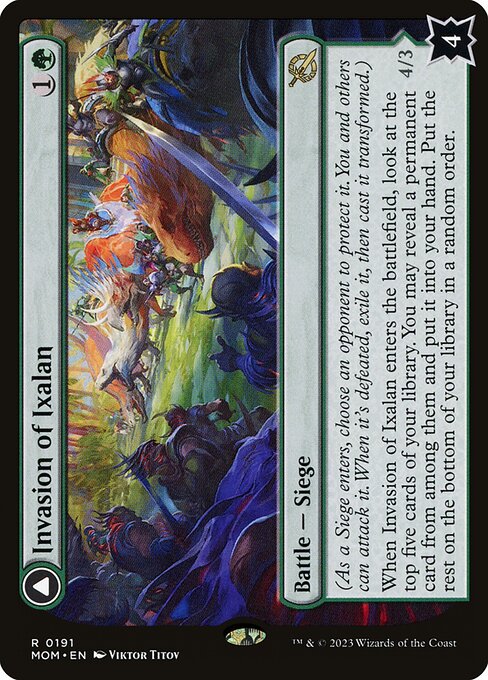
Invasion of Ixalan
Battle — Siege
rare
(As a Siege enters, choose an opponent to protect it. You and others can attack it. When it's defeated, exile it, then cast it transformed.) When this Siege enters, look at the top five cards of your library. You may reveal a permanent card from among them and put it into your hand. Put the rest on the bottom of your library in a random order.
Defense: 4
 Card Kingdom
 Cardmarket
Semantic Tags
Format Legality
Price history
Loading price history…
Printings (2)
| Set | Rarity | TCGplayer | Card Kingdom | Cardmarket |
|---|---|---|---|---|
| March of the Machine Promos#191s | rare | · | · | · |
| March of the Machine#191 | rare | · | · | · |
Related Concepts
Related Rules
If an ability would produce one or more mana of an undefined type, it produces no mana instead.
Some abilities produce mana based on the type of mana another permanent or permanents “could produce.” The type of mana a permanent could produce at any time includes any type of mana that an ability of that permanent would produce if the ability were to resolve at that time, taking into account any applicable replacement effects in any possible order. Ignore whether any costs of the ability could or could not be paid. If that permanent wouldn’t produce any mana under these conditions, or no type of mana can be defined this way, there’s no type of mana it could produce.
To “tap [a permanent] for mana” is to activate a mana ability of that permanent that includes the {T} symbol in its activation cost. See rule 605, “Mana Abilities.”
An ability that triggers whenever a permanent “is tapped for mana” or is tapped for mana of a specified type triggers whenever such a mana ability resolves and produces mana or the specified type of mana.
A replacement effect that applies if a permanent “is tapped for mana” or tapped for mana of a specific type and/or amount modifies the mana production event while such an ability is resolving and producing mana or the specified type and/or amount of mana.
If an object’s enters-the-battlefield triggered ability or replacement effect refers to X, and the spell that became that object as it resolved had a value of X chosen for any of its costs, the value of X for that ability is the same as the value of X for that spell, although the value of X for that permanent is 0. This is an exception to rule 107.3i.
The tap symbol is {T}. The tap symbol in an activation cost means “Tap this permanent.” A permanent that’s already tapped can’t be tapped again to pay the cost. A creature’s activated ability with the tap symbol in its activation cost can’t be activated unless the creature has been under its controller’s control continuously since their most recent turn began. See rule 302.6.
The untap symbol is {Q}. The untap symbol in an activation cost means “Untap this permanent.” A permanent that’s already untapped can’t be untapped again to pay the cost. A creature’s activated ability with the untap symbol in its activation cost can’t be activated unless the creature has been under its controller’s control continuously since their most recent turn began. See rule 302.6.
Rulings
A battle’s “defense” is displayed in the bottom right corner of the card. A battle enters the battlefield with that number of defense counters. If another permanent enters the battlefield as a copy of a battle, it also enters with that number of defense counters.
If a battle that’s being attacked somehow stops being a battle, it is removed from combat. Similarly, if its controller changes in the middle of combat, it is removed from combat.
A Siege’s controller can’t be its protector. If a Siege’s protector ever gains control of it, they choose a new player to be its protector. This is a state-based action.
Damage dealt to a battle causes that many defense counters to be removed from it.
If a battle has no defense counters, and it isn’t the source of a triggered ability that has triggered but not yet left the stack, that battle is put into its owner’s graveyard. This is a state-based action. This doesn’t cause a Siege’s intrinsic triggered ability to trigger.
As a Siege enters the battlefield, its controller chooses an opponent to be its protector.
A battle can be dealt damage and be target of spells and/or abilities that target “any target.”
Battles can’t attack or block, even if one also becomes a creature. If an attacking or blocking creature somehow becomes a battle in addition to being a creature, it is removed from combat.
In a multiplayer game, if the protector of a battle leaves the game and that battle is not currently being attacked, its controller chooses a new protector for it as a state-based action. If it is being attacked, its controller chooses a new protector for it once no creatures are attacking it. This means that it continues to be attacked and can be dealt combat damage as normal.
A battle can be attacked by all players other than its protector. Notably, this means a Siege’s controller can attack it.
Only creatures controlled by a battle’s protector can block creatures that are attacking that battle. This means a Siege’s controller can never assign creatures to block for it.
If a token or a card that isn’t represented by a transforming double-faced card becomes a copy of a Siege, it can’t be cast as its triggered ability resolves. It will remain in exile. If it’s a token, it will cease to exist the next time state-based actions are performed.
Sieges each have an intrinsic triggered ability. That ability is “When the last defense counter is removed from this permanent, exile it, then you may cast it transformed without paying its mana cost.”
If a non-battle permanent that is already on the battlefield become a copy of a Siege, its controller chooses one of their opponents to be that battle’s protector. However, it will most likely be put into its owner’s graveyard because it has no defense counters (see below).
If a permanent that is represented by a transforming double-faced card becomes a copy of a Siege, it will be exiled as that Siege’s triggered ability resolves, then it will be cast transformed. Note that this applies only to transforming double-faced cards, not to modal double-faced cards that can normally be played using either face.
If a Siege never had defense counters on it (perhaps because a permanent became a copy of one), it can’t have its last defense counter removed. It will be put into its owner’s graveyard. You won’t exile it or cast the other face.