Search
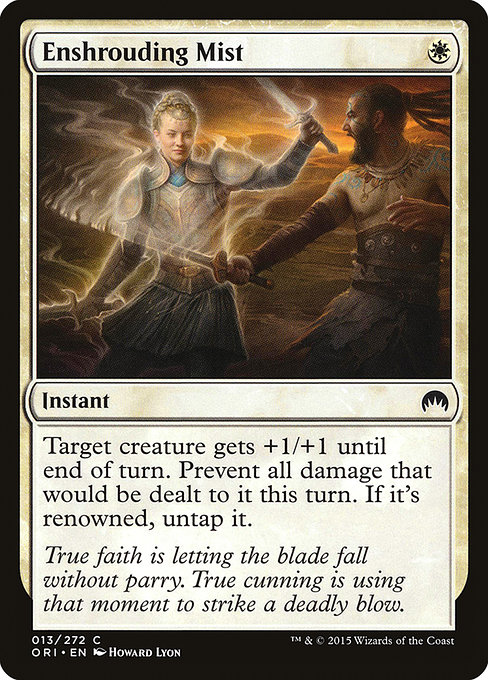
Enshrouding Mist
Instant
common
Target creature gets +1/+1 until end of turn. Prevent all damage that would be dealt to it this turn. If it's renowned, untap it.
 Card Kingdom
 Cardmarket
Semantic Tags
A keyword ability that can make a creature particularly brutal when it attacks. See rule 702.86, “Annihilator.”
An instant-speed spell that modifies combat — pump, protection, or removal during combat.
An instant-speed spell that modifies combat — pump, protection, or removal during combat.
A keyword ability that causes damage dealt by an object to be especially effective. See rule 702.2, “Deathtouch.”
A keyword ability that prohibits a creature from attacking. See rule 702.3, “Defender.”
A keyword ability that lets a creature deal its combat damage twice. See rule 702.4, “Double Strike.”
A keyword ability that lets a creature deal its combat damage before other creatures. See rule 702.7, “First Strike.”
A keyword ability that precludes a permanent or player from being targeted by an opponent. See rule 702.11, “Hexproof.”
A keyword ability that affects how an object deals damage to creatures and players. See rule 702.90, “Infect.”
A keyword ability that lets a creature suddenly enter combat. See rule 702.49, “Ninjutsu.”
A keyword ability that provides a range of benefits against objects with a specific quality. See rule 702.16, “Protection.”
A keyword ability that causes a creature to get +1/+1 whenever its controller casts a noncreature spell. See rule 702.108, “Prowess.”
A spell or ability that gives a temporary power/toughness boost.
Format Legality
Price history
Loading price history…
Printings (1)
| Set | Rarity | TCGplayer | Card Kingdom | Cardmarket |
|---|---|---|---|---|
| Magic Origins#13 | common | · | · | · |
Related Rules
Damage dealt to a player by a source without infect causes that player to lose that much life.
Damage dealt to a player by a source with infect causes that source’s controller to give the player that many poison counters.
Damage dealt to a creature by a source with wither and/or infect causes that source’s controller to put that many -1/-1 counters on that creature.
Damage dealt to a creature by a source with neither wither nor infect causes that much damage to be marked on that creature.
First, if an effect that’s causing damage to be dealt states that excess damage that would be dealt to a permanent is dealt to another permanent or player instead, the damage event is modified accordingly. If the first permanent is a creature, the excess damage is the amount of damage in excess of what would be lethal damage, taking into account damage already marked on the creature and damage from other sources that would be dealt at the same time. (See rule 120.6.) Any amount of damage greater than 1 is excess damage if the source dealing that damage to a creature has deathtouch. (See rule 702.2.) If the first permanent is a planeswalker, the excess damage is the amount of damage in excess of that planeswalker’s loyalty, taking into account damage from other sources that would be dealt at the same time. If the first permanent is a battle, the excess damage is the amount of damage in excess of that battle’s defense, taking into account damage from other sources that would be dealt at the same time. If the first permanent has multiple card types from among the list of creature, planeswalker, and battle, the excess damage is the greatest of the calculated amounts for each of the card types it has.
A keyword counter on a permanent or on a card in a zone other than the battlefield causes that object to gain that keyword. The keywords that a keyword counter can be are flying, first strike, double strike, deathtouch, decayed, exalted, haste, hexproof, indestructible, lifelink, menace, reach, shadow, trample, and vigilance, as well as any variants of those keywords. See rule 613.1f.
The text that a name sticker is modifying may change due to other effects and/or a permanent’s face-down status (see rule 708, “Face-Down Spells and Permanents”). To determine the name of an object with one or more name stickers, start with the object’s copiable values, then apply each name sticker’s effect and each other text-changing effect in timestamp order. The position of each name sticker will continue to be after the number of words that were before it in the object’s name when it was placed. If there are fewer words in the object’s current name, the word on that sticker is added at the end of its name instead. The position and timestamp order of each name sticker on an object is remembered as the object that sticker is on moves from one public zone to another, and it continues to apply to the new object it becomes in that zone (see rule 123.5). This is an exception to rule 400.7.
Multiple instances of infect on the same object are redundant.