Search
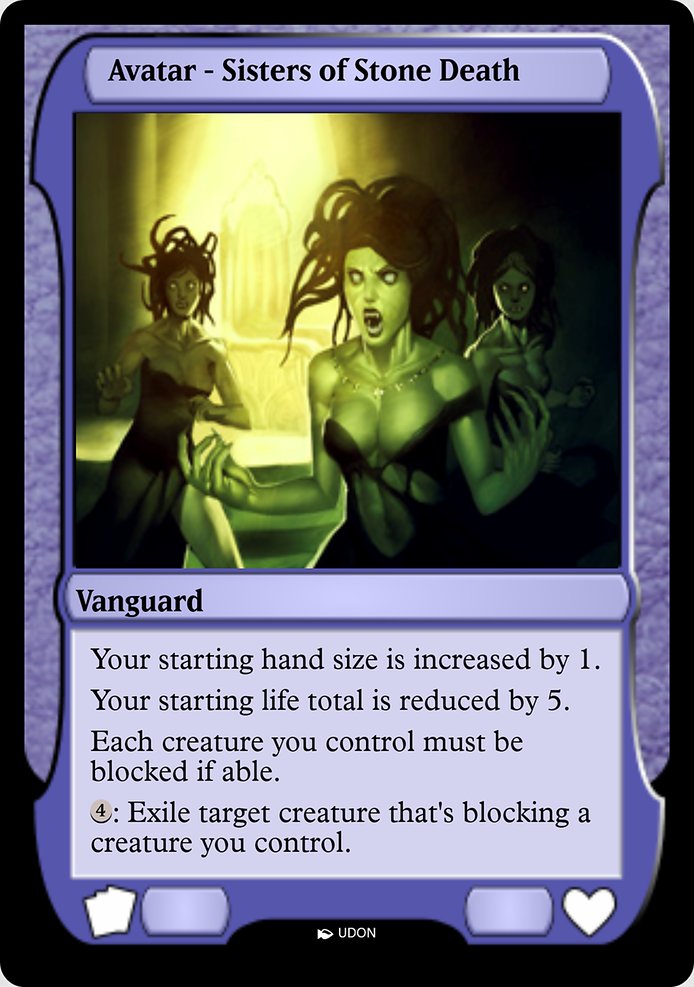
Sisters of Stone Death Avatar
Vanguard
rare
Each creature you control must be blocked if able. : Exile target creature that's blocking a creature you control.
Semantic Tags
Punishes or prevents creature-based strategies — makes creatures enter tapped, prevents attacking, taxes creatures.
Specifically removes creatures — destroy, exile, damage, or -X/-X.
Specifically removes creatures — destroy, exile, damage, or -X/-X.
Difficult to block or grants evasion. Includes flying, menace, fear, intimidate, shadow, skulk, horsemanship, unblockable effects, and cards that grant these abilities.
A keyword ability that can make a creature better in combat. See rule 702.83, “Exalted.”
Removes threats by exiling rather than destroying — bypasses indestructible and death triggers.
Removes threats by exiling rather than destroying — bypasses indestructible and death triggers.
A keyword ability that restricts how a creature may be blocked. See rule 702.9, “Flying.”
Exile-based card advantage — exile cards from the top of your library and cast them temporarily. Red's primary draw mechanic.
A permanent with a repeatable activated ability that converts excess mana into value.
An evasion ability that makes creatures unblockable by a single creature. See rule 702.111, “Menace.”
Cares about power of creatures — Fling effects, power-based draw, Xenagos strategies.
Answers an opponent's threat by destroying, exiling, bouncing, or otherwise removing a permanent or spell.
A keyword ability that provides an alternative way to play a card. See rule 702.62, “Suspend.” A card is “suspended” if it’s in the exile zone, has suspend, and has a time counter on it.
Cannot be blocked or has an ability that makes it very hard to block.
Format Legality
Price history
Loading price history…
Printings (1)
| Set | Rarity | TCGplayer | Card Kingdom | Cardmarket |
|---|---|---|---|---|
| Magic Online Avatars#55 | rare | · | · | · |
Related Rules
If a cost associated with a special action, such as a suspend cost or a morph cost, has an {X} or an X in it, the value of X is chosen by the player taking the special action immediately before they pay that cost.
An effect that sets an object’s characteristic, or simply states a quality of that object, is different from an ability granted by an effect. When an object “gains” or “has” an ability, that ability can be removed by another effect. If an effect defines a characteristic of the object (“[permanent] is [characteristic value]”), it’s not granting an ability. (See rule 604.3.) Similarly, if an effect states a quality of that object (“[creature] can’t be blocked,” for example), it’s neither granting an ability nor setting a characteristic.
A player who has a card with suspend in their hand may exile that card. This is a special action. A player can take this action any time they have priority, but only if they could begin to cast that card by putting it onto the stack. See rule 702.62, “Suspend.”
A keyword counter on a permanent or on a card in a zone other than the battlefield causes that object to gain that keyword. The keywords that a keyword counter can be are flying, first strike, double strike, deathtouch, decayed, exalted, haste, hexproof, indestructible, lifelink, menace, reach, shadow, trample, and vigilance, as well as any variants of those keywords. See rule 613.1f.
The illustration is printed on the upper half of a card and has no effect on game play. For example, a creature doesn’t have the flying ability unless stated in its rules text, even if it’s depicted as flying.
One card (City in a Bottle) refers to permanents and cards with a name originally printed in the Arabian Nights™ expansion. Those names are Abu Ja’far, Aladdin, Aladdin’s Lamp, Aladdin’s Ring, Ali Baba, Ali from Cairo, Army of Allah, Bazaar of Baghdad, Bird Maiden, Bottle of Suleiman, Brass Man, Camel, City in a Bottle, City of Brass, Cuombajj Witches, Cyclone, Dancing Scimitar, Dandân, Desert, Desert Nomads, Desert Twister, Diamond Valley, Drop of Honey, Ebony Horse, Elephant Graveyard, El-Hajjâj, Erg Raiders, Erhnam Djinn, Eye for an Eye, Fishliver Oil, Flying Carpet, Flying Men, Ghazbán Ogre, Giant Tortoise, Guardian Beast, Hasran Ogress, Hurr Jackal, Ifh-Biff Efreet, Island Fish Jasconius, Island of Wak-Wak, Jandor’s Ring, Jandor’s Saddlebags, Jeweled Bird, Jihad, Junún Efreet, Juzám Djinn, Khabál Ghoul, King Suleiman, Kird Ape, Library of Alexandria, Magnetic Mountain, Merchant Ship, Metamorphosis, Mijae Djinn, Moorish Cavalry, Nafs Asp, Oasis, Old Man of the Sea, Oubliette, Piety, Pyramids, Repentant Blacksmith, Ring of Ma’rûf, Rukh Egg, Sandals of Abdallah, Sandstorm, Serendib Djinn, Serendib Efreet, Shahrazad, Sindbad, Singing Tree, Sorceress Queen, Stone-Throwing Devils, Unstable Mutation, War Elephant, Wyluli Wolf, and Ydwen Efreet.
The defending player checks each creature they control to see whether it’s affected by any restrictions (effects that say a creature can’t block, or that it can’t block unless some condition is met). If any restrictions are being disobeyed, the declaration of blockers is illegal.
The defending player checks each creature they control to see whether it’s affected by any requirements (effects that say a creature must block, or that it must block if some condition is met). If the number of requirements that are being obeyed is fewer than the maximum possible number of requirements that could be obeyed without disobeying any restrictions, the declaration of blockers is illegal. If a creature can’t block unless a player pays a cost, that player is not required to pay that cost, even if blocking with that creature would increase the number of requirements being obeyed. If a requirement that says a creature blocks if able during a certain turn refers to a turn with multiple combat phases, the creature blocks if able during each declare blockers step in that turn.