Search
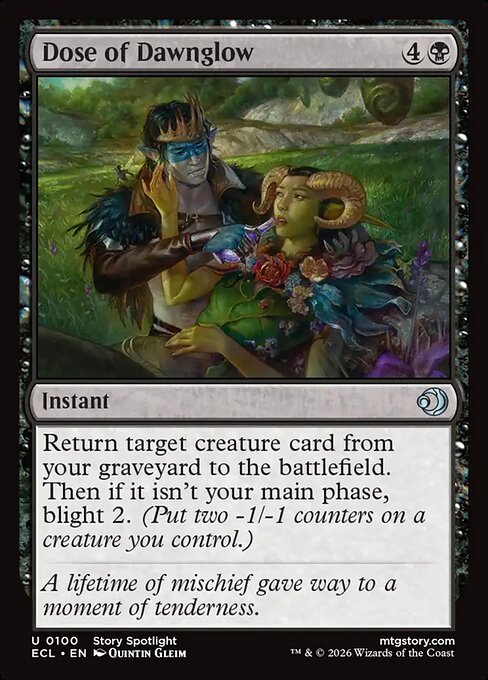
Dose of Dawnglow
Instant
uncommon
Return target creature card from your graveyard to the battlefield. Then if it isn't your main phase, blight 2. (Put two -1/-1 counters on a creature you control.)
 Card Kingdom
 Cardmarket
Semantic Tags
Cares about +1/+1 counters — places, moves, doubles, or benefits from counters on creatures.
Cares about cards in the graveyard, puts cards into the graveyard, or benefits from things dying.
Returns cards from the graveyard to your hand, the battlefield, or the top of your library.
Puts creatures into the graveyard then returns them to the battlefield cheaply.
Puts creatures into the graveyard then returns them to the battlefield cheaply.
A keyword ability that can return a creature from the graveyard to the battlefield. See rule 702.93, “Undying.”
Format Legality
Price history
Loading price history…
Printings (1)
| Set | Rarity | TCGplayer | Card Kingdom | Cardmarket |
|---|---|---|---|---|
| Lorwyn Eclipsed#100 | uncommon | · | · | · |
Related Concepts
Related Rules
If an ability of an object refers to that object by name, and an object with a different name gains that ability, each instance of the first name in the gained ability that refers to the first object by name should be treated as the second name.
Blight
To “blight N” means to put N -1/-1 counters on a creature you control.
If a player is given the choice to blight but is unable to put N -1/-1 counters on a creature they control (usually because they control no creatures), they can’t choose to blight.
Some spells and abilities that instruct a player to blight refer to the “blighted creature.” This phrase refers to the object that the player who was instructed to blight chose to put -1/-1 counters on when blighting.
Undying
Undying is a triggered ability. “Undying” means “When this permanent is put into a graveyard from the battlefield, if it had no +1/+1 counters on it, return it to the battlefield under its owner’s control with a +1/+1 counter on it.”
If a state-based action results in a permanent leaving the battlefield at the same time other state-based actions were performed, that permanent’s last known information is derived from the game state before any of those state-based actions were performed.
Rulings
If you can't place -1/-1 counters on any creatures you control (probably because you control no creatures), you can't choose to blight.
If a creature has +1/+1 counters and -1/-1 counters on it, state-based actions remove the same number of each so that it has only one kind of those counters on it. For example, if a creature has three +1/+1 counters on it and two -1/-1 counters are put on it, state-based actions will remove two of each of those kinds of counters, leaving the creature with just one +1/+1 counter.
If a creature that has +1/+1 counters on it receives enough -1/-1 counters to cause it to be destroyed by lethal damage or put into its owner's graveyard for having 0 or less toughness, effects that refer to the counters on that creature when it died will see all of those +1/+1 and -1/-1 counters.
All of the -1/-1 counters must be put on a single creature. You can't choose to split them up between multiple creatures.
Once you've announced that you're casting a spell or activating an ability, players can't take actions until you've finished doing so. Notably, opponents can't try to destroy or otherwise remove your creatures to stop you from blighting as part of paying the cost of that spell or ability.
The creature you choose to put -1/-1 counters on doesn't have to have enough toughness to survive the process. For example, if you blight 2, you can choose to put the counters on a 1/1 creature you control.