Search
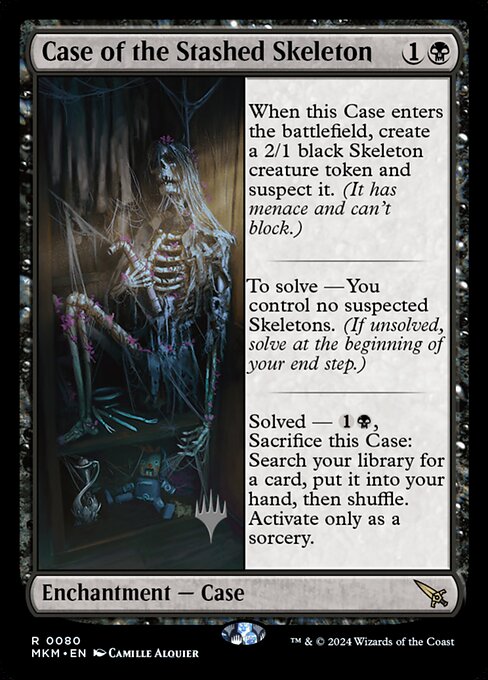
Case of the Stashed Skeleton
Enchantment — Case
rare
When this Case enters, create a 2/1 black Skeleton creature token and suspect it. (It has menace and can't block.) To solve — You control no suspected Skeletons. (If unsolved, solve at the beginning of your end step.) Solved — , Sacrifice this Case: Search your library for a card, put it into your hand, then shuffle. Activate only as a sorcery.
 Card Kingdom
 Cardmarket
Semantic Tags
Puts additional cards into your hand. Includes direct draw, 'look/reveal and put into hand' effects, and conditional draw triggers.
A permanent with a repeatable activated ability that converts excess mana into value.
A card or token on the battlefield. See rule 110, “Permanents.”
Creates creature tokens, Treasure tokens, Food tokens, Clue tokens, or other token types.
Prevents token creation or punishes tokens on the battlefield.
Searches your library for a specific card. Named after Demonic Tutor. Excludes land search (that's ramp).
Format Legality
Price history
Loading price history…
Printings (3)
| Set | Rarity | TCGplayer | Card Kingdom | Cardmarket |
|---|---|---|---|---|
| Murders at Karlov Manor Promos#80p | rare | · | · | · |
| Murders at Karlov Manor#80 | rare | · | · | · |
| Murders at Karlov Manor Promos#80s | rare | · | · | · |
Related Concepts
Related Rules
If an ability would produce one or more mana of an undefined type, it produces no mana instead.
Some abilities produce mana based on the type of mana another permanent or permanents “could produce.” The type of mana a permanent could produce at any time includes any type of mana that an ability of that permanent would produce if the ability were to resolve at that time, taking into account any applicable replacement effects in any possible order. Ignore whether any costs of the ability could or could not be paid. If that permanent wouldn’t produce any mana under these conditions, or no type of mana can be defined this way, there’s no type of mana it could produce.
To “tap [a permanent] for mana” is to activate a mana ability of that permanent that includes the {T} symbol in its activation cost. See rule 605, “Mana Abilities.”
An ability that triggers whenever a permanent “is tapped for mana” or is tapped for mana of a specified type triggers whenever such a mana ability resolves and produces mana or the specified type of mana.
A replacement effect that applies if a permanent “is tapped for mana” or tapped for mana of a specific type and/or amount modifies the mana production event while such an ability is resolving and producing mana or the specified type and/or amount of mana.
If an object’s enters-the-battlefield triggered ability or replacement effect refers to X, and the spell that became that object as it resolved had a value of X chosen for any of its costs, the value of X for that ability is the same as the value of X for that spell, although the value of X for that permanent is 0. This is an exception to rule 107.3i.
The tap symbol is {T}. The tap symbol in an activation cost means “Tap this permanent.” A permanent that’s already tapped can’t be tapped again to pay the cost. A creature’s activated ability with the tap symbol in its activation cost can’t be activated unless the creature has been under its controller’s control continuously since their most recent turn began. See rule 302.6.
The untap symbol is {Q}. The untap symbol in an activation cost means “Untap this permanent.” A permanent that’s already untapped can’t be untapped again to pay the cost. A creature’s activated ability with the untap symbol in its activation cost can’t be activated unless the creature has been under its controller’s control continuously since their most recent turn began. See rule 302.6.
Rulings
"To solve" abilities will check for their condition twice: once when the ability would trigger, and once when it resolves. If the condition isn't true at the beginning of your end step, the ability won't trigger at all. If the condition isn't true when the ability resolves, the Case won't become solved.
"Solved — [Triggered ability]" means "[Triggered ability]. This ability triggers only if this Case is solved." Triggered abilities use the word "when," "whenever," or "at." They're often written as "[Trigger condition], [effect]."
"Solved — [static ability]" means "As long as this Case is solved, [static ability]." Static abilities are written as statements, such as "Creatures you control get +1/+1" or "Instant and sorcery spells you cast cost {1} less to cast."
When an effect suspects a creature, it becomes suspected. It gains menace and "This creature can't block" for as long as it's suspected. It stays suspected until it leaves the battlefield or another effect causes it to no longer be suspected.
There's no limit to the number of creatures that can be suspected simultaneously. Suspecting a new creature doesn't cause other creatures to stop being suspected.
If a creature is already suspected, suspecting it again won't have any effect.
Each Case has two special keyword abilities: to solve and solved.
The meaning of "solved" differs based on what type of ability follows it. "Solved — [activated ability]" means "[Activated ability]. Activate only if this Case is solved." Activated abilities contain a colon. They're generally written "[Cost]: [Effect]."
Once a Case becomes solved, it stays solved until it leaves the battlefield.
"To Solve — [condition]" means "At the beginning of your end step, if [condition] and this Case is not solved, it becomes solved."
Cases don't lose their other abilities when they become solved.
Being solved is not part of a permanent's copiable values. A permanent that becomes a copy of a solved Case is not solved. A solved Case that somehow becomes a copy of a different Case stays solved.
If a suspected creature loses all abilities, it will lose menace and "This creature can't block", but it won't stop being suspected.
Being suspected isn't a copiable value. If a permanent becomes a copy of a suspected creature, it won't be suspected.