Search
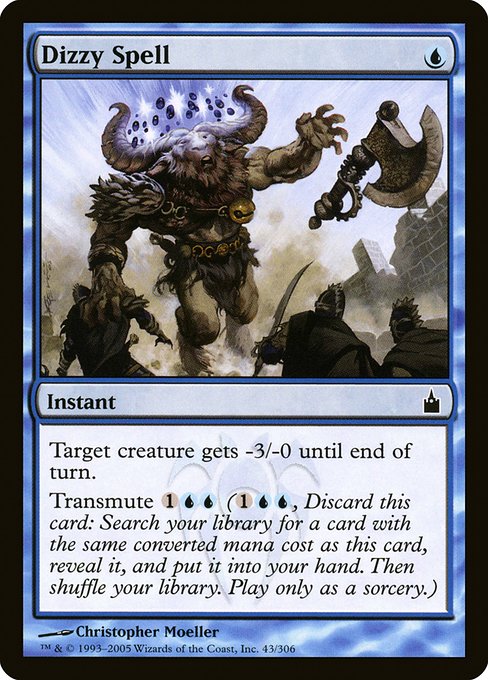
Dizzy Spell
Instant
common
Target creature gets -3/-0 until end of turn. Transmute (, Discard this card: Search your library for a card with the same mana value as this card, reveal it, put it into your hand, then shuffle. Transmute only as a sorcery.)
 Card Kingdom
 Cardmarket
Semantic Tags
Puts additional cards into your hand. Includes direct draw, 'look/reveal and put into hand' effects, and conditional draw triggers.
Specifically removes creatures — destroy, exile, damage, or -X/-X.
A keyword ability that allows a player to cast a double-faced card transformed from the graveyard. See rule 702.146, “Disturb.”
A permanent with a repeatable activated ability that converts excess mana into value.
A keyword ability that lets a card be cast face down as a 2/2 creature. See rule 702.37, “Morph,” and rule 708, “Face-Down Spells and Permanents.”
A keyword that lets a creature card be cast as a mutating creature spell. See rule 702.140, “Mutate.”
Answers an opponent's threat by destroying, exiling, bouncing, or otherwise removing a permanent or spell.
Searches your library for a specific card. Named after Demonic Tutor. Excludes land search (that's ramp).
Format Legality
Price history
Loading price history…
Printings (1)
| Set | Rarity | TCGplayer | Card Kingdom | Cardmarket |
|---|---|---|---|---|
| Ravnica: City of Guilds#43 | common | · | · | · |
Related Concepts
Related Rules
If a cost associated with a special action, such as a suspend cost or a morph cost, has an {X} or an X in it, the value of X is chosen by the player taking the special action immediately before they pay that cost.
Morph
Morph is a static ability that functions in any zone from which you could play the card it’s on, and the morph effect works any time the card is face down. “Morph [cost]” means “You may cast this card as a 2/2 face-down creature with no text, no name, no subtypes, and no mana cost by paying {3} rather than paying its mana cost.” (See rule 708, “Face-Down Spells and Permanents.”)
Some keyword abilities, such as equip and modular, represent targeted activated or triggered abilities, and some keyword abilities, such as mutate, cause spells to have targets. In those cases, the phrase “target [something]” appears in the rule for that keyword ability rather than in the ability itself. (The keyword’s reminder text will often contain the word “target.”) See rule 702, “Keyword Abilities.”
Some spells, activated abilities, and triggered abilities read, “[Do something]. If [a player] [does, doesn’t, or can’t], [effect].” Or “[A player] may [do something]. If [that player] [does, doesn’t, or can’t], [effect].” The action [do something] is a cost, paid when the spell or ability resolves. The “If [a player] [does, doesn’t, or can’t]” clause checks whether the player chose to pay an optional cost or started to pay a mandatory cost, regardless of what events actually occurred.
One card (Golgothian Sylex) refers to permanents with a name originally printed in the Antiquities™ expansion. Those names are Amulet of Kroog, Argivian Archaeologist, Argivian Blacksmith, Argothian Pixies, Argothian Treefolk, Armageddon Clock, Artifact Blast, Artifact Possession, Artifact Ward, Ashnod’s Altar, Ashnod’s Battle Gear, Ashnod’s Transmogrant, Atog, Battering Ram, Bronze Tablet, Candelabra of Tawnos, Circle of Protection: Artifacts, Citanul Druid, Clay Statue, Clockwork Avian, Colossus of Sardia, Coral Helm, Crumble, Cursed Rack, Damping Field, Detonate, Drafna’s Restoration, Dragon Engine, Dwarven Weaponsmith, Energy Flux, Feldon’s Cane, Gaea’s Avenger, Gate to Phyrexia, Goblin Artisans, Golgothian Sylex, Grapeshot Catapult, Haunting Wind, Hurkyl’s Recall, Ivory Tower, Jalum Tome, Martyrs of Korlis, Mightstone, Millstone, Mishra’s Factory, Mishra’s War Machine, Mishra’s Workshop, Obelisk of Undoing, Onulet, Orcish Mechanics, Ornithopter, Phyrexian Gremlins, Power Artifact, Powerleech, Priest of Yawgmoth, Primal Clay, The Rack, Rakalite, Reconstruction, Reverse Polarity, Rocket Launcher, Sage of Lat-Nam, Shapeshifter, Shatterstorm, Staff of Zegon, Strip Mine, Su-Chi, Tablet of Epityr, Tawnos’s Coffin, Tawnos’s Wand, Tawnos’s Weaponry, Tetravus, Titania’s Song, Transmute Artifact, Triskelion, Urza’s Avenger, Urza’s Chalice, Urza’s Mine, Urza’s Miter, Urza’s Power Plant, Urza’s Tower, Wall of Spears, Weakstone, Xenic Poltergeist, Yawgmoth Demon, and Yotian Soldier.
Megamorph is a variant of the morph ability. “Megamorph [cost]” means “You may cast this card as a 2/2 face-down creature with no text, no name, no subtypes, and no mana cost by paying {3} rather than paying its mana cost” and “As this permanent is turned face up, put a +1/+1 counter on it if its megamorph cost was paid to turn it face up.” A megamorph cost is a morph cost.
If the spell is modal, the player announces the mode choice (see rule 700.2). If the player wishes to splice any cards onto the spell (see rule 702.47), they reveal those cards in their hand. If the spell has alternative or additional costs that will be paid as it’s being cast such as buyback or kicker costs (see rules 118.8 and 118.9), the player announces their intentions to pay any or all of those costs (see rule 601.2f). A player can’t apply two alternative methods of casting or two alternative costs to a single spell. If the spell has a variable cost that will be paid as it’s being cast (such as an {X} in its mana cost; see rule 107.3), the player announces the value of that variable. If the value of that variable is defined in the text of the spell by a choice that player would make later in the announcement or resolution of the spell, that player makes that choice at this time instead of that later time. If a cost that will be paid as the spell is being cast includes hybrid mana symbols, the player announces the nonhybrid equivalent cost they intend to pay. If a cost that will be paid as the spell is being cast includes Phyrexian mana symbols, the player announces whether they intend to pay 2 life or a corresponding colored mana cost for each of those symbols. Previously made choices (such as choosing to cast a spell with flashback from a graveyard or choosing to cast a creature with morph face down) may restrict the player’s options when making these choices.