Search
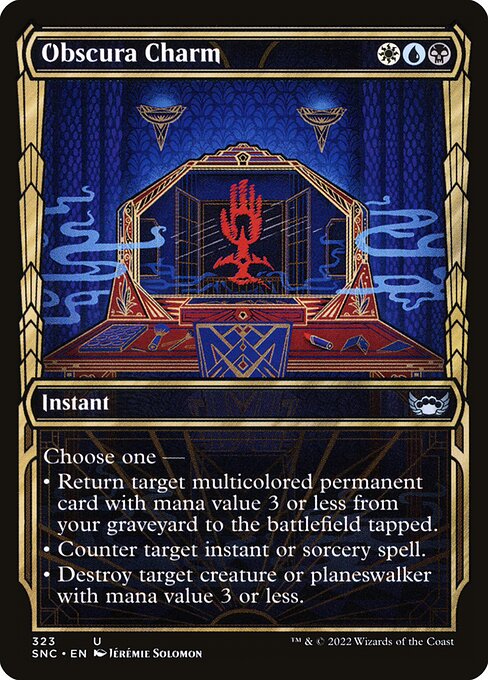
Obscura Charm
Instant
uncommon
Choose one — • Return target multicolored permanent card with mana value 3 or less from your graveyard to the battlefield tapped. • Counter target instant or sorcery spell. • Destroy target creature or planeswalker with mana value 3 or less.
 Card Kingdom
 Cardmarket
Semantic Tags
Specifically removes creatures — destroy, exile, damage, or -X/-X.
A keyword ability that allows a player to cast a double-faced card transformed from the graveyard. See rule 702.146, “Disturb.”
A keyword ability that lets a player return a card from their graveyard to their hand. See rule 702.52, “Dredge.”
Cares about cards in the graveyard, puts cards into the graveyard, or benefits from things dying.
Answers an opponent's threat by destroying, exiling, bouncing, or otherwise removing a permanent or spell.
Format Legality
Price history
Loading price history…
Printings (3)
| Set | Rarity | TCGplayer | Card Kingdom | Cardmarket |
|---|---|---|---|---|
| Streets of New Capenna#323 | uncommon | · | · | · |
| Streets of New Capenna#388 | uncommon | · | · | · |
| Streets of New Capenna#208 | uncommon | · | · | · |
Related Rules
Dredge
Dredge is a static ability that functions only while the card with dredge is in a player’s graveyard. “Dredge N” means “As long as you have at least N cards in your library, if you would draw a card, you may instead mill N cards and return this card from your graveyard to your hand.”
A player with fewer cards in their library than the number required by a dredge ability can’t mill any of them this way.
Disturb
Disturb is an ability found on the front face of some double-faced cards (see rule 712, “Double-Faced Cards”). “Disturb [cost]” means “You may cast this card transformed from your graveyard by paying [cost] rather than its mana cost.” See rule 712.8c.
A resolving double-faced spell that was cast using its disturb ability enters the battlefield with its back face up.