Search
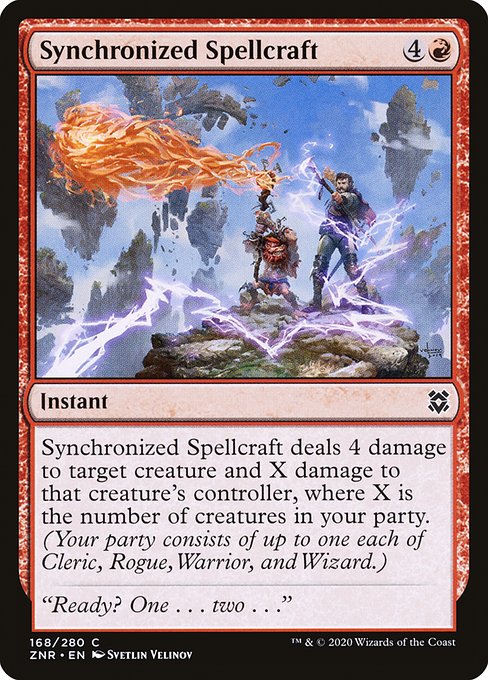
Synchronized Spellcraft
Instant
common
Synchronized Spellcraft deals 4 damage to target creature and X damage to that creature's controller, where X is the number of creatures in your party. (Your party consists of up to one each of Cleric, Rogue, Warrior, and Wizard.)
 Card Kingdom
 Cardmarket
Semantic Tags
A spell that deals direct damage to creatures or players.
A spell that deals direct damage to creatures or players.
Specifically removes creatures — destroy, exile, damage, or -X/-X.
A keyword ability that allows a spell to affect either a single target or many objects. See rule 702.96, “Overload.”
Answers an opponent's threat by destroying, exiling, bouncing, or otherwise removing a permanent or spell.
Format Legality
Price history
Loading price history…
Printings (1)
| Set | Rarity | TCGplayer | Card Kingdom | Cardmarket |
|---|---|---|---|---|
| Zendikar Rising#168 | common | · | · | · |
Related Rules
Overload
Overload is a keyword that represents two static abilities that function while the spell with overload is on the stack. Overload [cost] means “You may choose to pay [cost] rather than pay this spell’s mana cost” and “If you chose to pay this spell’s overload cost, change its text by replacing all instances of the word ‘target’ with the word ‘each.’” Casting a spell using its overload ability follows the rules for paying alternative costs in rules 601.2b and 601.2f–h.
If a player chooses to pay the overload cost of a spell, that spell won’t require any targets. It may affect objects that couldn’t be chosen as legal targets if the spell were cast without its overload cost being paid.
Overload’s second ability creates a text-changing effect. See rule 612, “Text-Changing Effects.”
Rulings
To determine “the number of creatures in your party,” check whether you control a Cleric, whether you control a Rogue, whether you control a Warrior, and whether you control a Wizard. The number is the total number of those checks to which you answered yes. Each creature you control can be counted for only one of those checks.
If the target creature is an illegal target by the time Synchronized Spellcraft tries to resolve, the spell doesn’t resolve. No player is dealt damage.
An ability referring to the number of creatures in your party gets a number from zero to four. Such abilities never ask which creatures are in your party, and you never have to designate specific creatures as being in your party. You can’t choose to exclude creatures from this count to lower the number.
If a creature has more than one party creature type, and there are multiple ways to count that creature that could result in a different number of creatures in your party, the highest such number is used. For example, if you control a Cleric and a Cleric Wizard, the number of creatures in your party is two. You can’t choose to have it be just one by counting the Cleric Wizard first as a Cleric.