Search
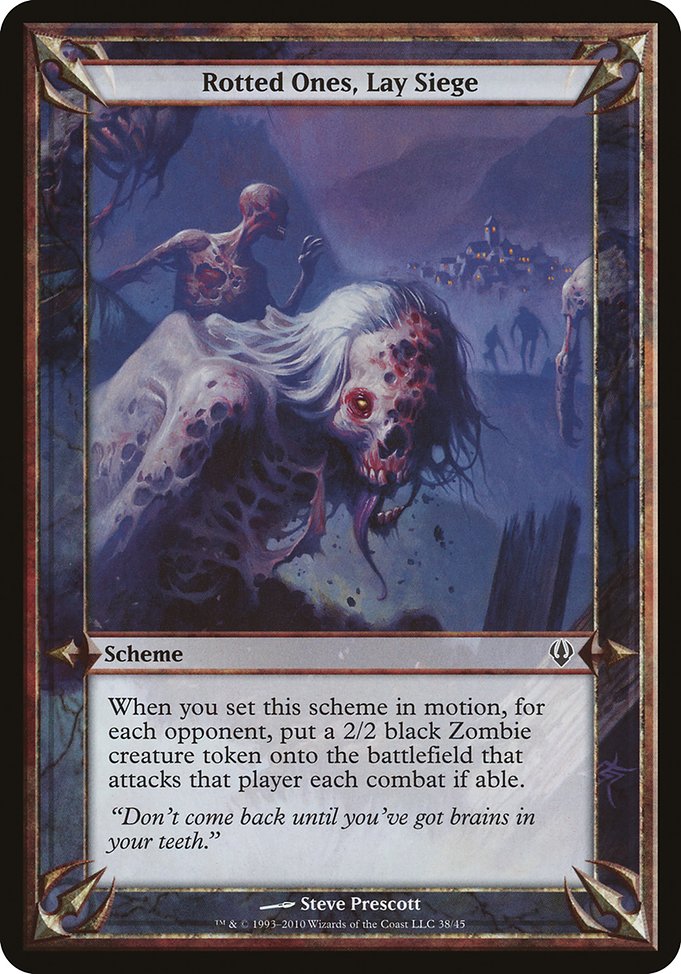
Rotted Ones, Lay Siege
Scheme
common
When you set this scheme in motion, for each opponent, create a 2/2 black Zombie creature token that attacks that player each combat if able.
 Card Kingdom
 Cardmarket
Semantic Tags
Creates creature tokens, Treasure tokens, Food tokens, Clue tokens, or other token types.
Prevents token creation or punishes tokens on the battlefield.
Cares about tokens being on the battlefield — payoffs for having or creating tokens. Distinct from token_generation (which creates them).
Format Legality
Price history
Loading price history…
Printings (1)
| Set | Rarity | TCGplayer | Card Kingdom | Cardmarket |
|---|---|---|---|---|
| Archenemy Schemes#38★ | common | · | · | · |
Rulings
Each of these Zombies must attack its designated player, not a planeswalker that player controls.
If there are multiple combat phases in a turn, each of these Zombies must attack its designated player in each of them that it’s able to.
For each Zombie token you put onto the battlefield this way, make sure it’s clear who its designated player is. A token’s designated player won’t change for the rest of the game.
If one of these Zombies can’t attack its designated player during any given turn (because that player has left the game, due to a spell or ability such as Chronomantic Escape, or because a player on the opposing team has gained control of it, for example), it may attack another player, attack a planeswalker an opponent controls, or not attack at all. If there’s a cost with having that creature attack its designated player, you aren’t forced to pay that cost, so it may attack another player, attack a planeswalker an opponent controls, or not attack at all.
If, during your declare attackers step, one of these Zombies is tapped or is affected by a spell or ability that says it can’t attack, then it doesn’t attack. If there’s a cost associated with having that creature attack, you aren’t forced to pay that cost, so it doesn’t have to attack in that case either.