Search
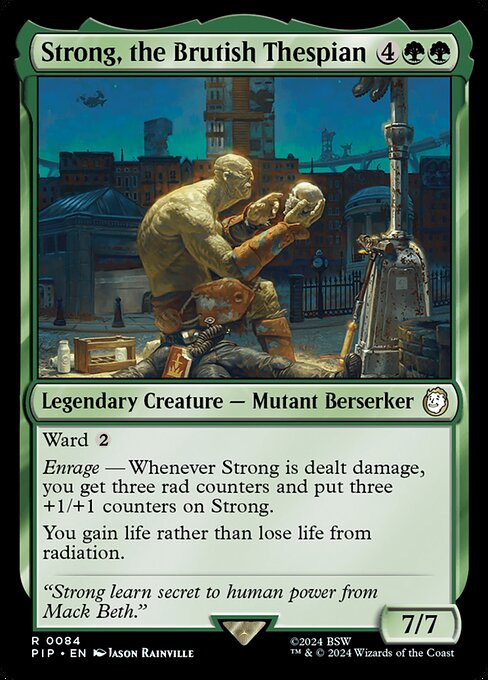
Strong, the Brutish Thespian
Legendary Creature — Mutant Berserker
rare
Ward Enrage — Whenever Strong is dealt damage, you get three rad counters and put three +1/+1 counters on Strong. You gain life rather than lose life from radiation.
7/7
 Card Kingdom
 Cardmarket
Semantic Tags
Cares about +1/+1 counters — places, moves, doubles, or benefits from counters on creatures.
Gains you life. Relevant for lifegain-matters strategies and general survivability.
A card or token on the battlefield. See rule 110, “Permanents.”
A keyword ability that provides a range of benefits against objects with a specific quality. See rule 702.16, “Protection.”
A triggered ability that can counter spells or abilities that target the permanent with ward. See rule 702.21, “Ward.”
Format Legality
Price history
Loading price history…
Printings (4)
| Set | Rarity | TCGplayer | Card Kingdom | Cardmarket |
|---|---|---|---|---|
| Fallout#84 | rare | · | · | · |
| Fallout#612 | rare | · | · | · |
| Fallout#403 | rare | · | · | · |
| Fallout#931 | rare | · | · | · |
Related Concepts
Related Rules
If an ability would produce one or more mana of an undefined type, it produces no mana instead.
Some abilities produce mana based on the type of mana another permanent or permanents “could produce.” The type of mana a permanent could produce at any time includes any type of mana that an ability of that permanent would produce if the ability were to resolve at that time, taking into account any applicable replacement effects in any possible order. Ignore whether any costs of the ability could or could not be paid. If that permanent wouldn’t produce any mana under these conditions, or no type of mana can be defined this way, there’s no type of mana it could produce.
To “tap [a permanent] for mana” is to activate a mana ability of that permanent that includes the {T} symbol in its activation cost. See rule 605, “Mana Abilities.”
An ability that triggers whenever a permanent “is tapped for mana” or is tapped for mana of a specified type triggers whenever such a mana ability resolves and produces mana or the specified type of mana.
A replacement effect that applies if a permanent “is tapped for mana” or tapped for mana of a specific type and/or amount modifies the mana production event while such an ability is resolving and producing mana or the specified type and/or amount of mana.
If an object’s enters-the-battlefield triggered ability or replacement effect refers to X, and the spell that became that object as it resolved had a value of X chosen for any of its costs, the value of X for that ability is the same as the value of X for that spell, although the value of X for that permanent is 0. This is an exception to rule 107.3i.
The tap symbol is {T}. The tap symbol in an activation cost means “Tap this permanent.” A permanent that’s already tapped can’t be tapped again to pay the cost. A creature’s activated ability with the tap symbol in its activation cost can’t be activated unless the creature has been under its controller’s control continuously since their most recent turn began. See rule 302.6.
The untap symbol is {Q}. The untap symbol in an activation cost means “Untap this permanent.” A permanent that’s already untapped can’t be untapped again to pay the cost. A creature’s activated ability with the untap symbol in its activation cost can’t be activated unless the creature has been under its controller’s control continuously since their most recent turn began. See rule 302.6.
Rulings
Any effects (such as proliferate) that interact with counters a player gets, has, or loses can interact with rad counters.
Keep track of how many rad counters each player has. Potential ways to track this include writing them down on paper or using dice, but any method that is clear and mutually agreeable is fine.
The cards are milled all at once, which means abilities that trigger “whenever one or more nonland cards are milled” will trigger exactly once as long as at least one nonland card was milled.
Rad counters don’t go away as steps, phases, or turns end. They only go away when an effect instructs a player to remove rad counters from themselves.
If multiple sources deal damage to Strong at the same time, most likely because multiple creatures blocked it, its enrage ability will trigger only once.
In a game using the shared team turns option, such as an Archenemy or Two-Headed Giant game, the inherent triggered ability associated with rad counters triggers once for each player on the active team that has rad counters. Each instance of that ability is controlled by one of those players.
Strong’s last ability changes what happens when the inherent triggered ability associated with having rad counters resolves. You’ll still mill cards equal to the number of rad counters you have, and you’ll still remove a rad counter from yourself for each nonland card you milled, but instead of losing life, you’ll gain 1 life for each nonland card you milled.
There is an inherent triggered ability associated with having rad counters. This triggered ability has no source and is controlled by the active player. The full text of this ability is “At the beginning of the precombat main phase of a player with rad counters, that player mills cards equal to the number of rad counters they have. For each nonland card milled this way, that player loses 1 life and removes one rad counter from themselves.”
If lethal damage is dealt to Strong, its enrage ability triggers. Strong leaves the battlefield before that ability resolves, so you won’t put three +1/+1 counters on it. In this or any other case where Strong is no longer on the battlefield when its enrage ability resolves, you’ll still get three rad counters.
Rad counters are a kind of counter that a player may have. They’re not associated with any specific permanents.
If a player has fewer cards remaining in their library than the number of rad counters they have when the triggered ability resolves, they’ll mill as many cards as they can.