Search
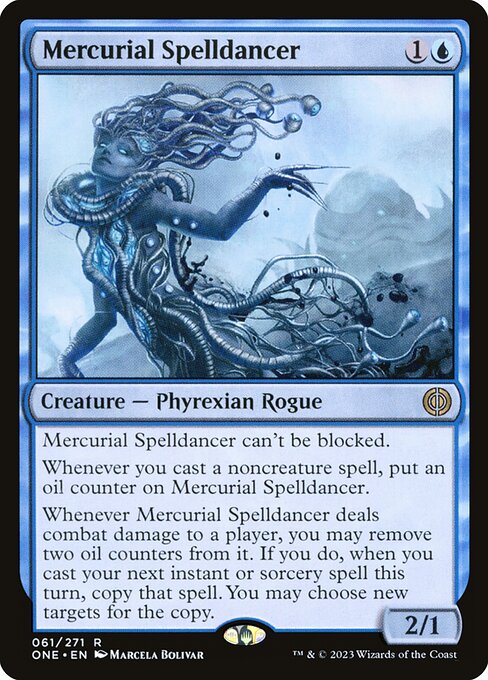
Mercurial Spelldancer
Creature — Phyrexian Rogue
rare
This creature can't be blocked. Whenever you cast a noncreature spell, put an oil counter on this creature. Whenever this creature deals combat damage to a player, you may remove two oil counters from it. If you do, when you next cast an instant or sorcery spell this turn, copy that spell. You may choose new targets for the copy.
2/1
 Card Kingdom
 Cardmarket
Semantic Tags
Creates copies of creatures, permanents, or spells.
Cares about +1/+1 counters — places, moves, doubles, or benefits from counters on creatures.
Difficult to block or grants evasion. Includes flying, menace, fear, intimidate, shadow, skulk, horsemanship, unblockable effects, and cards that grant these abilities.
Cares about casting noncreature spells — magecraft, prowess-adjacent strategies.
A card or token on the battlefield. See rule 110, “Permanents.”
Rewards casting instants and sorceries. Includes magecraft, prowess triggers, and spell-count payoffs.
Storm count strategies — casting many spells in a single turn for storm triggers.
Cannot be blocked or has an ability that makes it very hard to block.
Format Legality
Price history
Loading price history…
Printings (4)
| Set | Rarity | TCGplayer | Card Kingdom | Cardmarket |
|---|---|---|---|---|
| Phyrexia: All Will Be One#61 | rare | · | · | · |
| Phyrexia: All Will Be One#381 | rare | · | · | · |
| Phyrexia: All Will Be One Promos#61p | rare | · | · | · |
| Phyrexia: All Will Be One Promos#61s | rare | · | · | · |
Related Rules
If an ability would produce one or more mana of an undefined type, it produces no mana instead.
Some abilities produce mana based on the type of mana another permanent or permanents “could produce.” The type of mana a permanent could produce at any time includes any type of mana that an ability of that permanent would produce if the ability were to resolve at that time, taking into account any applicable replacement effects in any possible order. Ignore whether any costs of the ability could or could not be paid. If that permanent wouldn’t produce any mana under these conditions, or no type of mana can be defined this way, there’s no type of mana it could produce.
To “tap [a permanent] for mana” is to activate a mana ability of that permanent that includes the {T} symbol in its activation cost. See rule 605, “Mana Abilities.”
An ability that triggers whenever a permanent “is tapped for mana” or is tapped for mana of a specified type triggers whenever such a mana ability resolves and produces mana or the specified type of mana.
A replacement effect that applies if a permanent “is tapped for mana” or tapped for mana of a specific type and/or amount modifies the mana production event while such an ability is resolving and producing mana or the specified type and/or amount of mana.
If an object’s enters-the-battlefield triggered ability or replacement effect refers to X, and the spell that became that object as it resolved had a value of X chosen for any of its costs, the value of X for that ability is the same as the value of X for that spell, although the value of X for that permanent is 0. This is an exception to rule 107.3i.
The tap symbol is {T}. The tap symbol in an activation cost means “Tap this permanent.” A permanent that’s already tapped can’t be tapped again to pay the cost. A creature’s activated ability with the tap symbol in its activation cost can’t be activated unless the creature has been under its controller’s control continuously since their most recent turn began. See rule 302.6.
The untap symbol is {Q}. The untap symbol in an activation cost means “Untap this permanent.” A permanent that’s already untapped can’t be untapped again to pay the cost. A creature’s activated ability with the untap symbol in its activation cost can’t be activated unless the creature has been under its controller’s control continuously since their most recent turn began. See rule 302.6.
Rulings
If the spell that's copied is modal (that is, it says "Choose one —" or the like), the copy will have the same mode or modes. You can't choose different ones.
If the spell has damage divided as it was put onto the stack, the division can't be changed, although the targets receiving that damage still can. The same is true of spells that distribute counters.
If the spell that's copied has an X whose value was determined as it was cast, the copy has the same value of X.
Any choices made when the spell resolves won't have been made yet when it's copied. Any such choices will be made separately when the copy resolves.
A copy is created even if the spell that caused the delayed triggered ability to trigger has been countered by the time that delayed triggered ability resolves. The copy resolves before the original spell.
The copy will have the same targets as the spell it's copying unless you choose new ones. You may change any number of the targets, including all of them or none of them. If the spell is a permanent spell with targets, such as an Aura, you may also choose a new target for that spell. The new targets must be legal. If, for any target, you can't choose a new legal target, then it remains unchanged (even if the current target is illegal).
The copy is created on the stack, so it's not "cast." Creating the copy won't cause abilities that trigger when a player casts a spell to trigger.
You can't choose to pay any additional costs for a copied spell. However, effects based on any additional costs that were paid for the original spell are copied as though those same costs were paid for the copy too.