Search
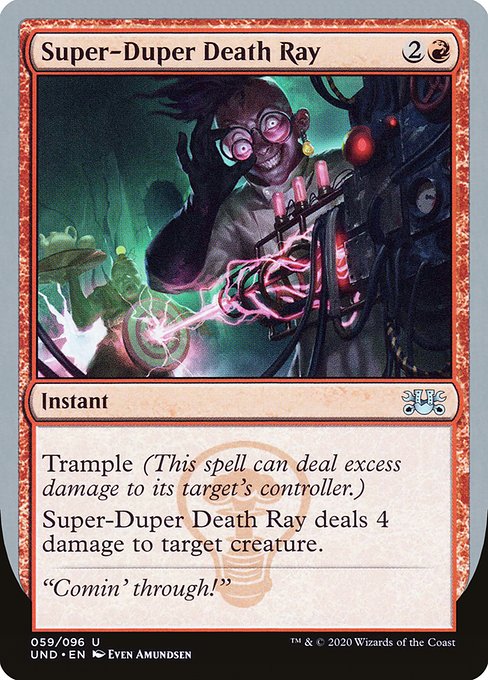
Super-Duper Death Ray
Instant
uncommon
Trample (This spell can deal excess damage to its target's controller.) Super-Duper Death Ray deals 4 damage to target creature.
 Card Kingdom
 Cardmarket
Semantic Tags
A spell that deals direct damage to creatures or players.
Specifically removes creatures — destroy, exile, damage, or -X/-X.
A keyword ability that allows a spell to affect either a single target or many objects. See rule 702.96, “Overload.”
Answers an opponent's threat by destroying, exiling, bouncing, or otherwise removing a permanent or spell.
A keyword ability that modifies how a creature assigns combat damage. See rule 702.19, “Trample.”
Format Legality
Price history
Loading price history…
Printings (2)
| Set | Rarity | TCGplayer | Card Kingdom | Cardmarket |
|---|---|---|---|---|
| Unsanctioned#59 | uncommon | · | · | · |
| Unstable#97 | uncommon | · | · | · |
Related Concepts
Related Rules
A spell or ability that creates a token sets both its name and its subtype(s). If the spell or ability doesn’t specify the name of the token, its name is the same as its subtype(s) plus the word “Token.” Once a token is on the battlefield, changing its name doesn’t change its subtype(s), and vice versa.
A Monster Role token is a colorless Aura Role enchantment token named Monster with enchant creature and “Enchanted creature gets +1/+1 and has trample.”
A keyword counter on a permanent or on a card in a zone other than the battlefield causes that object to gain that keyword. The keywords that a keyword counter can be are flying, first strike, double strike, deathtouch, decayed, exalted, haste, hexproof, indestructible, lifelink, menace, reach, shadow, trample, and vigilance, as well as any variants of those keywords. See rule 613.1f.
An effect may state that “the same is true for” a list of keyword abilities or similar. If one of those keyword abilities has variants or variables and the effect grants that keyword or counters of that keyword to one or more objects and/or players, it grants each appropriate variant and variable of that keyword.
Trample
Trample is a static ability that modifies the rules for assigning an attacking creature’s combat damage. The ability has no effect when a creature with trample is blocking or is dealing noncombat damage. (See rule 510, “Combat Damage Step.”)
The controller of an attacking creature with trample first assigns damage to the creature(s) blocking it. Once all those blocking creatures are assigned lethal damage, any excess damage is assigned as its controller chooses among those blocking creatures and the player, planeswalker, or battle the creature is attacking. When checking for assigned lethal damage, take into account damage already marked on the creature and damage from other creatures that’s being assigned during the same combat damage step, but not any abilities or effects that might change the amount of damage that’s actually dealt. The attacking creature’s controller need not assign lethal damage to all those blocking creatures but in that case can’t assign any damage to the player or planeswalker it’s attacking.
Trample over planeswalkers is a variant of trample that modifies the rules for assigning combat damage to planeswalkers. The controller of a creature with trample over planeswalkers assigns that creature’s combat damage as described in rule 702.19b, with one exception. If that creature is attacking a planeswalker, after lethal damage is assigned to all blocking creatures and damage at least equal to the loyalty of the planeswalker the creature is attacking is assigned to that planeswalker, further excess damage may be assigned as the attacking creature’s controller chooses among those blocking creatures, that planeswalker, and that planeswalker’s controller. When checking for assigned damage equal to a planeswalker’s loyalty, take into account damage from other creatures that’s being assigned during the same combat damage step, but not any abilities or effects that might change the amount of damage that’s actually dealt.
Rulings
Trample on an instant or sorcery is similar to how it works on an attacking creature. If Super-Duper Death Ray would deal more damage that what it would take to destroy the creature (called “excess damage”), it deals the excess to the creature’s controller. For example, if you aim Super-Duper Death Ray at a 1/1 creature, it will deal 1 damage to the creature and 3 damage to its controller.
If Super-Duper Death Ray doesn’t resolve because its target leaves the battlefield or otherwise becomes an illegal target in response, it will have no effect. It won’t deal damage to any creature or player.
Super-Duper Death Ray targets only the creature. It can deal damage to a player with hexproof, for example.
If damage is already marked on the creature, that damage is considered when calculating excess damage. For example, say your opponent controls a 6/6 creature. Your first Super-Duper Death Ray deals 4 damage to it. Then your SECOND Super-Duper Death Ray (i.e. the one they never see coming) deals 2 damage to the creature and 2 damage to your opponent.