Search
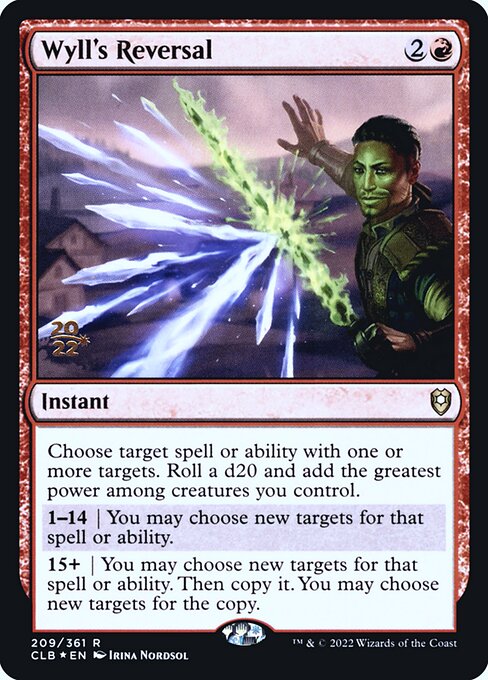
Wyll's Reversal
Instant
rare
Choose target spell or ability with one or more targets. Roll a d20 and add the greatest power among creatures you control. 1—14 | You may choose new targets for that spell or ability. 15+ | You may choose new targets for that spell or ability. Then copy it. You may choose new targets for the copy.
 Card Kingdom
 Cardmarket
Semantic Tags
A keyword ability that allows a spell to affect either a single target or many objects. See rule 702.96, “Overload.”
Cares about power of creatures — Fling effects, power-based draw, Xenagos strategies.
A keyword ability that causes a creature to get +1/+1 whenever its controller casts a noncreature spell. See rule 702.108, “Prowess.”
Format Legality
Price history
Loading price history…
Printings (3)
| Set | Rarity | TCGplayer | Card Kingdom | Cardmarket |
|---|---|---|---|---|
| Battle for Baldur's Gate Promos#209s | rare | · | · | · |
| Commander Legends: Battle for Baldur's Gate#209 | rare | · | · | · |
| Commander Legends: Battle for Baldur's Gate#586 | rare | · | · | · |
Related Rules
Overload
Overload is a keyword that represents two static abilities that function while the spell with overload is on the stack. Overload [cost] means “You may choose to pay [cost] rather than pay this spell’s mana cost” and “If you chose to pay this spell’s overload cost, change its text by replacing all instances of the word ‘target’ with the word ‘each.’” Casting a spell using its overload ability follows the rules for paying alternative costs in rules 601.2b and 601.2f–h.
If a player chooses to pay the overload cost of a spell, that spell won’t require any targets. It may affect objects that couldn’t be chosen as legal targets if the spell were cast without its overload cost being paid.
Overload’s second ability creates a text-changing effect. See rule 612, “Text-Changing Effects.”
Prowess
Prowess is a triggered ability. “Prowess” means “Whenever you cast a noncreature spell, this creature gets +1/+1 until end of turn.”
If a creature has multiple instances of prowess, each triggers separately.
Rulings
You can't choose to pay any additional costs for the copy. However, effects based on any additional costs that were paid for the original spell or ability are copied as though those same costs were paid for the copy. For example, if you sacrifice a 3/3 creature to cast Fling and then copy it with Wyll's Reversal, the copy of Fling will also deal 3 damage to its target.
If the target spell or ability is modal (that is, it has a bulleted list of choices), the copy will have the same mode(s). You can't choose different ones.
Even though you do not gain control of the original spell or ability, you control the copy. That copy is created on the stack, so it isn't "cast." Abilities that trigger when a player casts a spell won't trigger. The copy will then resolve like a normal spell or ability, after players get a chance to cast spells and activate abilities. The copy will resolve before the original spell or ability.
If the spell is a permanent spell with a target (such as an Aura spell), and you create a copy of it, the copy will become a token that you control. Because the spell becomes a token, the token isn't "created." Effects that care about a token being created won't interact with a token that enters the battlefield because Wyll's Reversal copied a permanent spell.
The copy will have the same targets as the spell or ability it's copying unless you choose new ones. You may change any number of the targets, including all of them or none of them. If, for one of the targets, you can't choose a new legal target, then it remains unchanged (even if the current target is illegal).
If the target spell or ability has an X whose value was determined as it was cast, activated, or put on the stack (like Fireball does), the copy has the same value of X.