Search
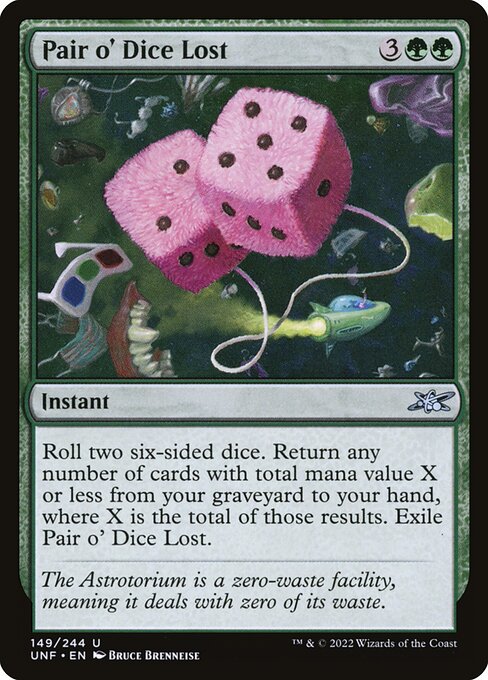
Pair o' Dice Lost
Instant
uncommon
Roll two six-sided dice. Return any number of cards with total mana value X or less from your graveyard to your hand, where X is the total of those results. Exile Pair o' Dice Lost.
 Card Kingdom
 Cardmarket
Semantic Tags
A keyword ability that allows a player to cast a double-faced card transformed from the graveyard. See rule 702.146, “Disturb.”
A keyword ability that lets a player return a card from their graveyard to their hand. See rule 702.52, “Dredge.”
Cares about cards in the graveyard, puts cards into the graveyard, or benefits from things dying.
Returns cards from the graveyard to your hand, the battlefield, or the top of your library.
A keyword ability that lets a player cast a card they discard. See rule 702.35, “Madness.”
Makes all players discard their hand and draw a new one. Named after Wheel of Fortune.
Format Legality
Price history
Loading price history…
Printings (2)
| Set | Rarity | TCGplayer | Card Kingdom | Cardmarket |
|---|---|---|---|---|
| Unfinity#149 | uncommon | · | · | · |
| Unfinity#435 | uncommon | · | · | · |
Related Rules
After resolving a madness triggered ability (see rule 702.35), if the exiled card wasn’t cast and was moved to a public zone, effects referencing the discarded card can find that object.
Madness
Madness is a keyword that represents two abilities. The first is a static ability that functions while the card with madness is in a player’s hand. The second is a triggered ability that functions when the first ability is applied. “Madness [cost]” means “If a player would discard this card, that player discards it, but exiles it instead of putting it into their graveyard” and “When this card is exiled this way, its owner may cast it by paying [cost] rather than paying its mana cost. If that player doesn’t, they put this card into their graveyard.”
Casting a spell using its madness ability follows the rules for paying alternative costs in rules 601.2b and 601.2f–h.
After resolving a madness triggered ability, if the exiled card wasn’t cast and was moved to a public zone, effects referencing the discarded card can find that card. See rule 400.7k.
Dredge
Dredge is a static ability that functions only while the card with dredge is in a player’s graveyard. “Dredge N” means “As long as you have at least N cards in your library, if you would draw a card, you may instead mill N cards and return this card from your graveyard to your hand.”
A player with fewer cards in their library than the number required by a dredge ability can’t mill any of them this way.
Rulings
Results can be numbers not ordinarily possible on a six-sided die. Spells like Scooch can change the result to 0 or 7, for example.
Some effects may modify the result of a die roll. This may be part of the instruction to roll a die, or it may come from other cards. Anything that references the "result" of a die roll is looking for the result after these modifications.
If Pair o' Dice Lost resolves, it will be exiled, even if you don't return any cards to your hand.
If a die is rerolled, the original roll essentially never happened: it doesn't cause any abilities to trigger, and no effect that cares about die rolls will consider it.
Pair o' Dice Lost doesn't target any of the cards in the graveyard. You choose which cards you're returning to your hand, if any, after rolling the dice.
Each die is identified by the number of faces it has. A six-sided die is a die with six equally likely outcomes: 1, 2, 3, 4, 5, and 6. The roll must be fair. Although physical dice are recommended, digital substitutes are allowed except in cases where the physical die is required for the effect.
You can return any number of cards with mana value 0 (such as land cards) from your graveyard to your hand regardless of the results.
Something in the game must tell you to roll a die. If you roll a die for any other reason (to simulate a coin flip, to choose pizza toppings, to create alternate timelines), that roll doesn't count.
If an ability triggers "whenever you roll a die," it will trigger whenever you roll any die, including the planar die. This is a change from previous Un- rules. Some abilities use the result to determine part of the effect. If you get a non-numerical result (currently just the planar die, but the future is long), that part of the effect won't do anything.