Search
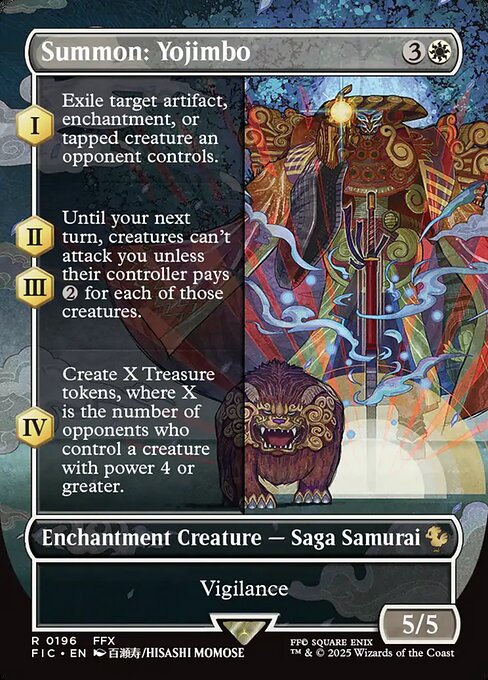
Summon: Yojimbo
Enchantment Creature — Saga Samurai
rare
(As this Saga enters and after your draw step, add a lore counter. Sacrifice after IV.) I — Exile target artifact, enchantment, or tapped creature an opponent controls. II, III — Until your next turn, creatures can't attack you unless their controller pays for each of those creatures. IV — Create X Treasure tokens, where X is the number of opponents who control a creature with power 4 or greater. Vigilance
5/5
 Card Kingdom
 Cardmarket
Semantic Tags
Specifically destroys, exiles, or shuts down artifacts.
Specifically removes artifacts.
Punishes or prevents creature-based strategies — makes creatures enter tapped, prevents attacking, taxes creatures.
Suited for blocking and defense. Includes defender, reach, vigilance, and cards that incentivize blocking.
Removes threats by exiling rather than destroying — bypasses indestructible and death triggers.
A card or token on the battlefield. See rule 110, “Permanents.”
Discourages opponents from attacking you with taxes, penalties, and deterrents.
Cares about power of creatures — Fling effects, power-based draw, Xenagos strategies.
Answers an opponent's threat by destroying, exiling, bouncing, or otherwise removing a permanent or spell.
Broadly benefits from sacrificing permanents — overlaps aristocrats but includes non-creature sacrifice.
Slows opponents down by taxing actions or restricting what they can do.
Creates creature tokens, Treasure tokens, Food tokens, Clue tokens, or other token types.
Creates Treasure tokens for mana or sacrifice synergies.
A keyword ability that lets a creature attack without tapping. See rule 702.20, “Vigilance.”
Format Legality
Price history
Loading price history…
Printings (2)
| Set | Rarity | TCGplayer | Card Kingdom | Cardmarket |
|---|---|---|---|---|
| Final Fantasy Commander#196 | rare | · | · | · |
| Final Fantasy Commander#28 | rare | · | · | · |
Related Concepts
Related Rules
If an ability would produce one or more mana of an undefined type, it produces no mana instead.
Some abilities produce mana based on the type of mana another permanent or permanents “could produce.” The type of mana a permanent could produce at any time includes any type of mana that an ability of that permanent would produce if the ability were to resolve at that time, taking into account any applicable replacement effects in any possible order. Ignore whether any costs of the ability could or could not be paid. If that permanent wouldn’t produce any mana under these conditions, or no type of mana can be defined this way, there’s no type of mana it could produce.
To “tap [a permanent] for mana” is to activate a mana ability of that permanent that includes the {T} symbol in its activation cost. See rule 605, “Mana Abilities.”
An ability that triggers whenever a permanent “is tapped for mana” or is tapped for mana of a specified type triggers whenever such a mana ability resolves and produces mana or the specified type of mana.
A replacement effect that applies if a permanent “is tapped for mana” or tapped for mana of a specific type and/or amount modifies the mana production event while such an ability is resolving and producing mana or the specified type and/or amount of mana.
If an object’s enters-the-battlefield triggered ability or replacement effect refers to X, and the spell that became that object as it resolved had a value of X chosen for any of its costs, the value of X for that ability is the same as the value of X for that spell, although the value of X for that permanent is 0. This is an exception to rule 107.3i.
The tap symbol is {T}. The tap symbol in an activation cost means “Tap this permanent.” A permanent that’s already tapped can’t be tapped again to pay the cost. A creature’s activated ability with the tap symbol in its activation cost can’t be activated unless the creature has been under its controller’s control continuously since their most recent turn began. See rule 302.6.
The untap symbol is {Q}. The untap symbol in an activation cost means “Untap this permanent.” A permanent that’s already untapped can’t be untapped again to pay the cost. A creature’s activated ability with the untap symbol in its activation cost can’t be activated unless the creature has been under its controller’s control continuously since their most recent turn began. See rule 302.6.
Rulings
As a Saga enters, its controller puts a lore counter on it. As your first main phase begins (immediately after your draw step), you put another lore counter on each Saga you control. Putting a lore counter on a Saga in either of these ways doesn't use the stack.
Once a chapter ability has triggered, the ability on the stack won't be affected if the Saga gains or loses counters, or if it leaves the battlefield.
The value of X is determined only once, as Summon: Yojimbo's fourth chapter ability resolves.
On turns where the effect of Summon: Yojimbo's second or third chapter ability is applying, your opponents can choose not to attack with a creature that must attack if able as long as there is no other player, planeswalker, or battle for that creature to attack that wouldn't require a cost.
Removing lore counters won't cause a previous chapter ability to trigger. If lore counters are removed from a Saga, the appropriate chapter abilities will trigger again when the Saga receives more lore counters.
If multiple chapter abilities trigger at the same time, their controller puts them on the stack in any order. If any of them require targets, those targets are chosen as you put the abilities on the stack, before any of those abilities resolve.
Saga creatures have two sections to their text boxes. The first section, above the type line, contains their chapter abilities, and the second section, below the type line, contains any other abilities (or italicized flavor text). Any abilities in the latter section aren't chapter abilities and apply no matter how many lore counters are on the creature.
A chapter ability doesn't trigger if a lore counter is put on a Saga that already had a number of lore counters greater than or equal to that chapter's number. For example, the third lore counter put on a Saga causes the chapter III ability to trigger, but chapters I and II won't trigger again.
Due to a rules change that takes effect with this release (see below for details), a Saga that somehow loses all of its chapter abilities will not be sacrificed as a state-based action. It will also not gain a lore counter at the beginning of each of its controller's first main phases.
Once the number of lore counters on a Saga is greater than or equal to the greatest number among its chapter abilities, the Saga's controller sacrifices it as soon as its chapter ability has left the stack, most likely by resolving or being countered. This state-based action doesn't use the stack.
Each symbol on the left of a Saga's text box represents a chapter ability. A chapter ability is a triggered ability that triggers when a lore counter that is put on the Saga causes the number of lore counters on the Saga to become equal to or greater than the ability's chapter number. Chapter abilities are put onto the stack and may be responded to.