Search
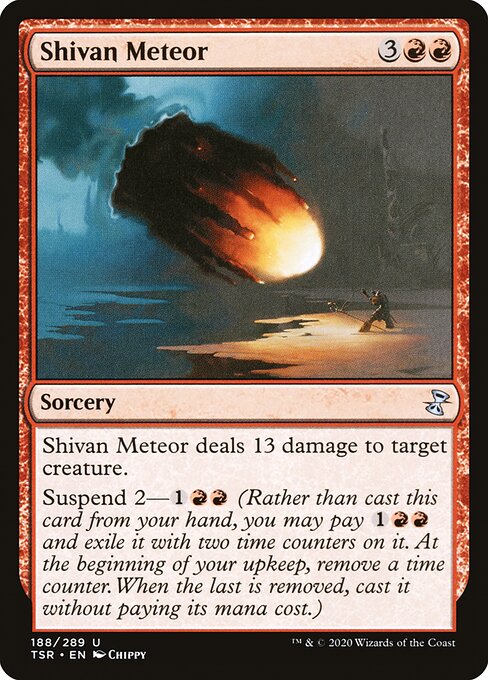
Shivan Meteor
Sorcery
uncommon
Shivan Meteor deals 13 damage to target creature. Suspend 2— (Rather than cast this card from your hand, you may pay and exile it with two time counters on it. At the beginning of your upkeep, remove a time counter. When the last is removed, you may cast it without paying its mana cost.)
 Card Kingdom
 Cardmarket
Semantic Tags
A spell that deals direct damage to creatures or players.
Specifically removes creatures — destroy, exile, damage, or -X/-X.
Answers an opponent's threat by destroying, exiling, bouncing, or otherwise removing a permanent or spell.
A keyword ability that provides an alternative way to play a card. See rule 702.62, “Suspend.” A card is “suspended” if it’s in the exile zone, has suspend, and has a time counter on it.
Format Legality
Price history
Loading price history…
Printings (4)
| Set | Rarity | TCGplayer | Card Kingdom | Cardmarket |
|---|---|---|---|---|
| Time Spiral Remastered#188 | uncommon | · | · | · |
| The List#PLC-106 | uncommon | · | · | · |
| Duel Decks: Mind vs. Might#18 | uncommon | · | · | · |
| Planar Chaos#106 | uncommon | · | · | · |
Related Concepts
Related Rules
If a cost associated with a special action, such as a suspend cost or a morph cost, has an {X} or an X in it, the value of X is chosen by the player taking the special action immediately before they pay that cost.
A player who has a card with suspend in their hand may exile that card. This is a special action. A player can take this action any time they have priority, but only if they could begin to cast that card by putting it onto the stack. See rule 702.62, “Suspend.”
Suspend
To time travel means to choose any number of permanents you control with one or more time counters on them and/or suspended cards you own in exile with one or more time counters on them and, for each of those objects, put a time counter on it or remove a time counter from it. See rule 702.62, “Suspend.”
Suspend is a keyword that represents three abilities. The first is a static ability that functions while the card with suspend is in a player’s hand. The second and third are triggered abilities that function in the exile zone. “Suspend N—[cost]” means “If you could begin to cast this card by putting it onto the stack from your hand, you may pay [cost] and exile it with N time counters on it. This action doesn’t use the stack,” and “At the beginning of your upkeep, if this card is suspended, remove a time counter from it,” and “When the last time counter is removed from this card, if it’s exiled, you may play it without paying its mana cost if able. If you don’t, it remains exiled. If you cast a creature spell this way, it gains haste until you lose control of the spell or the permanent it becomes.”
A card is “suspended” if it’s in the exile zone, has suspend, and has a time counter on it.
While determining if you could begin to cast a card with suspend, take into consideration any effects that would prohibit that card from being cast.
Casting a spell as an effect of its suspend ability follows the rules for paying alternative costs in rules 601.2b and 601.2f–h.
Rulings
Due to a recent rules change to suspend, you are no longer required to cast the suspended card as the second triggered ability of suspend resolves. Instead, as the second triggered ability resolves, you may cast the card. Timing permissions based on the card's type are ignored. If you don't cast the card, it remains exiled with no time counters on it, and it's no longer suspended.
When the last time counter is removed, the second triggered ability of suspend (the one that lets you cast the card) triggers. It doesn't matter why the last time counter was removed or what effect removed it.
Exiling a card with suspend isn't casting that card. This action doesn't use the stack and can't be responded to.
If the card has {X} in its mana cost, you must choose 0 as the value of X when casting it without paying its mana cost.
If the second triggered ability is countered, the card can't be cast. It remains exiled with no time counters on it, and it's no longer suspended.
If you cast a card "without paying its mana cost," such as with suspend, you can't choose to cast it for any alternative costs. You can, however, pay additional costs. If the card has any mandatory additional costs, you must pay those if you want to cast the card.
Cards exiled with suspend are exiled face up.
The mana value of a spell cast without paying its mana cost is determined by its mana cost, even though that cost wasn't paid.
Suspend is a keyword that represents three abilities. The first is a static ability that allows you to exile the card from your hand with the specified number of time counters (the number before the dash) on it by paying its suspend cost (listed after the dash). The second is a triggered ability that removes a time counter from the suspended card at the beginning of each of your upkeeps. The third is a triggered ability that gives you the option to cast the card when the last time counter is removed.
If the first triggered ability of suspend (the one that removes time counters) is countered, no time counter is removed. The ability will trigger again at the beginning of the card's owner's next upkeep.
If the spell requires any targets, those targets are chosen when the spell is finally cast, not when it's exiled.
You can exile a card in your hand using suspend any time you could cast that card. Consider its card type, any effects that modify when you could cast it (such as flash) and any other effects that stop you from casting it (such as from Meddling Mage's ability) to determine if and when you can do this. Whether you could actually complete all steps in casting the card is irrelevant. For example, you can exile a card with suspend that has no mana cost or that requires a target even if no legal targets are available at that time.
If an effect refers to a "suspended card," that means a card that (1) has suspend, (2) is in exile, and (3) has one or more time counters on it.