Search
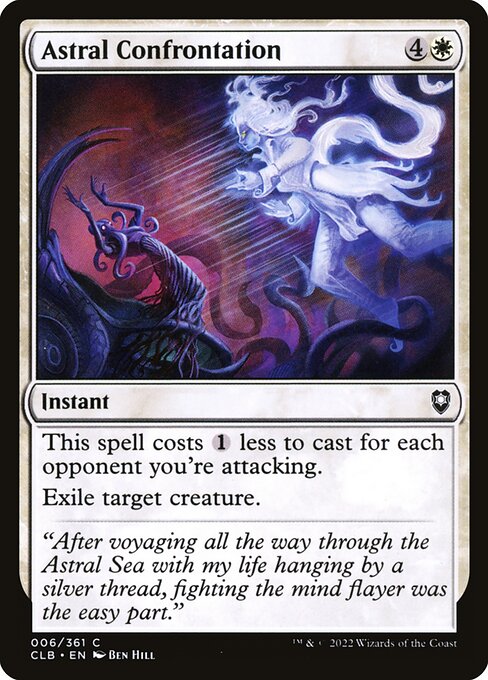
Astral Confrontation
Instant
common
This spell costs less to cast for each opponent you're attacking. Exile target creature.
 Card Kingdom
 Cardmarket
Semantic Tags
A keyword ability that reduces how much mana you need to spend to cast a spell. See rule 702.41, “Affinity.”
A keyword ability that may let a player cast a random extra spell for no cost. See rule 702.85, “Cascade.”
A keyword ability that lets you tap creatures rather than pay mana to cast a spell. See rule 702.51, “Convoke.”
A permanent or effect that makes spells or abilities cheaper to cast or activate.
A permanent or effect that makes spells or abilities cheaper to cast or activate.
Specifically removes creatures — destroy, exile, damage, or -X/-X.
A keyword ability found on creature cards that allows them to be cast for an alternative cost. See rule 702.109, “Dash.”
A keyword ability that lets a player cast a spell for less by sacrificing a creature. See rule 702.119, “Emerge.”
A keyword ability that can make a creature better in combat. See rule 702.83, “Exalted.”
Removes threats by exiling rather than destroying — bypasses indestructible and death triggers.
Removes threats by exiling rather than destroying — bypasses indestructible and death triggers.
A keyword ability that allows a spell to affect either a single target or many objects. See rule 702.96, “Overload.”
Answers an opponent's threat by destroying, exiling, bouncing, or otherwise removing a permanent or spell.
Format Legality
Price history
Loading price history…
Printings (1)
| Set | Rarity | TCGplayer | Card Kingdom | Cardmarket |
|---|---|---|---|---|
| Commander Legends: Battle for Baldur's Gate#6 | common | · | · | · |
Related Rules
A keyword counter on a permanent or on a card in a zone other than the battlefield causes that object to gain that keyword. The keywords that a keyword counter can be are flying, first strike, double strike, deathtouch, decayed, exalted, haste, hexproof, indestructible, lifelink, menace, reach, shadow, trample, and vigilance, as well as any variants of those keywords. See rule 613.1f.
Cascade
Subtypes of each card type except creature and plane are always single words and are listed after a long dash. Each word after the dash is a separate subtype. Subtypes of creature cards are one or two words and are listed after a long dash. Each word or two-word phrase, as listed in rule 205.3m, is a separate subtype. Objects other than planes may have multiple subtypes. Subtypes of planes are also listed after a long dash, but may be multiple words; all words after the dash are, collectively, a single subtype.
Artifact subtypes are always a single word and are listed after a long dash: “Artifact — Equipment.” Artifact subtypes are also called artifact types. Artifacts may have multiple subtypes. See rule 205.3g for the complete list of artifact types.
Creature subtypes are usually a single word long and are listed after a long dash: “Creature — Human Soldier,” “Artifact Creature — Golem,” and so on. Creature subtypes are also called creature types. Creatures may have multiple subtypes. See rule 205.3m for the complete list of creature types.
Enchantment subtypes are always a single word and are listed after a long dash: “Enchantment — Shrine.” Each word after the dash is a separate subtype. Enchantment subtypes are also called enchantment types. Enchantments may have multiple subtypes. See rule 205.3h for the complete list of enchantment types.
Instant subtypes are always a single word and are listed after a long dash: “Instant — Arcane.” Each word after the dash is a separate subtype. The set of instant subtypes is the same as the set of sorcery subtypes; these subtypes are called spell types. Instants may have multiple subtypes. See rule 205.3k for the complete list of spell types.
Land subtypes are always a single word and are listed after a long dash. Land subtypes are also called land types. Lands may have multiple subtypes. See rule 205.3i for the complete list of land types.