Search
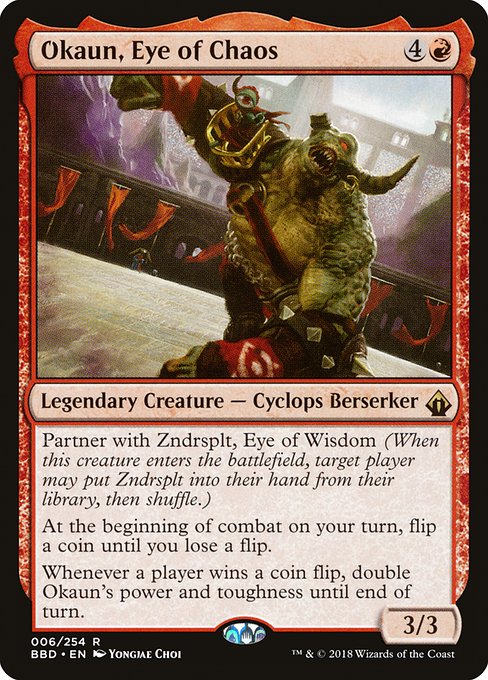
Okaun, Eye of Chaos
Legendary Creature — Cyclops Berserker
rare
Partner with Zndrsplt, Eye of Wisdom (When this creature enters, target player may put Zndrsplt into their hand from their library, then shuffle.) At the beginning of combat on your turn, flip a coin until you lose a flip. Whenever a player wins a coin flip, double Okaun's power and toughness until end of turn.
3/3
 Card Kingdom
 Cardmarket
Semantic Tags
Random, chaotic, or coin-flip effects that create unpredictable game states.
Triggers when a creature or permanent enters the battlefield. Prime blink targets.
A card or token on the battlefield. See rule 110, “Permanents.”
Format Legality
Price history
Loading price history…
Printings (2)
| Set | Rarity | TCGplayer | Card Kingdom | Cardmarket |
|---|---|---|---|---|
| Battlebond#6 | rare | · | · | · |
| Battlebond Promos#6s | rare | · | · | · |
Related Concepts
Related Rules
If an ability would produce one or more mana of an undefined type, it produces no mana instead.
Some spells or abilities that produce mana restrict how that mana can be spent, have an additional effect that affects the spell or ability that mana is spent on, or create a delayed triggered ability (see rule 603.7a) that triggers when that mana is spent. This doesn’t affect the mana’s type.
Some abilities produce mana based on the type of mana another permanent or permanents “could produce.” The type of mana a permanent could produce at any time includes any type of mana that an ability of that permanent would produce if the ability were to resolve at that time, taking into account any applicable replacement effects in any possible order. Ignore whether any costs of the ability could or could not be paid. If that permanent wouldn’t produce any mana under these conditions, or no type of mana can be defined this way, there’s no type of mana it could produce.
To “tap [a permanent] for mana” is to activate a mana ability of that permanent that includes the {T} symbol in its activation cost. See rule 605, “Mana Abilities.”
An ability that triggers whenever a permanent “is tapped for mana” or is tapped for mana of a specified type triggers whenever such a mana ability resolves and produces mana or the specified type of mana.
A replacement effect that applies if a permanent “is tapped for mana” or tapped for mana of a specific type and/or amount modifies the mana production event while such an ability is resolving and producing mana or the specified type and/or amount of mana.
If an object’s enters-the-battlefield triggered ability or replacement effect refers to X, and the spell that became that object as it resolved had a value of X chosen for any of its costs, the value of X for that ability is the same as the value of X for that spell, although the value of X for that permanent is 0. This is an exception to rule 107.3i.
The tap symbol is {T}. The tap symbol in an activation cost means “Tap this permanent.” A permanent that’s already tapped can’t be tapped again to pay the cost. A creature’s activated ability with the tap symbol in its activation cost can’t be activated unless the creature has been under its controller’s control continuously since their most recent turn began. See rule 302.6.
Rulings
Both commanders start in the command zone, and the remaining 98 cards of your deck are shuffled to become your library.
The second ability represented by the “partner with [name]” keyword modifies the rules for deck construction in the Commander variant and has no function outside of that variant. If a legendary creature card with “partner with [name]” is designated as your commander, the named legendary creature card can also be designated as your commander. For more information on the Commander variant, please visit Wizards.com/Commander.
An effect that checks whether you control your commander is satisfied if you control one or both of your two commanders.
“Partner with [name]” represents two abilities. The first is a triggered ability: “When this permanent enters the battlefield, target player may search their library for a card named [name], reveal it, put it into their hand, then shuffle their library.”
To have two commanders, both must have the partner ability (featured in the Magic: The Gathering—Commander™ (2016 Edition) set) or corresponding “partner with” abilities as the game begins. A creature with a “partner with” ability can’t partner with any creature other than its designated partner. Losing a partner ability during the game doesn’t cause either to cease to be your commander.
Note that the target player searches their library (which may be affected by effects such as that of Stranglehold) and that the card they find is revealed, even though these words aren’t included in the ability’s reminder text.
If your Commander deck has two commanders, you can only include cards whose own color identities are also found in your commanders’ combined color identities. If Khorvath and Sylvia are your commanders, your deck may contain cards with red and/or white in their color identity, but not blue, black, or green.
Once the game begins, your two commanders are tracked separately. If you cast one, you won’t have to pay an additional {2} the first time you cast the other. A player loses the game after having been dealt 21 damage from one of them, not from both of them combined. Command Beacon’s effect puts one into your hand from the command zone, not both.
If an effect instructs you to “double” a creature’s power, that creature gets +X/+0, where X is its power. The same is true for its toughness.
If a creature’s power is less than 0 when it’s doubled, instead that creature gets -X/-0, where X is how much less than 0 its power is. The same is true for its toughness. For example, if an effect has given Okaun -7/-0 so that its power and toughness are -4/3, doubling its power and toughness gives it -4/+3 and it’s -8/6 until end of turn.
The triggered ability of the “partner with” keyword still triggers in a Commander game. If your other commander has somehow ended up in your library, you can find it. You can also target another player who might have that card in their library.
If an effect has a player flip a coin but refers to whether the flip came up heads or tails, that flip has no winner or loser.
If an effect has a player flip a coin and refers to winning or losing a flip, only the player who flipped the coin wins or loses the flip. If that player loses the flip, nobody wins the flip.