Search
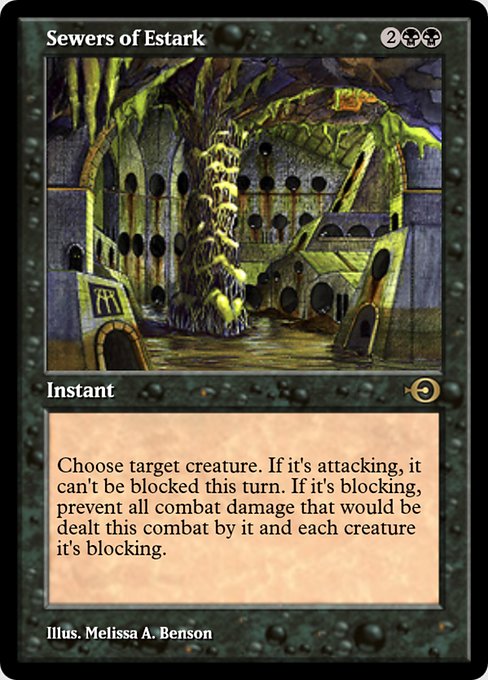
Sewers of Estark
Instant
rare
Choose target creature. If it's attacking, it can't be blocked this turn. If it's blocking, prevent all combat damage that would be dealt this combat by it and each creature it's blocking.
Semantic Tags
A keyword ability that can make a creature particularly brutal when it attacks. See rule 702.86, “Annihilator.”
Benefits from attacking — attack triggers, combat damage triggers, exalted.
An instant-speed spell that modifies combat — pump, protection, or removal during combat.
Punishes or prevents creature-based strategies — makes creatures enter tapped, prevents attacking, taxes creatures.
A keyword ability found on creature cards that allows them to be cast for an alternative cost. See rule 702.109, “Dash.”
A keyword ability that causes damage dealt by an object to be especially effective. See rule 702.2, “Deathtouch.”
A keyword ability that prohibits a creature from attacking. See rule 702.3, “Defender.”
Suited for blocking and defense. Includes defender, reach, vigilance, and cards that incentivize blocking.
A keyword ability that lets a creature deal its combat damage twice. See rule 702.4, “Double Strike.”
Prevents enter-the-battlefield triggers from resolving. Torpor Orb and friends. Shuts down blink and ETB value.
Difficult to block or grants evasion. Includes flying, menace, fear, intimidate, shadow, skulk, horsemanship, unblockable effects, and cards that grant these abilities.
A keyword ability that can make a creature better in combat. See rule 702.83, “Exalted.”
Takes extra combat phases for additional attacks and triggers.
A keyword ability that lets a creature deal its combat damage before other creatures. See rule 702.7, “First Strike.”
A keyword ability that restricts how a creature may be blocked. See rule 702.9, “Flying.”
A spell that prevents all combat damage for a turn.
A spell that prevents all combat damage for a turn.
A keyword ability that lets a creature ignore the “summoning sickness” rule. See rule 702.10, “Haste,” and rule 302.6.
A keyword ability that precludes a permanent or player from being targeted by an opponent. See rule 702.11, “Hexproof.”
A keyword ability that affects how an object deals damage to creatures and players. See rule 702.90, “Infect.”
An evasion ability that makes creatures unblockable by a single creature. See rule 702.111, “Menace.”
A keyword ability that lets a creature suddenly enter combat. See rule 702.49, “Ninjutsu.”
A keyword ability that allows a spell to affect either a single target or many objects. See rule 702.96, “Overload.”
A keyword ability that provides a range of benefits against objects with a specific quality. See rule 702.16, “Protection.”
A keyword ability that allows a creature to block an attacking creature with flying. See rule 702.17, “Reach.” See also Flying.
Slows opponents down by taxing actions or restricting what they can do.
Cannot be blocked or has an ability that makes it very hard to block.
Cannot be blocked or has an ability that makes it very hard to block.
Format Legality
Price history
Loading price history…
Printings (2)
| Set | Rarity | TCGplayer | Card Kingdom | Cardmarket |
|---|---|---|---|---|
| Magic Online Promos#35964 | rare | · | · | · |
| HarperPrism Book Promos#2 | rare | · | · | · |
Related Rules
A spell or ability that creates a token sets both its name and its subtype(s). If the spell or ability doesn’t specify the name of the token, its name is the same as its subtype(s) plus the word “Token.” Once a token is on the battlefield, changing its name doesn’t change its subtype(s), and vice versa.
If an effect instructs a player to create a token that is a copy of a nonexistent object, no token is created (see rule 707, “Copying Objects”). This does not apply to an effect that would use the last known information of an object.
An effect that sets an object’s characteristic, or simply states a quality of that object, is different from an ability granted by an effect. When an object “gains” or “has” an ability, that ability can be removed by another effect. If an effect defines a characteristic of the object (“[permanent] is [characteristic value]”), it’s not granting an ability. (See rule 604.3.) Similarly, if an effect states a quality of that object (“[creature] can’t be blocked,” for example), it’s neither granting an ability nor setting a characteristic.
Damage dealt to a player by a source without infect causes that player to lose that much life.
Damage dealt to a player by a source with infect causes that source’s controller to give the player that many poison counters.
Damage dealt to a creature by a source with wither and/or infect causes that source’s controller to put that many -1/-1 counters on that creature.
Damage dealt to a creature by a source with neither wither nor infect causes that much damage to be marked on that creature.
First, if an effect that’s causing damage to be dealt states that excess damage that would be dealt to a permanent is dealt to another permanent or player instead, the damage event is modified accordingly. If the first permanent is a creature, the excess damage is the amount of damage in excess of what would be lethal damage, taking into account damage already marked on the creature and damage from other sources that would be dealt at the same time. (See rule 120.6.) Any amount of damage greater than 1 is excess damage if the source dealing that damage to a creature has deathtouch. (See rule 702.2.) If the first permanent is a planeswalker, the excess damage is the amount of damage in excess of that planeswalker’s loyalty, taking into account damage from other sources that would be dealt at the same time. If the first permanent is a battle, the excess damage is the amount of damage in excess of that battle’s defense, taking into account damage from other sources that would be dealt at the same time. If the first permanent has multiple card types from among the list of creature, planeswalker, and battle, the excess damage is the greatest of the calculated amounts for each of the card types it has.
Rulings
This spell can target any creature. The check for whether that creature is attacking or blocking made on resolution, and it will have the appropriate effect at that time.
If the creature is neither an attacking creature nor a blocking creature at the time the spell resolves, it will have no effect.