Search
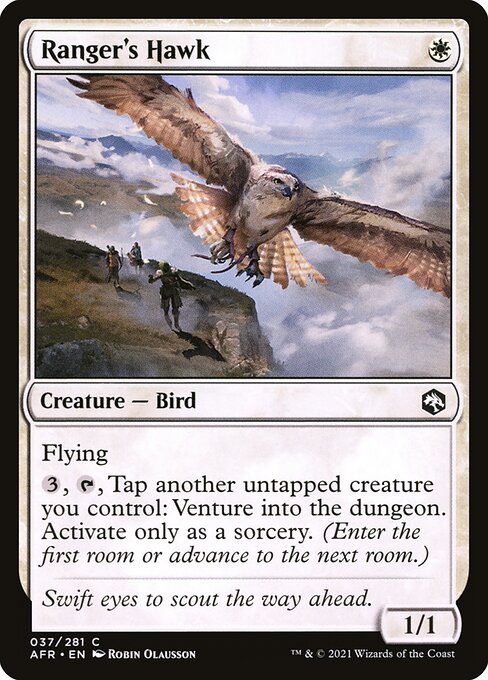
Ranger's Hawk
Creature — Bird
common
Flying , , Tap another untapped creature you control: Venture into the dungeon. Activate only as a sorcery. (Enter the first room or advance to the next room.)
1/1
 Card Kingdom
 Cardmarket
Semantic Tags
Difficult to block or grants evasion. Includes flying, menace, fear, intimidate, shadow, skulk, horsemanship, unblockable effects, and cards that grant these abilities.
A keyword ability that restricts how a creature may be blocked. See rule 702.9, “Flying.”
A permanent with a repeatable activated ability that converts excess mana into value.
A card or token on the battlefield. See rule 110, “Permanents.”
Format Legality
Price history
Loading price history…
Printings (1)
| Set | Rarity | TCGplayer | Card Kingdom | Cardmarket |
|---|---|---|---|---|
| Adventures in the Forgotten Realms#37 | common | · | · | · |
Related Concepts
Related Rules
If an ability would produce one or more mana of an undefined type, it produces no mana instead.
Some abilities produce mana based on the type of mana another permanent or permanents “could produce.” The type of mana a permanent could produce at any time includes any type of mana that an ability of that permanent would produce if the ability were to resolve at that time, taking into account any applicable replacement effects in any possible order. Ignore whether any costs of the ability could or could not be paid. If that permanent wouldn’t produce any mana under these conditions, or no type of mana can be defined this way, there’s no type of mana it could produce.
To “tap [a permanent] for mana” is to activate a mana ability of that permanent that includes the {T} symbol in its activation cost. See rule 605, “Mana Abilities.”
An ability that triggers whenever a permanent “is tapped for mana” or is tapped for mana of a specified type triggers whenever such a mana ability resolves and produces mana or the specified type of mana.
A replacement effect that applies if a permanent “is tapped for mana” or tapped for mana of a specific type and/or amount modifies the mana production event while such an ability is resolving and producing mana or the specified type and/or amount of mana.
If an object’s enters-the-battlefield triggered ability or replacement effect refers to X, and the spell that became that object as it resolved had a value of X chosen for any of its costs, the value of X for that ability is the same as the value of X for that spell, although the value of X for that permanent is 0. This is an exception to rule 107.3i.
The tap symbol is {T}. The tap symbol in an activation cost means “Tap this permanent.” A permanent that’s already tapped can’t be tapped again to pay the cost. A creature’s activated ability with the tap symbol in its activation cost can’t be activated unless the creature has been under its controller’s control continuously since their most recent turn began. See rule 302.6.
The untap symbol is {Q}. The untap symbol in an activation cost means “Untap this permanent.” A permanent that’s already untapped can’t be untapped again to pay the cost. A creature’s activated ability with the untap symbol in its activation cost can’t be activated unless the creature has been under its controller’s control continuously since their most recent turn began. See rule 302.6.
Rulings
Moving into a dungeon room will cause its room ability to trigger.
The player venturing into the dungeon chooses which dungeon they will venture into. They may choose a dungeon that they have already completed this game.
Choosing the dungeon or room to venture into is part of resolving the venture into the dungeon keyword action. Once that choice is made, players may not respond until after the appropriate room ability has triggered.
Once you resolve the last room ability of a dungeon, that dungeon is now completed and is removed from the game.
To venture into the dungeon, a player moves their venture marker into the next room of the dungeon they are currently in. If they aren't currently in a dungeon, that player instead chooses a dungeon card from outside the game, puts it into the command zone, and moves their venture marker onto the first room.
If you somehow venture into the dungeon while a room's ability is on the stack, you will continue on in the dungeon. If you're already in the last room, complete that dungeon and start a new one.
Dungeon cards are not part of a player's deck or sideboard. In both constructed and limited formats, players can use any dungeon card when they venture into the dungeon.
A player may only have one dungeon in the command zone at a time.
You can only move forward (well, downward) in a dungeon, never backwards or sideways.
Dungeons are removed from the game as a state-based action.