Search
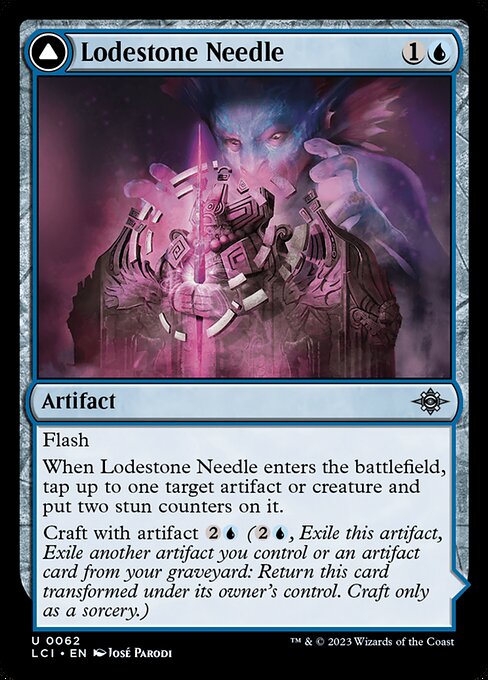
Lodestone Needle
Artifact
uncommon
Flash When this artifact enters, tap up to one target artifact or creature and put two stun counters on it. Craft with artifact (, Exile this artifact, Exile another artifact you control or an artifact card from your graveyard: Return this card transformed under its owner's control. Craft only as a sorcery.)
 Card Kingdom
 Cardmarket
Semantic Tags
A keyword ability that lets a player play a card any time they could cast an instant. See rule 702.8, “Flash.”
Flash-focused strategy — playing at instant speed for tempo and information advantage.
A card or token on the battlefield. See rule 110, “Permanents.”
Format Legality
Price history
Loading price history…
Printings (1)
| Set | Rarity | TCGplayer | Card Kingdom | Cardmarket |
|---|---|---|---|---|
| The Lost Caverns of Ixalan#62 | uncommon | · | · | · |
Related Concepts
Related Rules
If an ability would produce one or more mana of an undefined type, it produces no mana instead.
Some abilities produce mana based on the type of mana another permanent or permanents “could produce.” The type of mana a permanent could produce at any time includes any type of mana that an ability of that permanent would produce if the ability were to resolve at that time, taking into account any applicable replacement effects in any possible order. Ignore whether any costs of the ability could or could not be paid. If that permanent wouldn’t produce any mana under these conditions, or no type of mana can be defined this way, there’s no type of mana it could produce.
To “tap [a permanent] for mana” is to activate a mana ability of that permanent that includes the {T} symbol in its activation cost. See rule 605, “Mana Abilities.”
An ability that triggers whenever a permanent “is tapped for mana” or is tapped for mana of a specified type triggers whenever such a mana ability resolves and produces mana or the specified type of mana.
A replacement effect that applies if a permanent “is tapped for mana” or tapped for mana of a specific type and/or amount modifies the mana production event while such an ability is resolving and producing mana or the specified type and/or amount of mana.
If an object’s enters-the-battlefield triggered ability or replacement effect refers to X, and the spell that became that object as it resolved had a value of X chosen for any of its costs, the value of X for that ability is the same as the value of X for that spell, although the value of X for that permanent is 0. This is an exception to rule 107.3i.
The tap symbol is {T}. The tap symbol in an activation cost means “Tap this permanent.” A permanent that’s already tapped can’t be tapped again to pay the cost. A creature’s activated ability with the tap symbol in its activation cost can’t be activated unless the creature has been under its controller’s control continuously since their most recent turn began. See rule 302.6.
The untap symbol is {Q}. The untap symbol in an activation cost means “Untap this permanent.” A permanent that’s already untapped can’t be untapped again to pay the cost. A creature’s activated ability with the untap symbol in its activation cost can’t be activated unless the creature has been under its controller’s control continuously since their most recent turn began. See rule 302.6.
Rulings
The back faces of some cards with craft refer to cards "used to craft" it. This refers to the cards exiled as part of the cost of the craft ability of the front face. Those cards are considered to be "used to craft" that permanent as long as they remain exiled and the permanent remains on the battlefield, even if the permanent's controller changes or some of its characteristics change (because of a copy effect, for example.)
If no card is revealed, most likely because that player's library is empty, the exploring creature receives a +1/+1 counter.
If the materials required include multiple objects, you may exile some of them from among permanents you control and the rest from among cards in your graveyard. You don't have to choose all permanents or all cards from your graveyard.
If an ability instructs a creature to explore, its controller reveals the top card of their library. If it's a land card, they'll put it into their hand. Otherwise, they'll put a +1/+1 counter on that creature, then choose to either leave that card on top of their library or put it into their graveyard.
Once an ability that causes a creature to explore begins to resolve, no player may take any other actions until it's done. Notably, opponents can't try to remove the exploring creature after you reveal a nonland card but before it receives a counter.
Lodestone Needle's enters-the-battlefield ability can target an artifact or creature that's already tapped. If so, you'll just put two stun counters on that artifact or creature.
You may exile tokens you control as part of the materials required. However, because they aren't cards and won't stay in exile, any abilities that refer to what you "used to craft" the back faces won't refer to anything.
Some spells or abilities might cause a creature to explore multiple times in a row. If you reveal a nonland card when a creature explores and leave it on top of your library, then the creature explores again immediately afterwards, you'll reveal the same card again.
If a resolving spell or ability instructs a specific creature to explore but that creature has left the battlefield, the creature still explores. If you reveal a nonland card this way, you won't put a +1/+1 counter on anything, but you may put the revealed card into your graveyard. Effects that trigger "whenever a creature explores" trigger as appropriate.
If a card that isn't a transforming double-faced card becomes a copy of a card with craft, it'll stay in exile if you activate the craft ability. It won't return to the battlefield.
In some unusual cases, noncreature permanents may explore. For example, if the creature card returned by Defossilize is somehow not a creature once it's on the battlefield, it can still explore. You'll take all the same actions, and you may end up putting a +1/+1 counter on the permanent. (Note that some effects target a creature, and those effects would still require a legal target to have it explore.)